


Radar Level Sensor Accuracy Problems in Deep Water Tanks: Causes and Solutions
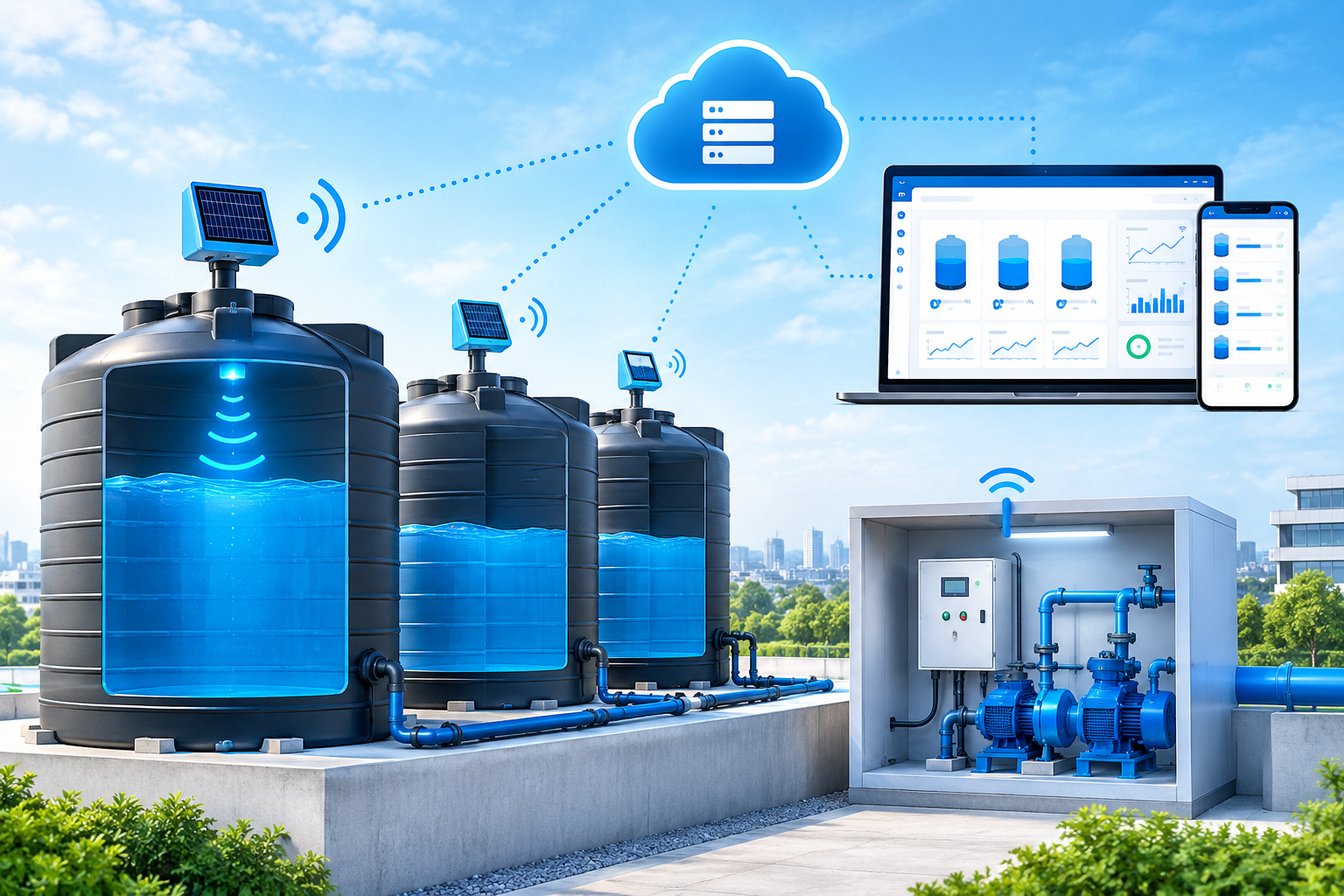
Monitoring water levels in deep tanks can be challenging, especially when organizations depend on accurate data for pump automation, water availability, and operational planning. Radar sensors are widely used for non-contact level measurement, but certain environmental and installation-related factors can affect their performance.
Understanding the causes of Radar level sensor accuracy problems is essential for selecting the right technology and maintaining reliable water monitoring systems.
This article explores common challenges associated with radar level sensors in deep water tanks, their possible causes, and practical solutions. It also explains how MyTank and an Enterprise IoT Platform can support more efficient and reliable water infrastructure monitoring.
Why Accurate Water Level Monitoring Matters
Water tanks are used across residential buildings, commercial facilities, industries, agriculture, and municipalities. In deep tanks, even a small measurement error can result in significant differences in estimated water volume.
Inaccurate readings can lead to:
-
Incorrect pump activation
-
Water overflow
-
Pump dry running
-
Unnecessary energy consumption
-
Water shortages
-
Delayed maintenance decisions
For organizations managing multiple tanks, reliable sensor data is particularly important.
This is where Radar level sensor accuracy becomes a critical consideration when designing a modern water management system.
Understanding Radar Level Sensors
A radar level sensor measures the distance between the sensor and the water surface using electromagnetic waves.
The sensor transmits a radar signal toward the water surface and calculates the distance based on the reflected signal.
The water level is then determined using the following principle:
Tank Height − Distance to Water Surface = Water Level
Radar sensors are commonly preferred for certain applications because they offer non-contact measurement and can operate in challenging environments.
However, deep water tanks may introduce specific measurement challenges that need to be addressed.
Common Radar Level Sensor Accuracy Problems in Deep Water Tanks
Signal Attenuation and Weak Reflections
One potential challenge in deep tanks is the strength and quality of the reflected radar signal.
Factors such as water surface conditions, tank materials, and environmental interference can affect signal quality.
In some applications, poor signal reflection may result in unstable or inconsistent readings.
Solution
Choose a radar sensor designed for the required measurement range and application conditions.
Proper antenna selection and installation can also improve signal performance.
Before deployment, evaluate:
-
Maximum tank depth
-
Sensor measurement range
-
Signal strength
-
Environmental conditions
-
Installation height
Selecting appropriate equipment is essential for maintaining Radar level sensor accuracy.
Condensation and Moisture on the Sensor
Deep water tanks, underground sumps, and enclosed storage environments may experience humidity and condensation.
Moisture accumulation near the sensor can interfere with signal transmission or create inconsistent readings.
This is particularly important in environments with significant temperature variations.
Solution
Install sensors suitable for humid environments and ensure proper protection against condensation.
Regular inspection and appropriate installation practices can help maintain consistent performance.
Organizations should also consider sensors with suitable enclosure protection ratings for their operating environment.
Turbulent Water Surface Conditions
Water movement can affect radar measurements.
If pumps are operating, water may become turbulent or create waves on the surface.
A moving water surface can result in fluctuating readings because the radar signal reflects from different points.
Solution
Install the sensor in a suitable position away from direct turbulence whenever possible.
Additional installation practices may include:
-
Avoiding placement directly above pump inlets
-
Using stilling wells where appropriate
-
Selecting suitable measurement locations
-
Configuring filtering or averaging settings
These steps can help improve measurement stability.
Internal Tank Obstructions
Deep water tanks may contain internal structures such as:
-
Pipes
-
Support beams
-
Ladders
-
Inlet channels
-
Outlet pipes
These objects can reflect radar signals and create false readings.
This is sometimes referred to as unwanted signal reflection or interference.
Solution
Careful sensor positioning is important.
The sensor should ideally have a clear line of sight toward the water surface.
Before installation, inspect the tank structure and identify potential obstructions.
Proper commissioning and calibration can further improve measurement reliability.
Incorrect Sensor Installation Height
Installation height directly affects measurement accuracy.
If the sensor is installed too close to the maximum water level or outside the recommended measurement range, readings may become unreliable.
Similarly, incorrect mounting angles can affect signal direction.
Solution
Follow the manufacturer's installation guidelines carefully.
Important considerations include:
-
Sensor mounting height
-
Vertical alignment
-
Measurement range
-
Dead zone
-
Tank geometry
Professional installation can significantly reduce avoidable accuracy problems.
Incorrect Configuration and Calibration
Even a high-quality radar sensor may produce inaccurate readings if its settings are not configured correctly.
Common configuration issues include:
-
Incorrect tank height
-
Wrong measurement reference point
-
Improper empty tank calibration
-
Incorrect threshold settings
Solution
During commissioning, ensure that all measurement parameters are configured according to the actual tank dimensions.
Regular verification against manual measurements can help identify discrepancies early.
This is particularly important when sensors are deployed across multiple locations.
Communication and Data Transmission Issues
Sometimes the sensor itself may be functioning correctly, but the data received by the monitoring platform may be delayed or incomplete.
Poor connectivity, network interruptions, or gateway issues can affect the visibility of water level data.
This may create the impression of inaccurate radar readings when the actual issue is communication.
Solution
Use a reliable communication architecture that supports continuous data transmission.
An Enterprise IoT Platform can help organizations monitor device connectivity, identify communication failures, and maintain centralized visibility across multiple water infrastructure locations.
How MyTank Supports Reliable Water Level Monitoring
MyTank is a smart water monitoring solution designed to help organizations improve visibility and control over their water infrastructure.
By integrating water level sensors, automation, and digital monitoring capabilities, MyTank can support applications such as:
-
Water tank level monitoring
-
Sump monitoring
-
Pump automation
-
Remote alerts
-
Water consumption tracking
-
Historical data analysis
For deep water tanks, selecting suitable sensing technology and implementing proper installation practices are essential for achieving reliable performance.
MyTank can serve as part of a broader smart water management ecosystem where accurate sensor data supports operational decision-making.
The Role of an Enterprise IoT Platform in Sensor Accuracy Management
An Enterprise IoT Platform provides centralized tools for managing connected devices, collecting sensor data, and monitoring infrastructure performance.
For organizations managing hundreds or thousands of water monitoring devices, an Enterprise IoT Platform can offer several advantages.
Centralized Device Monitoring
Organizations can monitor sensor health and connectivity across multiple locations.
Data Validation and Analytics
Historical readings can be analyzed to identify unusual fluctuations or inconsistencies.
Automated Alerts
The platform can notify maintenance teams when sensor readings exceed predefined limits or communication is interrupted.
Remote Configuration
Depending on system capabilities, device settings and operational parameters can be managed remotely.
Scalability
An Enterprise IoT Platform allows organizations to expand their water monitoring infrastructure without managing every device independently.
This makes enterprise-level IoT architecture particularly valuable for large residential communities, industries, municipalities, and commercial operations.
Best Practices for Improving Radar Level Sensor Accuracy
Organizations can improve performance by following these practices:
Select the Right Sensor
Choose a radar sensor with a suitable measurement range and environmental specifications.
Install Correctly
Ensure proper mounting height, alignment, and positioning.
Avoid Signal Obstructions
Maintain a clear path between the sensor and water surface.
Minimize Turbulence
Install sensors away from direct water inflow or pump discharge areas.
Calibrate Properly
Configure tank dimensions and measurement parameters accurately.
Monitor Sensor Health
Use a centralized platform to identify connectivity and device performance issues.
Perform Regular Maintenance
Periodically inspect sensors, mounting equipment, and communication infrastructure.
Radar Level Sensors vs Traditional Water Level Sensors
|
Feature |
Radar Level Sensor |
Traditional Float Sensor |
|
Measurement Type |
Non-contact |
Mechanical contact |
|
Moving Parts |
Minimal |
Mechanical components |
|
Remote Monitoring |
Supported with IoT integration |
Limited |
|
Maintenance |
Generally low |
May require mechanical maintenance |
|
Accuracy |
High when correctly installed |
Depends on mechanical conditions |
|
Deep Tank Applications |
Suitable with appropriate specifications |
May have installation limitations |
When Should You Consider Radar Level Sensors for Deep Tanks?
Radar technology can be a suitable choice when organizations require:
-
Non-contact water level measurement
-
Remote monitoring capabilities
-
High measurement reliability
-
Reduced mechanical maintenance
-
Integration with IoT platforms
-
Support for deep tank applications
However, the correct sensor model, installation conditions, and system configuration should always be evaluated before deployment.
Conclusion
Radar level sensors can provide reliable and accurate water level monitoring in deep tanks when properly selected, installed, and configured. However, factors such as signal interference, condensation, turbulent water surfaces, internal obstructions, and incorrect calibration can affect Radar level sensor accuracy.
By addressing these challenges through proper installation practices and intelligent monitoring infrastructure, organizations can improve the reliability of their water management systems.
Solutions such as MyTank, combined with an Enterprise IoT Platform, can help businesses achieve centralized monitoring, better device management, and improved operational visibility across multiple water infrastructure locations.
As industries continue adopting smart water technologies, accurate sensor data will remain a critical foundation for efficient, automated, and sustainable water management.
- Digital Agency
- Literie
- Location de voitures
- Restaurant
- Restaurant
- Mode
- Mode
- Information
- Marketing
- Tourisme
- Développement
- Découverte
- Législation
- Gastronomie
- Pâtisserie
- Eveniment
- Art
- Causes
- Crafts
- Dance
- Drinks
- Film
- Fitness
- Food
- Jocuri
- Gardening
- Health
- Acasă
- Literature
- Music
- Networking
- Alte
- Party
- Religion
- Shopping
- Sports
- Theater
- Wellness
 Romaian
 Indian
 English
 French
 Arabic
 Spanish
 Portuguese
 Deutsch
 Turkish
 Dutch
Dutch
 Italiano
 Russian
 Portuguese (Brazil)
 Greek
Greek
