


SOC 2 Audit Services: Complete Guide for Indian Businesses
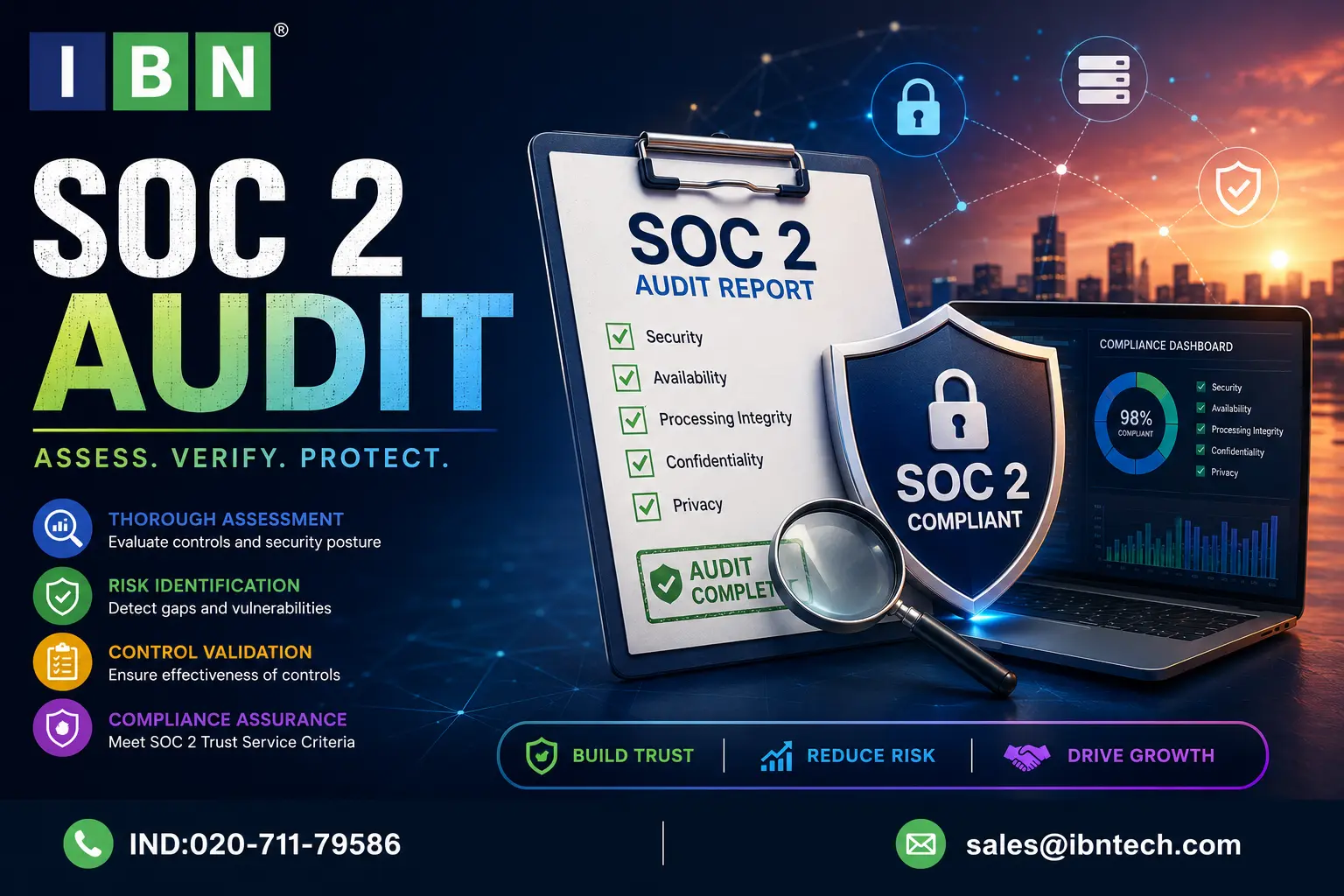
As Indian SaaS companies, technology providers, fintech organisations, and IT businesses increasingly serve enterprise customers, security assurance has become an important part of business growth. Customers want evidence that organisations have appropriate controls for protecting data, managing access, responding to incidents, and maintaining reliable systems. SOC 2 audit services help businesses prepare for and navigate an independent examination of controls against the applicable Trust Services Criteria.
SOC 2 is technically an attestation framework rather than a certification. An independent CPA firm performs the examination and issues a SOC 2 report based on the controls within the defined scope. Before that examination, businesses typically need to establish appropriate policies, implement controls, collect evidence, remediate gaps, and demonstrate that processes operate consistently.
For Indian businesses targeting enterprise customers, understanding how SOC 2 audits work can make the preparation process more structured and predictable.
What Are SOC 2 Audit Services?
SOC 2 audit services encompass the activities involved in assessing an organisation's control environment and preparing it for a SOC 2 examination.
The process can include readiness assessments, scope definition, control mapping, policy development, implementation support, evidence preparation, remediation, internal testing, and examination coordination.
SOC 2 evaluates controls against five Trust Services Criteria:
- Security: Protection against unauthorised access, disclosure, and damage.
- Availability: Availability of systems and services according to defined commitments.
- Processing Integrity: Ensuring system processing is complete, accurate, timely, and authorised.
- Confidentiality: Protection of information designated as confidential.
- Privacy: Appropriate handling of personal information.
An organisation does not necessarily need to include all five criteria. The applicable criteria depend on its services, commitments, systems, data, and business requirements.
Why SOC 2 Audit Services Matter for Indian Companies
Indian technology businesses frequently work with customers that conduct detailed vendor security assessments before entering into commercial relationships. A SOC 2 report can provide structured information about an organisation's relevant controls and their operation.
A properly managed SOC 2 programme can help organisations:
- Establish a formal security control framework.
- Identify weaknesses in existing processes.
- Improve access and identity management.
- Strengthen incident response procedures.
- Standardise security-related operations.
- Organise compliance evidence.
- Support enterprise customer due diligence.
- Improve accountability for security controls.
- Prepare for recurring compliance requirements.
- Demonstrate control maturity to business customers.
The objective should not be simply to complete an audit. The underlying controls need to become part of the organisation's normal operations.
SOC2 Type2: Understanding the Examination
The term SOC2 Type2 generally refers to a SOC 2 Type 2 examination and report.
A Type 1 examination evaluates whether relevant controls are suitably designed and implemented at a specific point in time. A Type 2 examination additionally evaluates whether those controls operated effectively over a defined period.
This distinction is important for organisations that need to demonstrate ongoing control operation.
For example, having an access review policy is different from demonstrating that access reviews were actually performed at the required intervals and that appropriate evidence was retained.
Type 2 preparation may therefore require evidence such as:
- User access reviews
- Employee onboarding and offboarding records
- Security awareness training
- Change management tickets
- Vulnerability management records
- Incident response documentation
- Risk assessments
- Vendor reviews
- Backup testing records
- Security monitoring evidence
The specific evidence requirements depend on the organisation's controls and examination scope.
SOC 2 Audit Services for SaaS Companies
SaaS organisations often have particularly complex environments because their applications continuously process customer information.
A typical SaaS environment can involve cloud infrastructure, production databases, application code, APIs, CI/CD pipelines, monitoring platforms, identity systems, and numerous third-party services.
This makes SOC 2 audit services for saas companies especially relevant when the organisation needs to demonstrate that its technology and operational controls are properly designed and consistently maintained.
Important areas may include:
Application Security
SaaS companies need processes for managing software changes, development access, code reviews, testing, and deployment.
Access Management
Access to production systems, databases, cloud infrastructure, and sensitive information should be appropriately authorised and reviewed.
Change Management
Changes to production environments should follow defined procedures, including appropriate approvals and testing where required.
Incident Response
The organisation should have documented processes for identifying, responding to, escalating, and resolving security incidents.
Vulnerability Management
Organisations should have processes for identifying vulnerabilities, assessing their risk, and addressing them according to defined priorities.
Vendor Management
Third-party providers that affect the organisation's services or control environment may need to be assessed and monitored according to the organisation's risk approach.
What Does a SOC2 Consultant Do?
A SOC2 consultant can help an organisation navigate the preparation process by providing expertise across compliance, security controls, documentation, and evidence management.
Depending on the engagement, a consultant may assist with:
- Assessing existing controls.
- Defining the examination scope.
- Mapping controls to applicable criteria.
- Identifying compliance gaps.
- Developing or improving policies.
- Assigning control ownership.
- Establishing evidence collection processes.
- Supporting remediation activities.
- Performing readiness testing.
- Preparing teams for the independent examination.
The consultant and independent auditor have different roles. A consultant can help the organisation prepare and remediate, while the independent auditor performs the examination and issues the resulting report.
SOC 2 Compliance Consultant vs. SOC 2 Auditor
These roles should not be confused.
A SOC 2 compliance consultant generally supports the organisation before and during the preparation process. This can include readiness assessments, control implementation, documentation, evidence management, and remediation.
The independent auditor evaluates the controls within the examination scope and provides the formal attestation report.
Maintaining this distinction is important because organisations should not treat their preparation consultant as the independent party responsible for issuing the examination report.
What Is Included in SOC 2 Audit Preparation?
Effective preparation generally involves several stages.
1. Define the Scope
The organisation identifies the services, systems, infrastructure, applications, locations, and processes that fall within the SOC 2 scope.
2. Determine Applicable Criteria
The organisation determines which Trust Services Criteria apply to its services and customer commitments.
3. Conduct a Readiness Assessment
Existing controls are evaluated to identify gaps between current practices and the requirements applicable to the examination.
4. Implement Required Controls
Gaps may involve access management, security monitoring, risk management, vendor management, change management, incident response, or other areas.
5. Establish Documentation
Policies and procedures should accurately reflect how the organisation operates.
6. Collect Evidence
Evidence should be generated as controls operate rather than recreated immediately before the examination.
7. Perform Internal Testing
The organisation can review its controls and evidence before the independent examination begins.
8. Remediate Gaps
Identified weaknesses should be assigned owners and addressed according to their risk and relevance to the examination.
Common SOC 2 Audit Challenges
Indian companies can encounter several recurring challenges during SOC 2 preparation.
Unclear control ownership: Employees may perform security activities without clearly documented responsibility.
Insufficient evidence: A control may be operating, but the organisation may not retain adequate evidence to demonstrate that operation.
Overly broad scope: Including unnecessary systems and processes can increase the complexity of the compliance programme.
Policy-control mismatch: Policies may describe procedures that are not consistently followed in practice.
Third-party dependencies: Cloud and technology providers can affect the organisation's overall control environment.
Late preparation: Starting evidence collection and remediation shortly before the examination can create avoidable pressure.
Addressing these issues early can make the overall process considerably more manageable.
How Indian Businesses Can Prepare for a SOC 2 Audit
A practical preparation roadmap can include:
Step 1: Identify the business reason for pursuing SOC 2.
Step 2: Define the services and systems that require examination.
Step 3: Determine the relevant Trust Services Criteria.
Step 4: Assess existing security and operational controls.
Step 5: Document gaps and assign control owners.
Step 6: Implement and test missing controls.
Step 7: Establish reliable evidence collection.
Step 8: Conduct an internal readiness review.
Step 9: Remediate outstanding issues.
Step 10: Coordinate with the independent auditor.
Step 11: Continue operating and monitoring controls after the examination.
This approach helps organisations treat SOC 2 as an ongoing control programme rather than a one-time documentation exercise.
How Long Does a SOC 2 Audit Take?
There is no universal SOC 2 timeline. Preparation and examination requirements vary according to the organisation's size, scope, existing control maturity, technology architecture, applicable Trust Services Criteria, and required remediation.
Type 2 examinations also involve a defined period during which the operating effectiveness of relevant controls is evaluated.
For this reason, organisations should avoid selecting an examination date before understanding their current readiness. A gap assessment can provide a more realistic basis for planning resources and timelines.
Benefits of a Well-Managed SOC 2 Programme
A mature SOC 2 programme can provide benefits beyond the resulting report.
It can help businesses establish:
- More consistent access management
- Better security accountability
- Structured risk management
- Stronger evidence management
- More predictable security processes
- Improved incident response
- Better vendor oversight
- Greater visibility into control performance
- More efficient responses to customer security questionnaires
For growing Indian technology companies, these improvements can become part of a broader information security and governance strategy.
Frequently Asked Questions About SOC 2 Audit Services
Is SOC 2 mandatory for Indian companies?
SOC 2 is not a universal legal requirement for all Indian companies. However, customers may require a SOC 2 report as part of their vendor security and procurement processes.
What is SOC 2 Type 2?
SOC 2 Type 2 evaluates whether relevant controls operated effectively over a defined examination period, rather than evaluating them only at a particular point in time.
Can a startup obtain SOC 2?
Yes. Startups can pursue SOC 2 when it aligns with their customer, contractual, or business requirements. The scope should be appropriately defined according to the services and systems being examined.
Does SOC 2 prove that a company is completely secure?
No. SOC 2 does not guarantee that an organisation is immune from cyberattacks or security incidents. It evaluates relevant controls against the applicable examination criteria.
Can a SOC 2 consultant perform the audit?
A consultant may support preparation and remediation, but the formal SOC 2 examination is performed by an independent auditor.
Is SOC 2 only relevant to SaaS companies?
No. SaaS companies are common SOC 2 adopters, but the framework can also be relevant to other organisations that provide services involving systems and customer information.
Conclusion
SOC 2 audit services provide a structured approach for Indian businesses preparing for a SOC 2 examination and seeking to strengthen their security control environment. The process involves much more than documentation. Organisations need clearly defined scope, appropriate controls, accountable owners, reliable evidence, consistent processes, and effective remediation.
For SaaS and technology companies serving enterprise customers, early preparation can make it easier to establish sustainable controls and demonstrate how those controls operate over time. When approached as an ongoing business process rather than a one-time audit exercise, SOC 2 can become part of a broader strategy for security governance, operational discipline, and customer assurance.
- Digital Agency
- Literie
- Location de voitures
- Restaurant
- Restaurant
- Mode
- Mode
- Information
- Marketing
- Tourisme
- Développement
- Découverte
- Législation
- Gastronomie
- Pâtisserie
- مناسبة
- Art
- Causes
- Crafts
- Dance
- Drinks
- Film
- Fitness
- Food
- الألعاب
- Gardening
- Health
- الرئيسية
- Literature
- Music
- Networking
- أخرى
- Party
- Religion
- Shopping
- Sports
- Theater
- Wellness
 Arabic
 Indian
 English
 French
 Spanish
 Portuguese
 Deutsch
 Turkish
 Dutch
Dutch
 Italiano
 Russian
 Romaian
 Portuguese (Brazil)
 Greek
Greek
