


From Radar Signals to Smart Insights: The Technology Behind IoT Water Monitoring
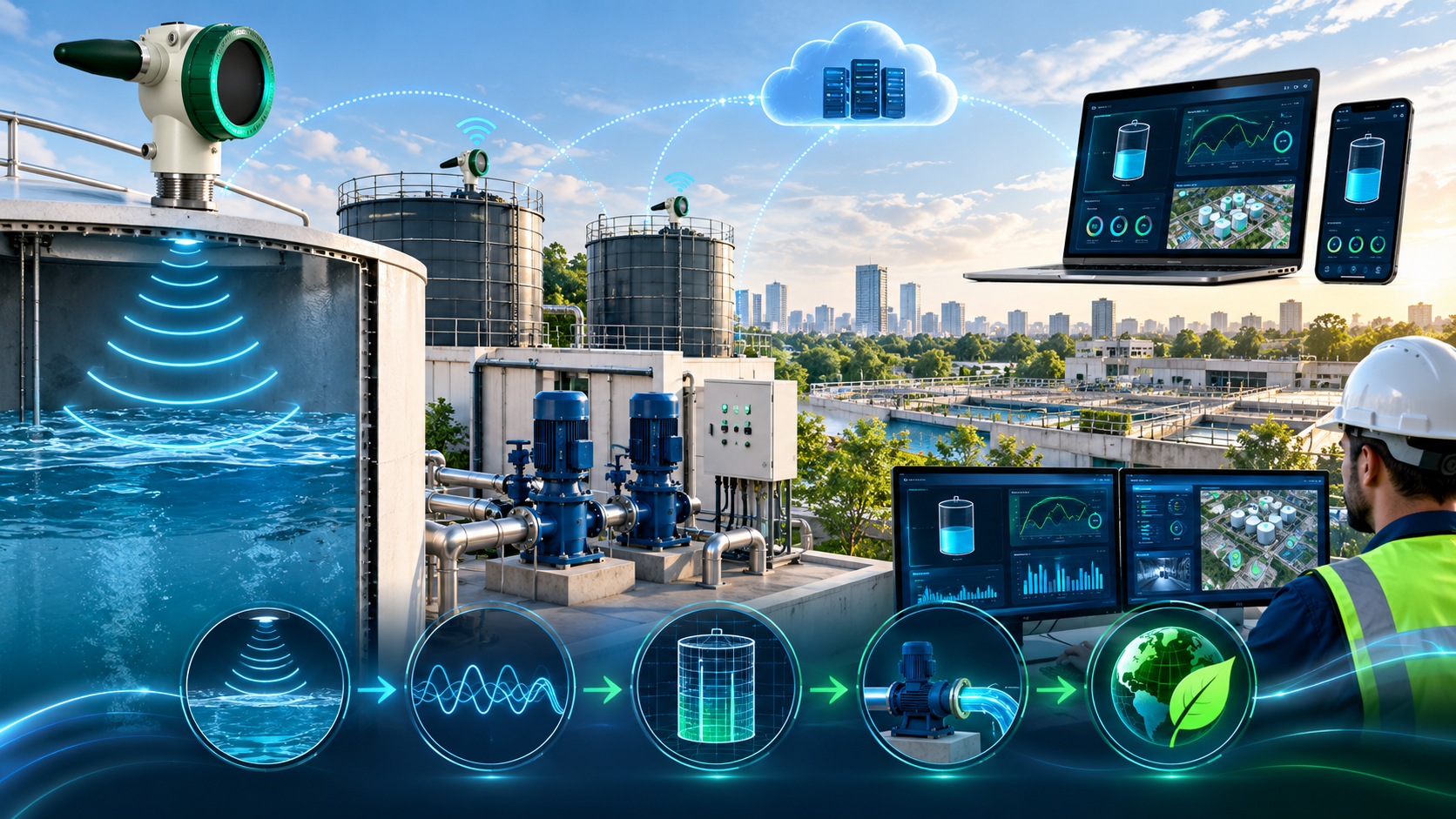
Modern water management is no longer limited to checking tank levels manually or switching pumps on and off. With radar sensing, IoT connectivity, and cloud-based analytics, water infrastructure can now deliver continuous, actionable insights.
From detecting the water surface to displaying live data on a dashboard, every stage of the monitoring process plays an important role in improving efficiency, reliability, and automation.
How Radar Technology Measures Water Levels
Radar level sensors use electromagnetic waves to measure the distance between the sensor and the water surface. The sensor transmits radar signals toward the water, receives the reflected signals, and calculates the water level based on the measured distance.
Unlike traditional contact-based sensors, radar sensors do not need to touch the water. This makes them suitable for industrial tanks, commercial buildings, underground reservoirs, and other challenging monitoring environments.
The Importance of Radar Level Sensor Installation
Accurate data begins with correct Radar level sensor installation. The sensor must be positioned properly to ensure a clear and reliable signal path to the water surface.
Important installation considerations include:
-
Mounting the sensor securely above the tank.
-
Avoiding obstructions such as pipes, ladders, and internal structures.
-
Selecting a suitable installation angle and position.
-
Protecting communication and power connections.
-
Ensuring the sensor is configured according to the tank dimensions.
Poor installation can lead to signal interference, unstable readings, or inaccurate water level measurements. Proper installation ensures that the sensor can consistently collect reliable data for further processing.
From Sensor Data to IoT Connectivity
Once the radar sensor captures water level information, the data must be transmitted to a monitoring platform. This is where IoT Connectivity becomes essential.
IoT connectivity allows sensors to communicate with cloud platforms through wireless networks or other communication technologies. Instead of relying on manual inspections, facility managers can access water level information remotely.
The connected system can transmit data such as:
-
Current water level
-
Tank filling and consumption patterns
-
Low-level and overflow alerts
-
Pump operating status
-
Historical monitoring records
This continuous flow of information creates better visibility across distributed water assets.
The Role of MyTank IoT Platform
The MyTank IoT Platform helps transform raw sensor readings into useful and accessible insights. Instead of viewing isolated measurements, users can monitor multiple tanks and water systems through a centralized digital platform.
A connected IoT platform can help users:
-
Monitor water levels in real time.
-
Receive alerts when water levels reach critical limits.
-
Track pump activity and system performance.
-
Identify unusual consumption patterns.
-
Review historical data for better planning.
-
Manage water infrastructure remotely.
By combining radar sensing with cloud-based monitoring, the system provides a complete view of water operations.
Turning Raw Data into Smart Insights
Raw data becomes valuable when it supports better decisions. IoT monitoring platforms can organize sensor information into dashboards, alerts, reports, and trends.
For example, a facility manager may identify:
-
A tank filling more slowly than usual.
-
Unexpected water consumption during non-operating hours.
-
Frequent pump activation caused by changing demand.
-
Potential leakage or abnormal water usage.
-
Water shortages before they affect operations.
These insights allow teams to respond proactively rather than waiting for manual inspections or system failures.
Supporting Smarter Water Management
The combination of radar sensors, reliable Radar level sensor installation, IoT Connectivity, and the MyTank IoT Platform creates a connected approach to water management.
This technology helps reduce dependence on manual monitoring while improving operational visibility. It also supports automation, preventive maintenance, and more efficient resource utilization.
Conclusion
The journey from radar signals to smart insights involves more than simply measuring water levels. It requires accurate sensing, proper installation, reliable IoT Connectivity, and a powerful monitoring platform such as the MyTank IoT Platform.
Together, these technologies enable real-time visibility, intelligent analysis, and better control of water infrastructure. As industries and facilities continue adopting digital solutions, IoT-based water monitoring will become an essential part of efficient and sustainable water management.
- Digital Agency
- Literie
- Location de voitures
- Restaurant
- Restaurant
- Mode
- Mode
- Information
- Marketing
- Tourisme
- Développement
- Découverte
- Législation
- Gastronomie
- Pâtisserie
- Evento
- Art
- Causes
- Crafts
- Dance
- Drinks
- Film
- Fitness
- Food
- Giochi
- Gardening
- Health
- Home
- Literature
- Music
- Networking
- Altre informazioni
- Party
- Religion
- Shopping
- Sports
- Theater
- Wellness
 Italiano
 Indian
 English
 French
 Arabic
 Spanish
 Portuguese
 Deutsch
 Turkish
 Dutch
Dutch
 Russian
 Romaian
 Portuguese (Brazil)
 Greek
Greek
