


Understanding Structural Behavior Before Manufacturing
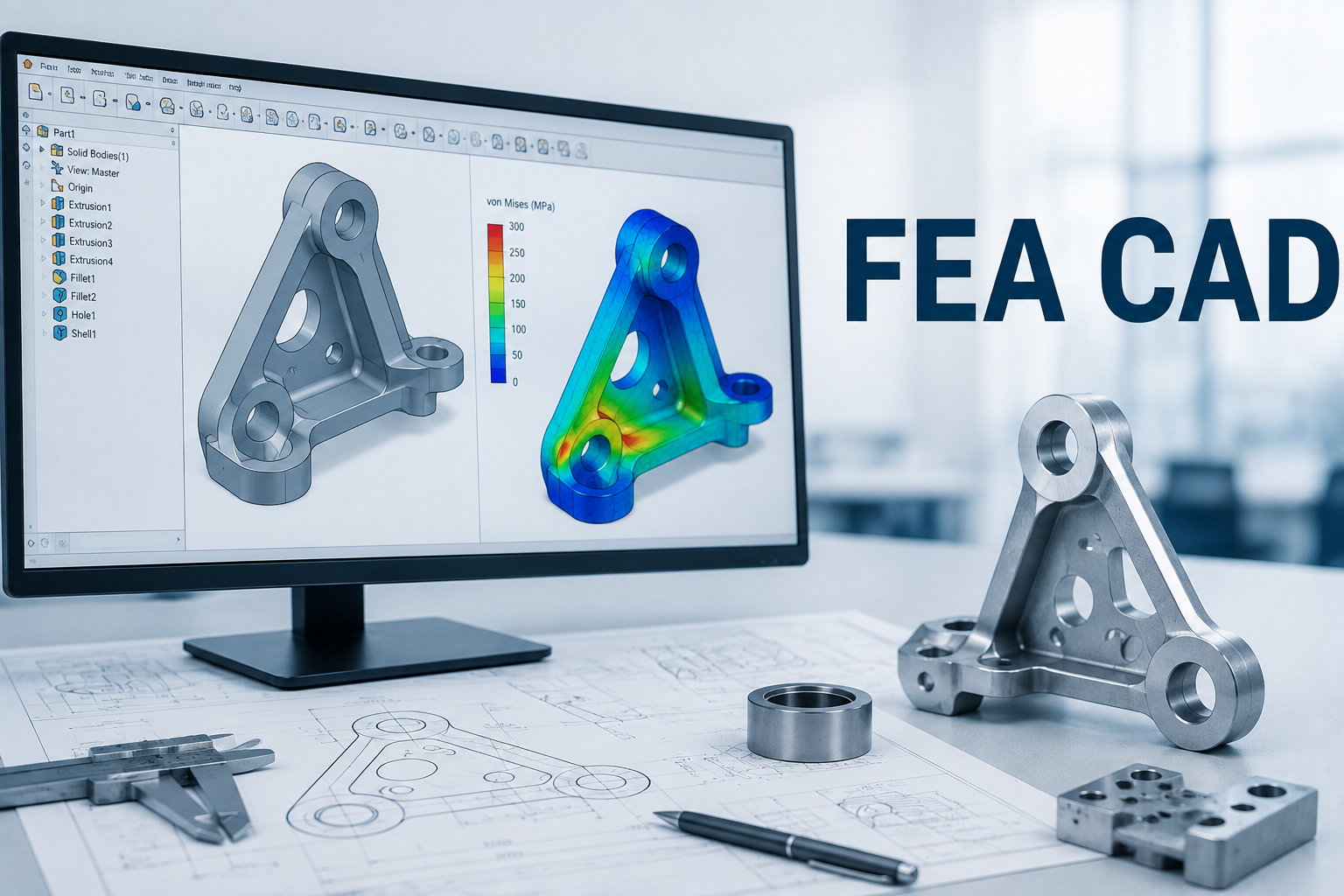
A mechanical component may appear suitable based on its shape and dimensions, but its actual performance depends on how it behaves under operating conditions. Loads, constraints, material properties, and component geometry can all influence structural performance.
CAD/FEA services offer a digital approach to examining these factors during engineering development. CAD models provide the geometric foundation for representing a component or assembly, while finite element analysis can be applied to study selected structural conditions.
Through analysis, engineers can investigate areas such as stress distribution and deformation under defined scenarios. The results can provide useful information when deciding whether a particular geometry or configuration needs improvement.
One benefit of conducting this type of evaluation digitally is the ability to compare design alternatives. Engineers can modify a component, repeat the analysis, and review how the changes affect the expected response.
This process does not replace physical testing, which remains important for many products. Instead, digital analysis can complement physical validation by helping teams understand potential structural behavior before reaching the testing stage.
For mechanical product development, combining accurate modeling with appropriate analysis can support more confident engineering decisions.
- Digital Agency
- Literie
- Location de voitures
- Restaurant
- Restaurant
- Mode
- Mode
- Information
- Marketing
- Tourisme
- Développement
- Découverte
- Législation
- Gastronomie
- Pâtisserie
- Event
- Art
- Causes
- Crafts
- Dance
- Drinks
- Film
- Fitness
- Food
- Games
- Gardening
- Health
- Home
- Literature
- Music
- Networking
- Other
- Party
- Religion
- Shopping
- Sports
- Theater
- Wellness
 English
 Indian
 French
 Arabic
 Spanish
 Portuguese
 Deutsch
 Turkish
 Dutch
Dutch
 Italiano
 Russian
 Romaian
 Portuguese (Brazil)
 Greek
Greek
