


Appointment-Based Logistics Services: Making Scheduled Deliveries Actually Work
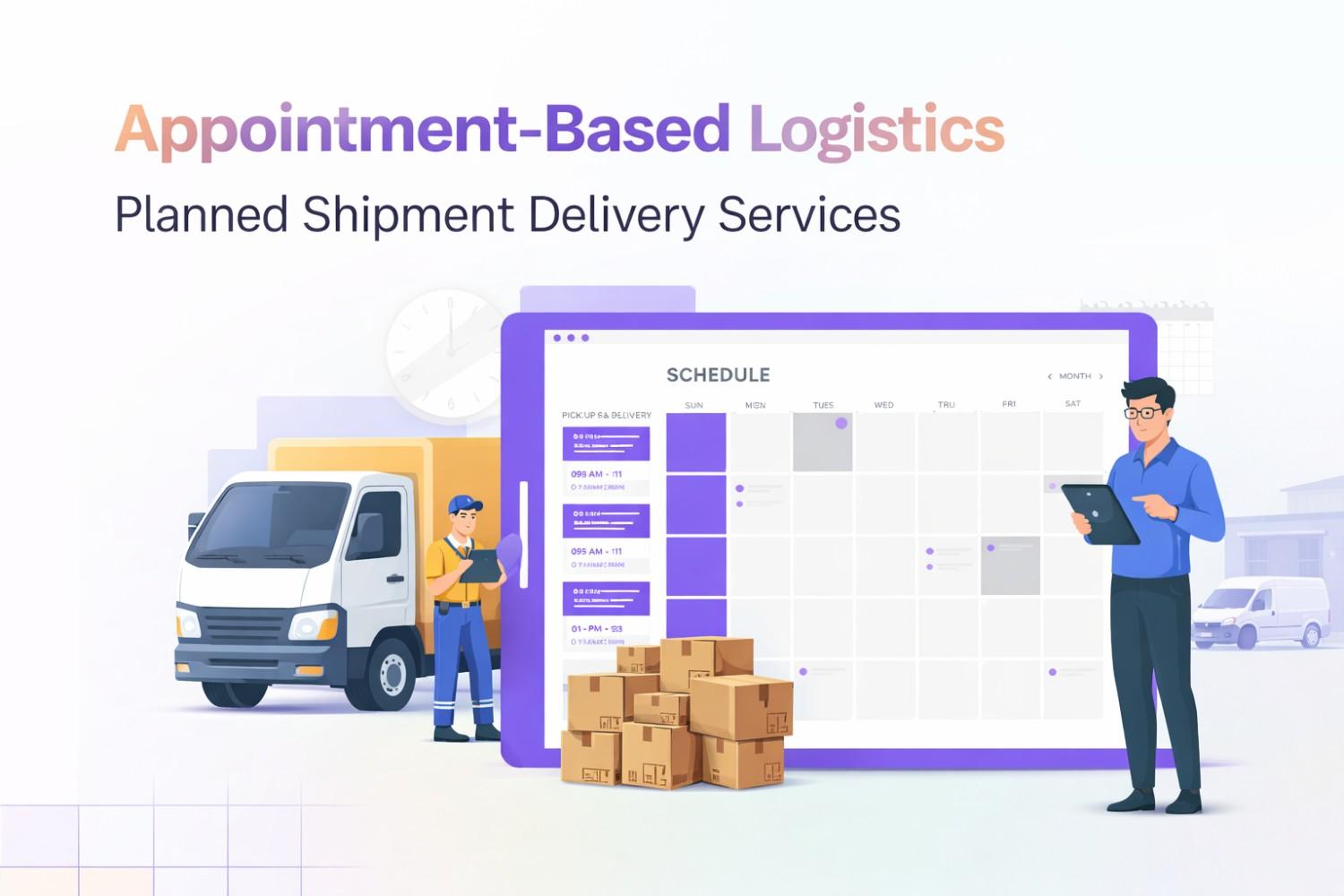
In logistics, a delivery is not always successful simply because the vehicle reached the destination. For many businesses, especially manufacturers, retailers, distributors, hospitals, and large commercial facilities, the shipment has to arrive at a specific time when the receiving team, loading bay, equipment, and documentation are ready. This is where appointment-based logistics services become important.
A truck arriving three hours early can create just as much trouble as a truck arriving late. The vehicle may wait outside, the driver may lose productive hours, and the warehouse team may have to rearrange its schedule. Multiply that across dozens of shipments and the problem starts showing up in transportation costs, dock congestion, customer complaints, and missed delivery commitments.
The real value of scheduled delivery is therefore not just punctuality. It is coordination.
Why Scheduled Delivery Has Become an Operational Issue
Traditional logistics often works around delivery windows. A shipment is dispatched, the transporter provides an expected arrival time, and the receiving location manages the rest. That model can work for straightforward deliveries, but it becomes unreliable when the destination has limited receiving capacity.
Consider a distribution centre receiving 20 vehicles a day. If several vehicles arrive at the same time, the problem is no longer transportation. It is dock management. Drivers wait, unloading gets delayed, and subsequent appointments are pushed back. The delay then travels through the entire route plan.
This is where most businesses struggle. They try to solve a scheduling problem by adding more vehicles or asking transporters to deliver faster. Neither addresses the underlying issue.
Appointment scheduling creates a shared commitment between the logistics provider and the receiving location. The shipment is planned around an agreed delivery slot rather than an approximate arrival.
In reality, that small change can make a major difference to how a logistics operation behaves.
How Appointment-Based Logistics Services Work in Practice
The process usually begins before the shipment leaves the origin facility. The logistics team checks the destination's receiving hours, available slots, shipment characteristics, vehicle requirements, and expected transit time. A delivery appointment is then coordinated with the receiving facility.
That sounds straightforward until actual operations begin.
A vehicle can be delayed because of traffic, loading issues, a breakdown, documentation problems, or a late departure from the previous stop. Good logistics appointment scheduling services account for these variables rather than treating the original appointment as a fixed number that cannot change.
Communication becomes critical here. If a vehicle is running two hours late and nobody informs the receiving facility, the appointment system has already failed. If the delay is communicated early, the slot may be moved, the dock can be reassigned, and unnecessary waiting can sometimes be avoided.
The best scheduled delivery operations therefore connect transportation planning with real-time communication. They do not treat appointment booking as an isolated administrative task.
Another practical issue is shipment readiness. A receiving facility might provide a slot for 2:00 PM, but if the shipment arrives without the required paperwork or the unloading team has not been notified, the appointment means very little. Reliable service depends on coordinating the complete delivery event.
Planned Shipment Delivery Services Need More Than a Time Slot
One common misunderstanding is that planned shipment delivery services are simply about selecting a date and time.
They are not.
A delivery appointment has value only when the surrounding operation supports it. Vehicle availability, route planning, driver schedules, warehouse capacity, loading times, unloading requirements, and customer communication all influence whether the commitment can actually be met.
For example, imagine a manufacturer shipping machinery to a plant where unloading requires a forklift and a specialised handling team. Sending the truck at 10 AM without confirming equipment availability is poor planning, even if the vehicle reaches the location exactly on time.
A logistics company offering appointment deliveries needs to understand the receiving environment. Some locations have strict gate procedures. Others require advanced vehicle details. Some operate with narrow unloading windows, while others prioritise specific shipment categories.
This is why experienced logistics teams spend time understanding the customer's operation before designing the delivery schedule.
What Makes a Reliable Appointment-Based Shipment Service?
Reliability is often misunderstood as a high percentage of on-time deliveries. That metric matters, but it does not tell the entire story.
A provider can technically achieve an impressive on-time percentage while still creating operational headaches through poor communication, inaccurate ETAs, excessive waiting, or weak exception handling.
A dependable scheduled logistics delivery solution should give the customer visibility before, during, and after delivery. The customer should know when the shipment is expected, whether the vehicle is on schedule, and what is happening if something goes wrong.
There is also a difference between planned and reactive logistics. In reactive operations, teams spend their day solving yesterday's planning mistakes. In a mature appointment model, potential problems are identified earlier.
For logistics managers, a few indicators are particularly useful:
-
Appointment adherence and actual arrival variance
-
Average driver waiting and dock turnaround time
-
Frequency of rescheduled deliveries
-
Failed or missed delivery appointments
-
Communication time during delivery exceptions
These numbers reveal more than simply asking whether shipments arrived on time.
Honestly speaking, waiting time is one of the easiest costs to overlook. A vehicle sitting at a customer location may not appear as a failed delivery in a basic report, but the carrier is still consuming vehicle and driver capacity.
Choosing the Right Approach for Your Logistics Operation
Not every shipment needs an appointment. Trying to schedule every delivery can create unnecessary administrative work and reduce flexibility.
The right approach depends on the nature of the destination and shipment.
For example, high-volume retail distribution, industrial facilities, healthcare locations, construction sites, and large warehouses are often better candidates for structured delivery scheduling. A small business receiving one parcel a day may not need the same level of coordination.
When evaluating a logistics provider, businesses should look beyond the phrase "appointment delivery." Ask how the provider handles delays, whether customers can receive live shipment updates, how delivery slots are coordinated, and what happens when a receiving facility rejects or reschedules a shipment.
It is also worth asking about integration. If appointment information sits in one system while transportation tracking exists somewhere else, employees may end up manually updating both. That creates avoidable errors.
A good system should reduce human intervention, not simply give employees another dashboard to monitor.
Decision-Making Guide for Logistics Teams
Before adopting appointment-based delivery, logistics managers should consider:
-
Which destinations genuinely require scheduled receiving?
-
How much waiting time are carriers currently experiencing?
-
Can the provider communicate delays before an appointment is missed?
-
Does the scheduling process integrate with existing transport or warehouse systems?
-
What happens when customers change or cancel delivery slots?
-
Can performance be measured using actual arrival, waiting, and turnaround data?
The answers matter more than the software or terminology used by the provider.
The Role of Technology in Scheduled Logistics
Technology is gradually changing how appointment scheduling works. Earlier, delivery coordination often depended heavily on phone calls, emails, spreadsheets, and manual confirmation. Those methods have not disappeared, but modern logistics operations increasingly connect appointment information with transportation management and tracking systems.
Real-time vehicle location can help teams estimate whether a shipment is likely to meet its slot. Automated notifications can alert customers when a vehicle is approaching. Historical delivery data can also reveal which routes, facilities, or time windows regularly cause delays.
Artificial intelligence is likely to make this more useful over time. Instead of simply showing that a vehicle is late, logistics systems can analyse historical traffic, route behaviour, loading times, and facility congestion to identify delivery risks earlier.
But technology is not a substitute for operational discipline. A sophisticated scheduling platform cannot fix inaccurate shipment information or a warehouse that consistently releases vehicles late.
That distinction is important as businesses evaluate new logistics technology in 2026. The strongest results usually come from combining better data with better processes.
What the Future Looks Like for Appointment Deliveries
Scheduled delivery is likely to become more closely connected with the wider supply chain rather than remaining a standalone transportation function.
Retailers and distribution centres are under constant pressure to use warehouse space efficiently. Manufacturers need predictable inbound material flows. Customers increasingly expect accurate delivery commitments instead of broad time windows.
This creates a stronger case for coordinated appointment planning.
The next stage will likely involve more predictive scheduling, where systems adjust delivery plans based on actual operating conditions rather than relying entirely on fixed schedules. If a warehouse is experiencing an unexpected backlog, upcoming appointments could potentially be prioritised or shifted before congestion becomes severe.
For logistics companies, this also changes the conversation with customers. Instead of selling transportation purely on price or transit time, providers can compete on predictability, visibility, and operational control.
That is a more meaningful advantage for businesses where a missed receiving slot can disrupt an entire day's operation.
Conclusion
Appointment-based logistics services work best when they are treated as an operational coordination system rather than simply a booking facility.
The goal is not to make every truck arrive at an exact minute. The goal is to make transportation, receiving capacity, people, equipment, and information work together with fewer surprises.
For logistics teams, the practical question should be simple: how much time, money, and capacity is being lost because deliveries are not properly coordinated?
If the answer is significant, scheduled delivery deserves serious attention. The right logistics partner can help turn unpredictable arrivals into planned movements, reduce unnecessary waiting, improve dock utilisation, and give customers a much clearer view of what is happening with their shipments.
In the long run, that predictability is often worth more than shaving a few hours from transit time.
FAQs
1. What are appointment-based logistics services?
Ans. Appointment-based logistics services coordinate shipment delivery around a confirmed receiving time at the destination. They are particularly useful when warehouses, plants, retailers, or commercial facilities have limited dock capacity or strict receiving schedules.
2. How do logistics appointment scheduling services reduce delivery delays?
Ans. They coordinate the vehicle arrival with the destination's available receiving capacity. When supported by tracking and proactive communication, scheduling can also help teams respond to delays before they become failed delivery appointments.
3. Which businesses benefit most from planned shipment delivery services?
Ans. Businesses with controlled receiving environments usually benefit the most, including manufacturers, large retailers, distribution centres, hospitals, and industrial facilities. Locations with limited docks or strict receiving procedures are especially suitable.
4. What should I check before choosing a logistics company offering appointment deliveries?
Ans. Check how the provider manages appointment changes, late vehicles, customer notifications, tracking, waiting time, and proof of delivery. It is also important to understand whether scheduling information connects with the provider's transportation and warehouse systems.
5. Are scheduled logistics delivery solutions more expensive?
Ans. Not necessarily. Scheduling can add coordination requirements, but it may reduce hidden costs caused by driver waiting, failed deliveries, dock congestion, and repeated delivery attempts. The overall financial impact should be measured against these operational costs.
- Digital Agency
- Literie
- Location de voitures
- Restaurant
- Restaurant
- Mode
- Mode
- Information
- Marketing
- Tourisme
- Développement
- Découverte
- Législation
- Gastronomie
- Pâtisserie
- Veranstaltung
- Art
- Causes
- Crafts
- Dance
- Drinks
- Film
- Fitness
- Food
- Spiele
- Gardening
- Health
- Startseite
- Literature
- Music
- Networking
- Andere
- Party
- Religion
- Shopping
- Sports
- Theater
- Wellness
 Deutsch
 Indian
 English
 French
 Arabic
 Spanish
 Portuguese
 Turkish
 Dutch
Dutch
 Italiano
 Russian
 Romaian
 Portuguese (Brazil)
 Greek
Greek
