


Mental Health Billing Services in New Jersey, USA: A Practical Guide to Stronger Revenue Cycle Performance
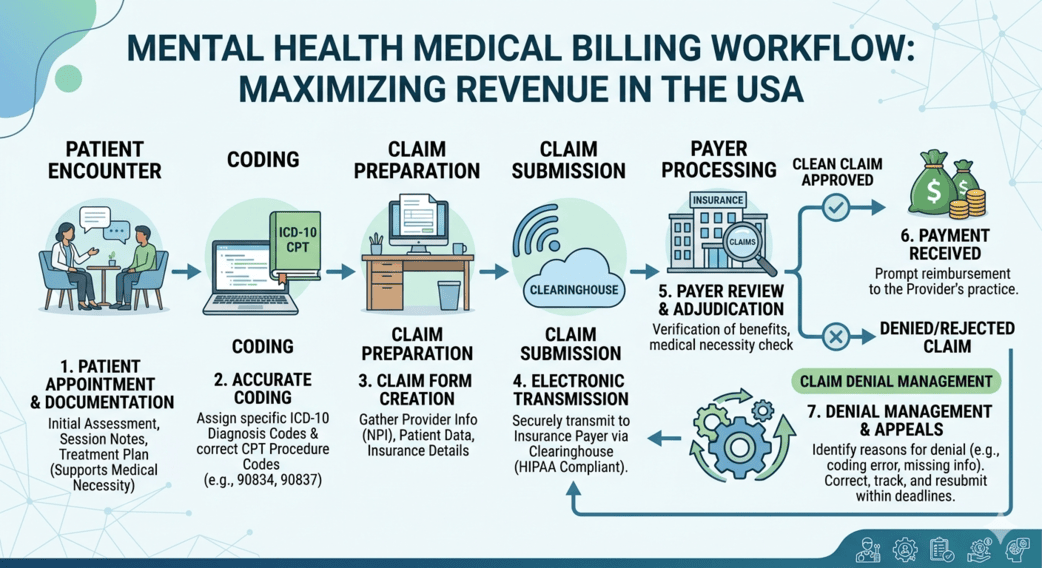
Mental health practices in New Jersey operate in a billing environment where clinical care and administrative complexity often collide. A provider may spend an hour helping a patient, yet the financial outcome of that appointment can depend on what happened before the visit, during documentation, and weeks afterward. Eligibility issues, authorization requirements, coding errors, claim rejections, payer-specific rules, and delayed follow-up can all affect whether a practice receives the payment it has earned.
This is why mental health billing services in New Jersey have become an important part of practice operations. Effective billing is not simply about submitting claims. It involves coordinating patient information, insurance verification, documentation, coding, claims processing, payment posting, denial management, and accounts receivable follow-up.
For behavioral health providers, therapists, psychiatrists, psychologists, social workers, counselors, and other mental health professionals, a well-managed billing process can reduce administrative pressure while creating greater visibility into the financial health of the practice.
Why Mental Health Billing Is Different
Mental health medical billing has its own challenges because behavioral health services can involve different provider types, treatment settings, appointment structures, documentation requirements, and payer policies.
A claim may look straightforward on the surface, but several details can influence reimbursement. The patient's coverage must be active. The provider must be properly enrolled with the payer. The diagnosis and procedure codes must accurately reflect the services documented. If prior authorization applies, the required authorization information needs to be connected to the claim.
Even a small inconsistency can create a delay.
For example, imagine a New Jersey behavioral health practice treating a patient for several months. The patient's insurance changes during that period, but the new coverage is not identified before a visit. The claim may eventually reject or deny. Staff then have to investigate eligibility, correct the insurance information, resubmit the claim, and potentially communicate with the patient.
Multiply that situation across dozens of patients, and administrative work can quickly become overwhelming.
Common Revenue Cycle Problems Faced by New Jersey Mental Health Providers
Many providers do not lose revenue because they are undercharging. They lose revenue because money gets stuck somewhere in the revenue cycle.
Some recurring problems include:
- Incorrect or incomplete patient demographics
- Insurance eligibility not verified before appointments
- Missing authorization information
- Incorrect CPT or diagnosis coding
- Claims submitted with provider enrollment discrepancies
- Rejected electronic claims
- Underpayments that are not identified
- Denials that remain unresolved
- Delayed payment posting
- Aging accounts receivable
- Patient balances that are difficult to collect
- Incomplete documentation affecting claim support
The challenge is that these problems are interconnected. A registration error can become a claim rejection. A coding issue can become a denial. A denial that is not worked quickly can eventually become aged A/R.
That is why billing should be viewed as a complete process rather than a single administrative task.
What Mental Health Billing Services Should Cover
The best mental health billing services are designed around the entire revenue cycle instead of focusing only on claim submission.
Patient Registration and Demographic Review
Accurate information is the foundation of a clean claim. Billing teams should verify essential patient details, insurance information, subscriber information, and other required data before services are billed.
A strong front-end process can prevent many downstream problems.
Insurance Eligibility Verification
Eligibility verification helps determine whether a patient's coverage is active and whether the planned service may have specific requirements.
For mental health practices, verification may involve checking benefits, copayment or coinsurance responsibilities, deductibles, network participation, and authorization requirements.
When this information is reviewed before the appointment, providers have a better opportunity to address financial or coverage issues early rather than discovering them after a claim has been denied.
Medical Coding and Documentation Review
Medical coding services play an important role in behavioral health revenue cycle management.
Mental health providers may use various evaluation and management and psychotherapy-related codes depending on the provider type, service delivered, time, setting, and documentation. The coding process must accurately represent the clinical service without introducing unsupported information.
Good coding is not about selecting the highest-paying code. It is about matching the code to the documentation and applicable billing requirements.
Claims Submission and Tracking
After coding and claim preparation, claims should be submitted through the appropriate electronic process and monitored for acceptance.
A rejected claim is different from a denied claim. A rejection generally means the claim could not move successfully through the initial processing stage, while a denial occurs when the payer adjudicates the claim but determines that payment cannot be made as submitted.
Understanding that difference helps billing teams prioritize corrective action.
Mental Health RCM Billing: Beyond Claims
Mental health RCM billing extends beyond sending claims to insurance companies.
Revenue cycle management looks at the financial journey from the patient's first registration through final payment. This includes front-end, mid-cycle, and back-end activities.
A practical mental health RCM workflow may include:
- Patient registration
- Insurance verification
- Authorization review
- Appointment and service documentation
- Charge capture
- Medical coding
- Claim creation
- Claim submission
- Rejection management
- Denial resolution
- Payment posting
- Patient balance management
- A/R follow-up
- Financial reporting
The advantage of this approach is visibility. Instead of asking only, "Were the claims submitted?", practice managers can ask more meaningful questions: Where are claims getting delayed? Which payers are producing the most denials? How much A/R is aging? Are payments matching expected reimbursement?
These questions can lead to practical improvements.
Why Credentialing Matters to Mental Health Billing
Billing performance can be affected long before the first claim is submitted.
Provider enrollment and credentialing are important because payers need accurate information about who is delivering services and under what network or participation status. A practice may have excellent coding and claim submission processes, but credentialing discrepancies can still create payment problems.
Mental health billing and credentialing services can help practices coordinate these administrative responsibilities more effectively.
Credentialing services may support activities such as:
- Provider enrollment
- Payer applications
- Recredentialing
- Demographic updates
- Participation status tracking
- Enrollment documentation
- NPI and related information review
- Monitoring credentialing deadlines
Keeping provider information current is especially important when a practice adds clinicians, changes locations, joins networks, or expands services.
Choosing Among Mental Health Billing Companies
There are many mental health billing companies offering different levels of support. A practice should not choose a provider simply because it promises faster payments.
Instead, consider how the company manages the complete billing workflow.
Ask questions such as:
Does the company understand behavioral health billing?
Mental health billing requires familiarity with behavioral health services, documentation, coding, payer requirements, and common denial scenarios. General billing experience can be useful, but specialty knowledge can make a significant difference.
How are denials handled?
Denial management should not end with identifying the denial code. The billing team should determine why the claim failed, correct the underlying problem when appropriate, appeal when justified, and track the outcome.
Is A/R actively monitored?
A billing company should be able to explain how it identifies aging claims and prioritizes follow-up. A claim that remains untouched for weeks represents more than an accounting entry; it represents delayed cash flow.
What reporting is provided?
Useful reporting should give practice owners and administrators insight into collection performance, denial trends, outstanding A/R, payer behavior, and other important financial indicators.
What Makes a Mental Health Billing Company Valuable?
A good mental health billing company should function as an extension of the practice's administrative team rather than simply acting as a claim submission vendor.
Communication matters.
If a practice manager discovers a recurring denial trend before the billing team does, the relationship is not working as effectively as it should. A proactive team should identify patterns and explain what they mean.
For example, suppose a practice notices that a particular payer is generating repeated denials related to authorization. Rather than correcting each claim individually, the billing team should investigate whether authorization information is being captured correctly during scheduling and registration.
That shift—from fixing individual claims to fixing the process—is one of the most valuable aspects of professional billing support.
The Role of Technology in Mental Health Billing Solutions
Technology has changed how billing teams monitor revenue cycles, but technology alone does not solve billing problems.
Modern mental health billing solutions can help automate eligibility checks, claim submission, electronic remittance processing, work queues, reporting, and payment posting. Automation can reduce repetitive work and make important information easier to identify.
However, automated systems still depend on accurate data and appropriate workflows.
A system may quickly identify a claim with missing information, but someone still needs to understand why the information is missing and determine how the process should be corrected.
The strongest approach combines technology with experienced human oversight.
How Billing Services for Mental Health Providers Can Improve Practice Operations
Outsourcing billing does not mean giving up financial control. When structured properly, it can give providers more visibility into their revenue cycle while reducing the amount of administrative work handled internally.
Professional billing support may help practices:
- Reduce avoidable claim errors
- Identify eligibility problems earlier
- Improve coding consistency
- Work denied claims more systematically
- Monitor aging A/R
- Improve payment posting accuracy
- Track payer trends
- Support provider credentialing
- Generate useful financial reports
The goal should not simply be to "send more claims." The goal is to create a cleaner and more predictable path from completed service to collected revenue.
Why New Jersey Practices Need a Process-Focused Approach
New Jersey's healthcare market includes independent practices, group practices, behavioral health organizations, and multidisciplinary providers. Each practice has different staffing structures and payer mixes.
That means there is no single billing model that works for everyone.
A small therapy practice may need help primarily with claims, eligibility, and A/R follow-up. A growing behavioral health group may require more comprehensive support covering credentialing, coding, payer enrollment, denial management, and financial reporting.
The right solution begins with understanding where the practice is losing time and revenue.
A useful internal review can start with three questions:
Where are claims being delayed?
Why are claims being denied?
How long does it take for completed services to become collected revenue?
The answers provide a much clearer picture than simply looking at monthly collections.
A Smarter Approach to Mental Health Medical Billing Services
Mental health medical billing services should ultimately support both financial stability and administrative efficiency.
Providers should be able to concentrate on patient care without constantly switching between clinical responsibilities and unresolved billing issues. At the same time, practice owners need reliable information to make decisions about staffing, growth, payer relationships, and operational investments.
This is where an integrated approach becomes valuable.
A provider such as 247 Medical Billing Services can support practices with medical billing services, medical coding services, medical billing and coding services, and revenue cycle management services. When these functions are coordinated, practices can address problems across the revenue cycle instead of treating each billing issue separately.
Credentialing services can also complement the billing process by helping maintain accurate provider enrollment and participation information.
The objective is not to create more administrative complexity. It is to remove unnecessary friction from the existing process.
Final Thoughts
For mental health providers in New Jersey, effective billing is an operational necessity—not merely a back-office function. Every eligibility check, coding decision, claim submission, denial review, and A/R follow-up contributes to the financial health of a practice.
The right mental health billing service should therefore provide more than basic claim processing. It should help identify revenue leakage, improve workflow consistency, monitor payer behavior, and give providers a clearer understanding of their financial performance.
Whether a practice is evaluating mental health billing companies for the first time or looking to improve an existing billing operation, the most important question is simple: Does the billing process make it easier to turn completed patient care into accurate, timely reimbursement?
When the answer is yes, providers can spend less time chasing administrative issues and more time building sustainable practices that serve their patients.
Frequently Asked Questions
1. What are mental health billing services?
Mental health billing services manage financial and administrative activities associated with behavioral health care, including eligibility verification, coding, claim submission, denial management, payment posting, A/R follow-up, and patient billing.
2. Why is mental health medical billing challenging?
Mental health billing can involve different provider types, service codes, documentation requirements, payer policies, authorization requirements, and reimbursement rules. Small errors in any part of the process can delay or prevent payment.
3. What should I look for in mental health billing companies?
Look for behavioral health billing experience, knowledgeable coding support, proactive denial management, A/R follow-up, credentialing capabilities, transparent reporting, and clear communication about billing performance.
4. Can billing services help reduce claim denials?
Yes. A structured billing process can identify common causes of denials, such as eligibility problems, coding inconsistencies, missing information, authorization issues, or enrollment discrepancies. Addressing the underlying cause is more effective than repeatedly correcting individual claims.
5. Are credentialing services important for mental health practices?
Yes. Accurate provider enrollment and credentialing information can help prevent administrative and reimbursement problems associated with incorrect or outdated payer records.
6. What are the benefits of outsourcing billing for mental health providers?
Outsourcing can reduce administrative workload, provide access to specialized billing expertise, improve follow-up on outstanding claims, and give practice leaders better visibility into revenue cycle performance while allowing clinicians to focus more heavily on patient care.
- Digital Agency
- Literie
- Location de voitures
- Restaurant
- Restaurant
- Mode
- Mode
- Information
- Marketing
- Tourisme
- Développement
- Découverte
- Législation
- Gastronomie
- Pâtisserie
- Eveniment
- Art
- Causes
- Crafts
- Dance
- Drinks
- Film
- Fitness
- Food
- Jocuri
- Gardening
- Health
- Acasă
- Literature
- Music
- Networking
- Alte
- Party
- Religion
- Shopping
- Sports
- Theater
- Wellness
 Romaian
 Indian
 English
 French
 Arabic
 Spanish
 Portuguese
 Deutsch
 Turkish
 Dutch
Dutch
 Italiano
 Russian
 Portuguese (Brazil)
 Greek
Greek
