


Dermatology Billing Solutions in the USA: A Practical Guide to Stronger Revenue Cycle Performance
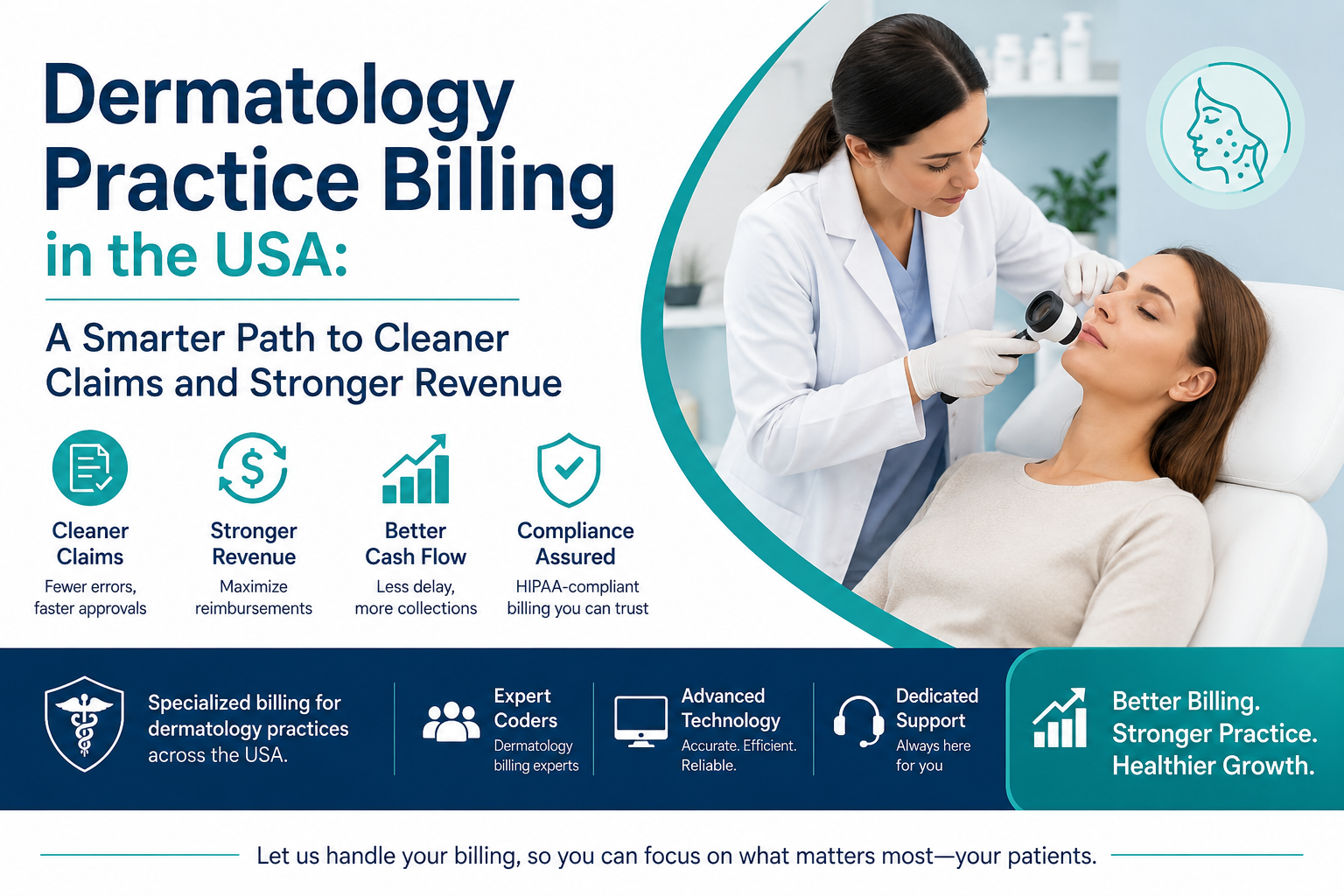
Dermatology practices in the USA operate in a billing environment where clinical complexity, payer requirements, coding accuracy, and patient financial responsibility all intersect. A visit that appears straightforward at the point of care can involve multiple diagnoses, procedures, pathology services, modifiers, authorization requirements, and payer-specific reimbursement rules. When even one part of the process is handled incorrectly, the result can be a delayed payment, denied claim, or unnecessary administrative burden.
This is where effective dermatology billing solutions become important. The goal is not simply to submit claims. A strong billing process should connect documentation, coding, claims management, payment posting, denial resolution, patient billing, and reporting into one coordinated workflow.
For dermatology practices looking to improve financial performance without allowing billing administration to interfere with patient care, understanding where revenue leakage occurs—and how the revenue cycle can be strengthened—is essential.
Why Dermatology Billing Requires Specialized Attention
Dermatology billing is different from general physician billing because practices frequently manage a combination of evaluation and management services, surgical procedures, biopsies, pathology-related services, cosmetic treatments, and recurring visits.
A single patient encounter may involve several billable components. For example, a dermatologist could evaluate a suspicious lesion, perform a biopsy, submit the specimen for pathology, and schedule the patient for a subsequent procedure. Each step creates different documentation and billing considerations.
Common challenges include:
- Selecting the appropriate CPT and HCPCS codes
- Matching diagnosis codes with the services performed
- Applying modifiers correctly
- Managing global surgical periods
- Distinguishing medically necessary services from cosmetic procedures
- Handling pathology-related billing
- Verifying patient eligibility and benefits
- Managing prior authorization requirements
- Correctly billing secondary insurance
- Following payer-specific claim rules
- Reducing avoidable claim denials
A dermatology billing workflow must therefore be precise from the beginning rather than relying on extensive follow-up after claims have already been rejected.
What Effective Dermatology Billing Solutions Should Cover
A complete solution should address the entire revenue cycle rather than concentrating exclusively on claim submission.
Patient Registration and Insurance Verification
Revenue cycle problems can begin before the patient sees the provider. Incorrect demographics, outdated insurance information, missing subscriber details, or an inactive policy can eventually create claim problems.
Eligibility verification should confirm information such as:
- Active coverage
- Deductible and coinsurance
- Copay requirements
- Specialist benefits
- Procedure-specific coverage
- Prior authorization requirements
- In-network or out-of-network status
Getting these details right at registration can prevent avoidable patient balances and rejected claims later.
Accurate Dermatology Coding
Coding accuracy is one of the most important components of dermatology reimbursement. Coders must understand the relationship between the provider's documentation and the reported service.
Common dermatology services may involve lesion removal, biopsies, destruction procedures, wound care, injections, examinations, and other procedures. Coding must accurately reflect what was documented and performed.
This is why specialized medical coding services can be valuable for practices with complicated procedure mixes. Coding should never be based simply on what appears to generate the highest reimbursement. It needs to be supported by documentation and applicable coding rules.
Clean Claim Submission
Even a correctly coded service can experience payment delays if the claim contains incorrect demographic information, invalid modifiers, missing information, or other technical errors.
A strong claim process includes pre-submission checks designed to identify problems before the claim reaches the payer.
The objective is simple: submit a claim that is complete, accurate, supported by documentation, and aligned with the applicable payer requirements.
Denial Management: Where Revenue Recovery Becomes Critical
Denials should not be treated as isolated billing mistakes. They often reveal patterns within the revenue cycle.
For example, if a practice repeatedly receives denials related to authorization, the underlying issue may be a weakness in the scheduling or verification process. If modifier-related denials occur frequently, the problem may involve coding review or insufficient education.
An effective denial management process should classify denials by root cause and monitor trends.
Important categories can include:
- Eligibility-related denials
- Authorization denials
- Coding and modifier errors
- Medical necessity issues
- Duplicate claims
- Timely filing problems
- Incorrect payer information
- Documentation-related issues
- Coordination-of-benefits problems
The value comes from using denial data to prevent future denials—not simply resubmitting the same claim.
Accounts Receivable and Dermatology Revenue Cycle Management
A practice can have a healthy volume of appointments and still experience cash-flow problems if accounts receivable is not actively managed.
Revenue cycle management services can support the complete financial lifecycle, from patient registration through final payment. A structured A/R process monitors unpaid claims according to aging, payer, balance, and denial status.
For example, an account that has remained unpaid for several weeks should not necessarily receive the same follow-up approach as an older high-value claim. Prioritization allows billing teams to focus effort where it can have the greatest financial impact.
Useful metrics include:
- Days in A/R
- Clean claim rate
- Net collection rate
- Denial rate
- First-pass acceptance rate
- Aging distribution
- Payment turnaround time
- Patient collection rate
These measurements provide a clearer picture of whether a billing operation is actually improving.
Why Documentation Matters in Dermatology Reimbursement
Coding accuracy begins with documentation.
When documentation clearly identifies the patient's condition, medical necessity, procedure performed, anatomical location, and other required details, coders have a stronger foundation for selecting appropriate codes.
Consider a lesion-related procedure. The clinical documentation should provide enough information for the coding team to understand what was evaluated or performed and why. If critical details are missing, the billing team may need clarification before submitting the claim.
A strong documentation process therefore benefits both compliance and reimbursement.
When Outsourcing Becomes a Practical Option
Not every dermatology practice needs a large internal billing department. Smaller practices may struggle to maintain dedicated expertise across coding, payer follow-up, denial management, credentialing, and accounts receivable.
Outsourcing can provide access to specialized personnel without requiring the practice to build every function internally.
However, outsourcing should not be viewed simply as a way to reduce payroll costs. The more important question is whether the external team can improve accuracy, visibility, collections, and operational consistency.
A useful outsourcing partner should understand:
- Dermatology-specific coding
- Payer claim requirements
- Denial prevention
- A/R follow-up
- Eligibility verification
- Payment posting
- Credentialing
- Compliance considerations
- Reporting and performance analysis
Lessons From Other Specialty Billing Models
Although dermatology has its own billing requirements, some revenue cycle principles apply across medical specialties.
For example, practices researching medical billing for mental health services often encounter authorization requirements, payer-specific rules, documentation concerns, and patient responsibility issues. Similar operational lessons can apply to dermatology: verification should happen early, documentation should support the service, and payer requirements should be incorporated into the workflow.
Likewise, organizations considering outsourcing mental health billing or evaluating an outsourced billing for mental health model often focus on specialized expertise rather than generic billing support. The same principle applies to dermatology. Specialty knowledge matters because different specialties have different coding structures, payer policies, and reimbursement challenges.
A mental health billing specialist, for instance, may understand behavioral-health-specific workflows that a general billing employee does not. In the same way, dermatology practices benefit from billing professionals who understand dermatology procedures and reimbursement patterns.
This broader perspective is also useful for organizations operating multiple specialties. A practice may use different workflows for dermatology, behavioral health, or other services while maintaining consistent standards for claim accuracy, A/R management, and compliance.
Understanding Payer-Specific Billing Requirements
Payers do not always apply identical rules to the same service. Coverage, authorization, medical necessity, documentation, coding edits, and reimbursement policies can vary by payer and plan.
This is particularly important for practices serving patients across different insurance networks.
Even examples from other specialties demonstrate the importance of payer awareness. Ohio Medicaid mental health billing, for example, can involve program-specific requirements that differ from commercial insurance workflows. The lesson for dermatology practices is broader: billing teams should verify the applicable payer's current policies rather than assuming one process works for every insurance plan.
Regular payer-policy review can help reduce surprises and improve claim consistency.
Credentialing Should Not Be an Afterthought
Provider credentialing is closely connected to revenue generation. A provider may deliver excellent clinical care, but reimbursement can be affected if enrollment information is incomplete, outdated, or incorrectly configured.
Credentialing services can help practices manage activities such as payer enrollment, provider information updates, recredentialing, and related administrative requirements.
Keeping payer participation information current is particularly important when practices add new dermatologists, expand into new locations, or participate in additional insurance networks.
Credentialing should therefore be treated as part of revenue cycle planning rather than a separate administrative task.
How to Evaluate a Dermatology Billing Partner
Before choosing an external billing company, dermatology practices should look beyond promises of "faster collections."
Ask potential partners about:
- Their experience with dermatology practices.
- Their approach to coding audits.
- How they identify denial root causes.
- How frequently A/R is reviewed.
- What reporting the practice receives.
- How payer policy changes are monitored.
- How credentialing and enrollment are handled.
- What quality-control processes are used before claim submission.
- How patient balances are managed.
- Which performance indicators are reported to practice leadership.
The right partner should be able to explain its process clearly and demonstrate how operational improvements are measured.
Building a More Efficient Dermatology Revenue Cycle
Technology can improve billing operations, but technology alone does not solve every revenue cycle problem. Automated eligibility checks, claim-scrubbing tools, electronic remittance processing, and reporting dashboards can make workflows faster, but they still require knowledgeable oversight.
The strongest model combines technology with human review.
For example, automated systems can flag a potential claim issue, while an experienced billing professional determines whether the issue is genuinely problematic. Similarly, reporting software can identify an increase in denials, but management still needs to investigate why the trend occurred.
This combination can create a more responsive and accountable revenue cycle.
Where 247 Medical Billing Services Fits Into the Picture
For practices seeking external support, 247 Medical Billing Services approaches the revenue cycle as an interconnected process rather than a series of disconnected billing tasks. The focus can include medical billing services, medical coding services, and complete medical billing and coding services designed around accurate claims and consistent reimbursement workflows.
Beyond claims and coding, practices may also require revenue cycle management services to monitor A/R, denials, payments, and financial performance across the entire billing lifecycle. Credentialing services can provide additional administrative support when payer enrollment and provider participation become difficult to manage internally.
The most valuable approach is not simply outsourcing individual tasks. It is creating a billing operation where registration, verification, coding, claims, payments, denials, A/R, and credentialing work together toward the same financial objectives.
Final Thoughts
Dermatology billing is too important to treat as a back-office afterthought. Small problems in eligibility, coding, documentation, authorization, claims processing, or A/R follow-up can accumulate into substantial revenue leakage over time.
Effective dermatology billing solutions should therefore focus on the complete revenue cycle. Practices need accurate coding, clean claims, proactive denial management, disciplined A/R follow-up, payer awareness, reliable reporting, and well-maintained credentialing processes.
Whether billing is handled internally or through an experienced outsourcing partner, the objective remains the same: create a revenue cycle that is accurate, transparent, compliant, and capable of supporting sustainable practice growth.
Frequently Asked Questions
1. What are dermatology billing solutions?
Dermatology billing solutions are specialized processes and services designed to manage billing activities for dermatology practices. They can include eligibility verification, coding, claim submission, payment posting, denial management, A/R follow-up, patient billing, reporting, and credentialing.
2. Why is specialized dermatology coding important?
Dermatology includes numerous procedures and diagnosis combinations that require accurate code selection and documentation. Specialized coding knowledge can help reduce coding errors, claim denials, and compliance risks while supporting appropriate reimbursement.
3. Can dermatology practices outsource their billing?
Yes. Practices can outsource some or all billing functions, including coding, claim submission, denial management, A/R follow-up, payment posting, and credentialing. The appropriate model depends on practice size, staffing, specialty complexity, and operational goals.
4. How can dermatology practices reduce claim denials?
Practices can reduce avoidable denials by verifying insurance before appointments, maintaining accurate patient information, reviewing documentation, using appropriate codes and modifiers, checking authorization requirements, and analyzing denial patterns to identify recurring problems.
5. What is the difference between medical billing and revenue cycle management?
Medical billing generally focuses on activities such as coding, claim submission, payment posting, and follow-up. Revenue cycle management is broader and covers the financial process from patient registration and eligibility through claims, payments, denials, A/R, and final collection.
6. Are billing lessons from other specialties relevant to dermatology?
Yes, although specialty-specific rules differ. Workflows used in areas such as mental health provider billing can demonstrate the importance of payer verification, documentation, authorization management, and specialized expertise. The same operational principles can help dermatology practices build a stronger revenue cycle while applying dermatology-specific coding and payer requirements.
- Digital Agency
- Literie
- Location de voitures
- Restaurant
- Restaurant
- Mode
- Mode
- Information
- Marketing
- Tourisme
- Développement
- Découverte
- Législation
- Gastronomie
- Pâtisserie
- Evento
- Art
- Causes
- Crafts
- Dance
- Drinks
- Film
- Fitness
- Food
- Jogos
- Gardening
- Health
- Início
- Literature
- Music
- Networking
- Outro
- Party
- Religion
- Shopping
- Sports
- Theater
- Wellness
 Portuguese (Brazil)
 Indian
 English
 French
 Arabic
 Spanish
 Portuguese
 Deutsch
 Turkish
 Dutch
Dutch
 Italiano
 Russian
 Romaian
 Greek
Greek
