


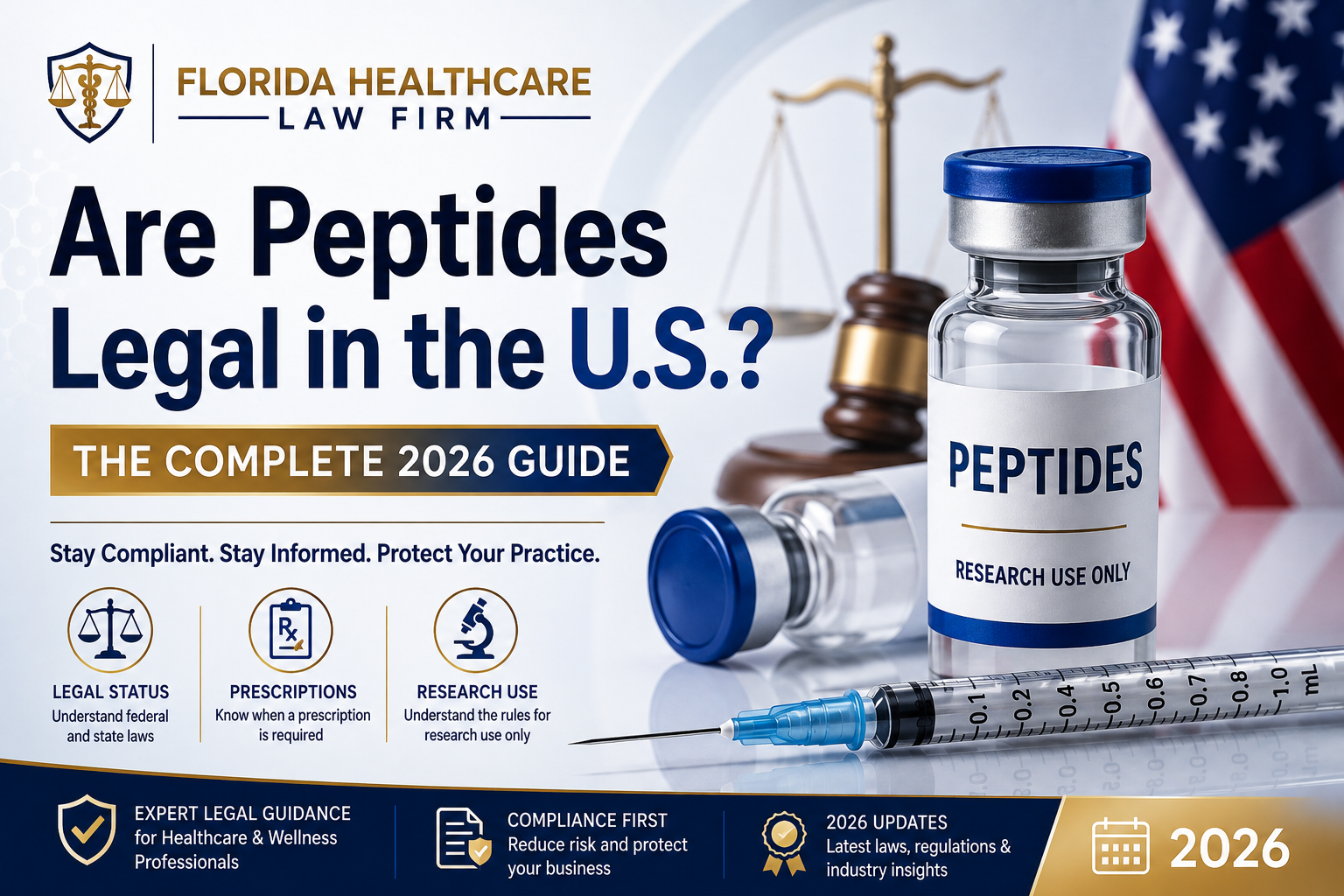
Are Peptides Legal in the U.S.? The Complete 2026 Guide
Why Everyone's Asking This Right Now
Peptide therapy has exploded across wellness clinics, telehealth platforms, and social media — marketed for anti-aging, weight loss, muscle recovery, and tissue repair. At the same time, 2026 has been the most volatile year for peptide regulation in recent memory: the FDA restricted a batch of popular peptides, then reversed course, then opened a formal review process to decide their long-term fate. If you searched this question even six months ago, the answer has likely moved since.
This guide breaks down the legal categories that still apply, walks through what actually changed in 2026, and lays out practical guardrails for patients, providers, and businesses.
What Peptides Are, in Plain Terms
Peptides are short chains of amino acids that act as hormones, enzymes, and signaling molecules in the body. They're smaller and more targeted than full proteins, which is part of why they've become popular in biomedical research — but that same targeted, potent nature is exactly why regulators pay close attention to how they're made, sold, and used.
They generally fall into three buckets:
| Category | Examples | Typical Legal Status |
|---|---|---|
| Therapeutic peptides | Insulin, liraglutide, leuprolide, gonadorelin | Legal with a prescription — FDA-approved |
| Cosmetic peptides | Collagen-stimulating peptides in skincare | Legal as topical cosmetic ingredients |
| Performance/wellness peptides | BPC-157, TB-500, GHRPs, IGF-1 analogs | Mixed — ranges from restricted compounding to banned in sport to outright illegal for human use |
The Three Legal Categories
1. FDA-Approved Peptides
These have completed the FDA's full drug approval process — safety and efficacy trials, manufacturing review, the works. Insulin and liraglutide are the best-known examples. If a licensed provider prescribes one of these for its approved use, that's unambiguously legal.
2. Research-Only Peptides
Labeled "for research use only" (RUO) or "not for human consumption," these can legally be sold to labs — but not to individuals for personal use. This is where most of the gray-market activity happens: vendors sell RUO peptides online in ways that clearly anticipate personal use while disclaiming it in the fine print. Buying or using them on yourself is a violation regardless of the label on the vial.
3. Controlled, Restricted, or Banned Peptides
The DEA can classify certain peptides as controlled substances based on abuse potential. Separately, the World Anti-Doping Agency bans performance-enhancing peptides like growth hormone-releasing peptides (GHRPs) and IGF-1 analogs from competitive sports — a restriction that exists independent of federal drug law.
The 2026 Compounding Timeline: What Actually Happened
This is the part of the story that's changed the most, and the sequence matters:
Early 2025 — The FDA tightened enforcement of its bulk drug substances policy, moving a group of widely-used compounded peptides — including BPC-157, TB-500, KPV, and MOTS-C — onto a restricted "Category 2" list. Patients who had been getting these through compounding pharmacies under physician supervision suddenly lost access.
February 27, 2026 — HHS Secretary Robert F. Kennedy Jr. announced that roughly 14 of the 19 restricted peptides were expected to move back to legal compounding status, after the parties who originally petitioned for the restriction withdrew their nominations.
April 15–23, 2026 — The FDA formalized the reversal, officially removing the affected peptides from the Category 2 restricted list effective April 23. Licensed compounding pharmacies could once again prepare them for patients with valid prescriptions and physician oversight.
July 23–24, 2026 — The FDA's Pharmacy Compounding Advisory Committee convened to formally evaluate whether several of these peptides — BPC-157, KPV, TB-500, MOTS-C, Emideltide (DSIP), Semax, and Epitalon — should be added to the official 503A Bulks List, which would give them a more durable, defined legal pathway for compounding going forward.
Before February 2027 — A second committee meeting is scheduled to review five more nominated peptides, including candidates like GHK-Cu, LL-37, Dihexa, and Melanotan II.
The key distinction to hold onto: coming off a restricted list, being reviewed for the 503A Bulks List, and receiving full FDA drug approval are three completely different legal states. A peptide can be legally compoundable today without ever having gone through a clinical trial. Treat any claim that a peptide is "now FDA-approved" with real skepticism unless it names the specific approval.
FDA Enforcement Beyond Compounding
Any peptide marketed as a treatment — whether sold by a compounding pharmacy, a wellness clinic, or an online retailer — needs to go through the New Drug Application or Biologics License Application process to be legally marketed as such. Peptides sold as treatments without that approval are considered misbranded or adulterated under the Federal Food, Drug, and Cosmetic Act, and the FDA has continued to issue warning letters against sellers making unsubstantiated medical claims. Practices considering a peptide program should build regulatory compliance into the plan from day one, not after an inquiry letter arrives.
Compounding Pharmacies: A Narrower Path Than People Assume
Compounding pharmacies can legally prepare customized medications for individual patients — but only for substances that are properly authorized, typically by inclusion on the FDA's 503A Bulks List or under a specific exemption. Even with 2026's reversals, every compounded peptide prescription still has to comply fully with Section 503A or 503B of the FD&C Act. Given how frequently this list has moved this year, pharmacies and prescribers relying on outdated information are taking on real risk. Firms with dedicated pharmacy law experience can track these shifts in real time — which a static article, however current, eventually can't.
The Supplement Industry Problem
Synthetic peptides generally don't qualify as "dietary ingredients" under the Dietary Supplement Health and Education Act unless they occur naturally in food. That means peptide products marketed as supplements — especially with muscle-building, fat-loss, or anti-aging claims — are frequently operating outside the law and subject to seizure or recall. If a peptide product is available with no prescription, no compounding pharmacy, and no clinical oversight anywhere in the chain, that's a signal to be cautious, not reassured.
How Other Countries Regulate Peptides
- Australia treats peptides as prescription-only medicines through the Therapeutic Goods Administration.
- Canada restricts peptide sales for human use unless approved for a specific therapeutic purpose.
- The UK and EU regulate peptides through the MHRA and EMA frameworks, respectively.
Every major regulator lands in the same place: legitimate peptide use requires clinical evidence and formal approval — not just the ability to buy the product.
What's Actually at Risk
- Patients face real safety exposure from illegally sourced peptides — contamination, incorrect dosing, or products that don't contain what the label claims.
- Providers who prescribe or recommend unapproved peptides, including through telemedicine and telehealth platforms, risk licensing board discipline and malpractice exposure.
- Businesses distributing unapproved peptides face fines, product seizure, and potential criminal liability under federal drug law.
- Athletes using WADA-banned peptides risk suspension or disqualification, regardless of the peptide's federal legal status.
Practical Checklist for 2026
- Verify current status before acting. The compounding list has moved multiple times this year — don't rely on information from more than a few months ago.
- Separate "compoundable" from "FDA-approved." They are not the same legal status, and conflating them is one of the most common mistakes in this space.
- Never use "research use only" peptides on yourself. The label isn't a technicality — it's a legal line.
- Source through licensed providers and 503A/503B-compliant pharmacies only. General online retailers are not a safe substitute.
- Watch the FDA's Pharmacy Compounding Advisory Committee calendar. Meetings through February 2027 will continue to reshape this landscape.
Frequently Asked Questions
Can doctors legally prescribe peptides in the U.S.? Yes, for FDA-approved peptides used for their approved conditions. Prescribing compounded peptides outside current 503A/503B rules, or peptides that remain unapproved, can violate FDA regulations and medical board standards.
Are peptides considered controlled substances? Not universally. Some, particularly those with anabolic or performance-enhancing effects, are regulated by the DEA and separately banned by organizations like WADA in competitive sports.
Can I legally buy peptides online? Only if they're FDA-approved or currently compoundable under 503A/503B rules, and dispensed by a licensed pharmacy with a valid prescription. Anything labeled "not for human use" is not legal for personal consumption, no matter how it's marketed.
Does the 2026 rollback mean peptides like BPC-157 are now FDA-approved? No. Coming off the restricted list makes certain peptides eligible for compounding again under physician supervision — it says nothing about whether they've completed clinical trials or received drug approval.
What happens if someone uses unapproved peptides? Potential health risks from unverified sourcing, legal exposure for both buyer and seller, and possible consequences for athletes or workers in regulated professions.
Talk to a Healthcare Attorney Before You Act
Peptide law has changed direction multiple times in 2026 alone, and the cost of guessing wrong — warning letters, licensing complaints, product seizures — is high. Whether you're a wellness clinic weighing a peptide program, a compounding pharmacy tracking 503A eligibility, or a provider trying to keep prescribing practices current, get advice before you launch, sign a supplier agreement, or respond to a regulatory inquiry.
Schedule a free consultation with the Florida Healthcare Law Firm to get clear, current guidance for your practice or business.
- Digital Agency
- Literie
- Location de voitures
- Restaurant
- Restaurant
- Mode
- Mode
- Information
- Marketing
- Tourisme
- Développement
- Découverte
- Législation
- Gastronomie
- Pâtisserie
- Evento
- Art
- Causes
- Crafts
- Dance
- Drinks
- Film
- Fitness
- Food
- Giochi
- Gardening
- Health
- Home
- Literature
- Music
- Networking
- Altre informazioni
- Party
- Religion
- Shopping
- Sports
- Theater
- Wellness
 Italiano
 Indian
 English
 French
 Arabic
 Spanish
 Portuguese
 Deutsch
 Turkish
 Dutch
Dutch
 Russian
 Romaian
 Portuguese (Brazil)
 Greek
Greek
