


Why Voltage Stability Matters More Than You Think: Understanding Servo Voltage Stabilizers
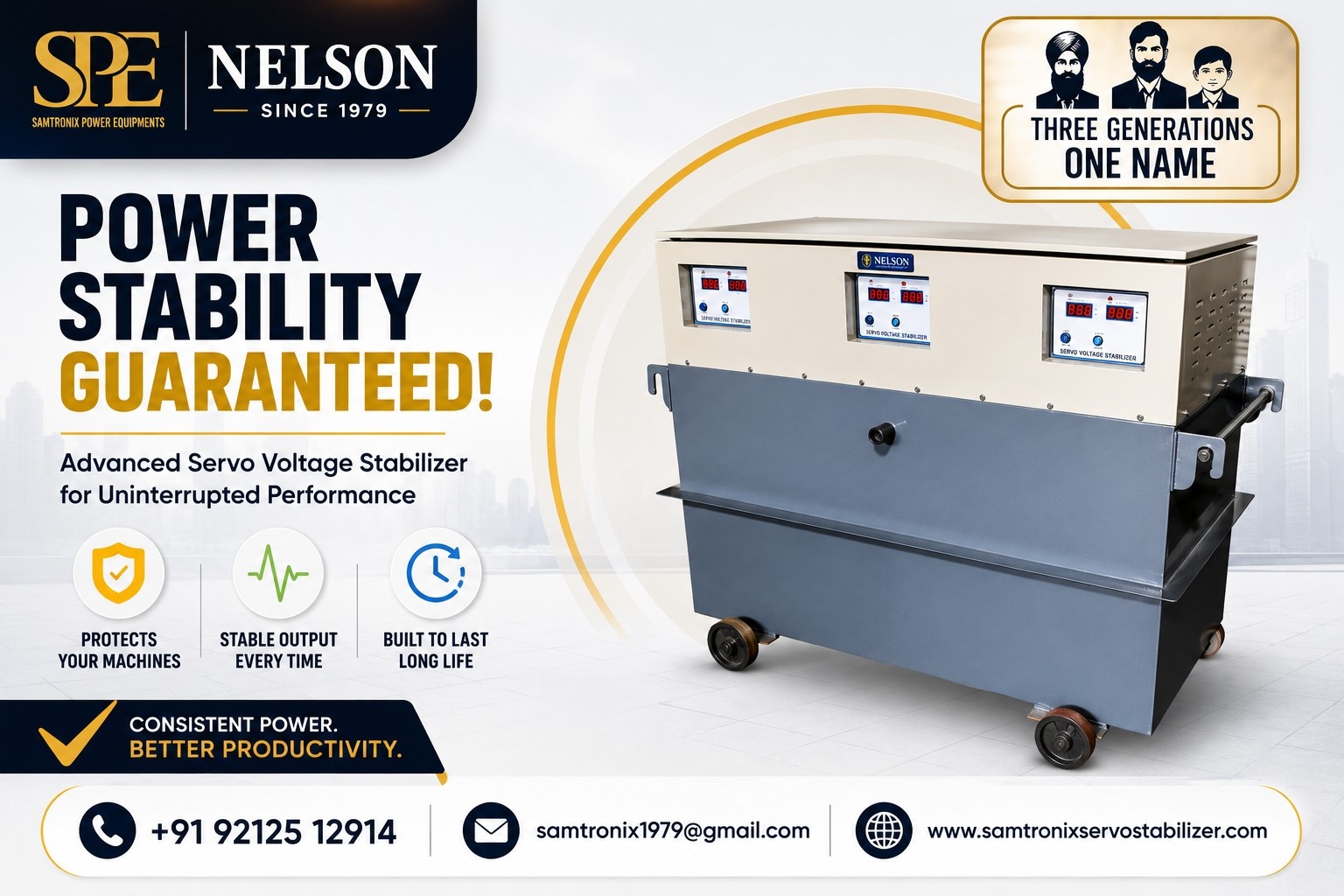
In many businesses, electrical power is treated as something that is simply “there.” Machines are switched on, production begins, and everyone expects the electricity supply to remain stable throughout the day. But in reality, voltage fluctuations are common in many industrial and commercial areas. A sudden rise or drop in voltage may seem harmless at first, yet repeated fluctuations can slowly affect machines, production quality, energy consumption and maintenance costs.
This is where a servo voltage stabilizer becomes an important part of an electrical system. Its purpose is not to create electricity or increase the available power. Instead, it helps maintain a more consistent voltage level for connected equipment, allowing machines to operate under more stable electrical conditions.
The Hidden Cost of Unstable Voltage
Imagine a manufacturing unit running several machines for eight or ten hours every day. If the incoming voltage frequently changes, motors may draw irregular current, control systems may behave unexpectedly and sensitive electronic components can experience unnecessary stress.
The problem is that these costs are not always visible immediately.
A machine may continue working even when the voltage is not ideal. However, over time, repeated electrical stress can contribute to component failures, overheating, unexpected shutdowns and shorter equipment life. Every unplanned stoppage can mean lost production time, delayed orders and additional repair expenses.
This is why voltage stability should be viewed as a long-term business consideration rather than simply an electrical requirement.
How a Servo Voltage Stabilizer Works
A servo voltage stabilizer continuously monitors the incoming voltage. When it detects a variation, its control mechanism adjusts the output so that the connected equipment receives voltage closer to the required level.
The basic concept is fairly simple.
If the input voltage falls below the desired level, the stabilizer compensates for the drop. If the input voltage rises, it works in the opposite direction to bring the output back toward the set range.
This automatic correction happens while the equipment is operating, making the stabilizer useful for applications where shutting down machinery every time the supply changes is not practical.
Modern servo stabilizers can also include digital monitoring systems that display input and output voltage, making it easier for operators to understand what is happening with the electrical supply.
Where Does the Investment Actually Pay Off?
The financial benefit of a stabilizer is rarely about the stabilizer itself. The real value comes from reducing the consequences of unstable voltage.
Consider a machine that costs several lakh rupees. If a voltage-related problem damages an important control board or motor, the repair bill may be significant. More importantly, the machine may remain unavailable while the problem is diagnosed and repaired.
Now consider production losses.
If a machine produces ₹20,000 worth of output per hour and remains stopped for five hours because of an electrical issue, the indirect loss can become much larger than the cost of a single component replacement.
A stabilizer cannot eliminate every possible electrical problem, but maintaining a more controlled voltage supply can reduce one important source of risk.
That is where the investment starts making practical sense.
Better Protection Can Mean Longer Equipment Life
Industrial machines often contain a combination of motors, contactors, sensors, PLCs, drives, controllers and electronic components. Different components can react differently to voltage variations.
Sensitive electronics may be particularly vulnerable to abnormal voltage conditions, while motors can experience heating and inefficient operation when electrical conditions are unsuitable.
Stable voltage does not magically make equipment last forever. However, operating machines within their recommended electrical conditions can help reduce unnecessary electrical stress.
Over several years, even a modest improvement in equipment reliability can have a meaningful financial impact.
Production Continuity Is Another Important Factor
For many businesses, downtime is more expensive than the repair itself.
A damaged component might cost ₹10,000 to replace. But if replacing it takes an entire working day, the business could lose considerably more through idle workers, delayed production and missed delivery schedules.
This is especially important in industries where machines are expected to run continuously or where production schedules are tightly planned.
A stable power supply can therefore contribute indirectly to productivity. The goal is not simply to keep the voltage number within a particular range; it is to create a more dependable electrical environment for the machines connected to the system.
Choosing the Right Stabilizer Is Important
A stabilizer should not be selected only by looking at its KVA rating.
The actual load, type of equipment, starting current, input-voltage range, number of phases and operating conditions all matter.
For example, a motor-driven machine can behave differently from a system dominated by electronic equipment. Similarly, a factory with frequent voltage fluctuations may require a different configuration from an office with relatively stable power.
Oil-cooled servo stabilizers are commonly considered for higher-capacity industrial applications because their design is suitable for handling substantial electrical loads and continuous operation.
The correct sizing should ideally be determined after understanding the connected load and actual electrical conditions at the site.
A Practical Way to Think About the Investment
Instead of asking, “How much does a stabilizer cost?” a business can ask a more useful question:
“How much could unstable voltage cost us over the next few years?”
Look at equipment repair expenses, unexpected downtime, damaged components, production interruptions and maintenance requirements.
Then consider how much of that risk could reasonably be reduced by improving voltage stability.
This approach gives a much clearer picture of the financial value of the investment.
For a small operation with minimal voltage fluctuation, the calculation may not justify a large system. But for a manufacturing facility running expensive equipment for long hours, even a few avoided breakdowns can make a substantial difference.
Final Thoughts
Electrical stability is one of those things businesses often notice only when it goes wrong. A machine stops, production slows down, an electronic component fails and suddenly everyone starts looking for the reason.
A servo voltage stabilizer is not a substitute for proper electrical design, maintenance, earthing, protection systems or a reliable power source. Instead, it works as one part of a broader electrical protection strategy.
When selected correctly and matched to the actual load, it can help create a more stable operating environment, reduce unnecessary electrical stress and protect the productivity of equipment over the long term.
The real return from such an investment is not simply visible on the stabilizer itself. It can appear gradually through fewer interruptions, lower maintenance pressure, better equipment reliability and more consistent production.
In a business where every productive hour matters, stable power is not just an electrical advantage. It can become a practical part of controlling operating costs.
Frequently Asked Questions
1. What is a servo voltage stabilizer?
A servo voltage stabilizer is an automatic voltage-regulating device that monitors incoming voltage and adjusts the output to maintain a more stable supply for connected equipment.
2. Why do industries need voltage stabilization?
Industrial equipment can be affected by frequent voltage fluctuations. Stabilization helps provide more consistent electrical conditions, potentially reducing electrical stress, interruptions and voltage-related equipment problems.
3. Does a servo stabilizer reduce electricity consumption?
A stabilizer is not primarily an electricity-saving device. Its main purpose is voltage regulation and equipment protection. Any improvement in efficiency depends on the equipment, electrical conditions and overall system design.
4. Can a stabilizer protect machines from every electrical problem?
No. A voltage stabilizer mainly addresses voltage variation. Other issues such as short circuits, overloads, poor earthing, harmonics and lightning require appropriate protection systems.
5. How do I select the correct KVA rating?
The required KVA depends on the connected load, equipment type, starting current, phase configuration and operating conditions. Proper load assessment should be carried out before selecting the capacity.
6. What is an oil-cooled servo voltage stabilizer?
An oil-cooled servo stabilizer uses insulating oil as part of its cooling and electrical insulation system. Such designs are commonly used for higher-capacity and industrial applications.
7. Is a servo voltage stabilizer a worthwhile investment?
It can be, particularly for businesses operating expensive machinery or experiencing frequent voltage fluctuations. The financial value should be assessed by considering potential downtime, repair costs, equipment reliability and production losses over time.
- Digital Agency
- Literie
- Location de voitures
- Restaurant
- Restaurant
- Mode
- Mode
- Information
- Marketing
- Tourisme
- Développement
- Découverte
- Législation
- Gastronomie
- Pâtisserie
- Evento
- Art
- Causes
- Crafts
- Dance
- Drinks
- Film
- Fitness
- Food
- Giochi
- Gardening
- Health
- Home
- Literature
- Music
- Networking
- Altre informazioni
- Party
- Religion
- Shopping
- Sports
- Theater
- Wellness
 Italiano
 Indian
 English
 French
 Arabic
 Spanish
 Portuguese
 Deutsch
 Turkish
 Dutch
Dutch
 Russian
 Romaian
 Portuguese (Brazil)
 Greek
Greek
