


Single-Phase Servo Voltage Stabilizer: How It Works and Why Stable Voltage Matters
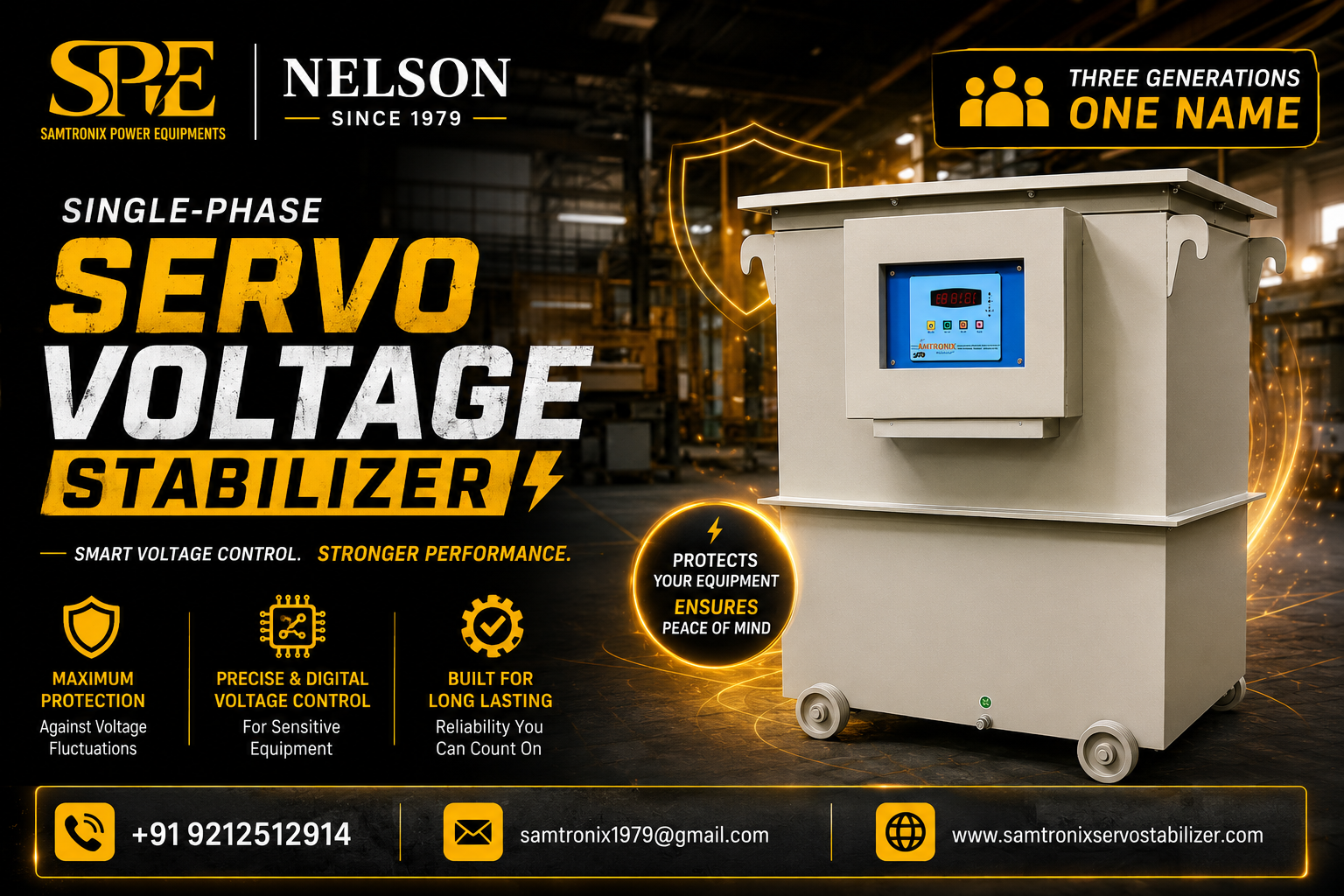
Electricity is expected to be reliable, but the voltage reaching our homes, offices, workshops and businesses is not always perfectly constant.
During the day, electrical demand keeps changing. Machines start and stop, motors switch on, production loads increase, and the local power network experiences different levels of demand. Because of these conditions, the incoming voltage can sometimes move above or below the desired level.
For ordinary equipment, a small variation may not create an obvious problem. But for equipment that depends on a controlled electrical supply, repeated voltage changes can become a concern.
This is where a single-phase servo voltage stabilizer comes into the picture.
A servo stabilizer is designed to continuously monitor the incoming voltage and automatically correct variations. It doesn't generate electricity and it isn't a backup power source. Its main job is much more specific: voltage regulation.
Let's understand how it works, where it can be used, how to select the right capacity, and what should be considered before installing one.
What Is a Single-Phase Servo Voltage Stabilizer?
A single-phase servo voltage stabilizer is an automatic voltage correction system used with single-phase electrical loads.
Its purpose is to maintain the output voltage closer to a preset value, even when the incoming supply changes within the stabilizer's specified operating range.
For example, suppose the required output is around a particular voltage level but the incoming supply falls significantly below it.
The stabilizer senses the change.
The control circuit calculates the required correction.
The servo mechanism then adjusts the voltage.
If the incoming voltage later rises, the system makes the necessary correction in the opposite direction.
This process happens automatically.
A typical servo stabilizer can contain:
-
Voltage sensing circuits
-
Control electronics
-
Servo motor
-
Voltage correction mechanism
-
Transformer or autotransformer
-
Protective components
-
Display or monitoring system, depending on the design
Different manufacturers may use different designs and components, so specifications should always be checked for the particular model.
Why Does the Voltage Change?
One of the first things to understand is that voltage variation can have several causes.
Electricity consumption is not constant throughout the day.
For example, imagine a commercial or industrial area during a busy period. Several machines may be operating at the same time. Motors, pumps, compressors and other equipment can create changing electrical demand.
When the load on the distribution system changes, the voltage available to connected users can also change.
Other possible factors include:
-
Long electrical distribution lines
-
Heavy local loads
-
Transformer loading
-
Uneven load distribution
-
Changes in utility supply
-
Starting of large motors
-
Local network conditions
The amount of variation is different for every location.
That is why saying “my voltage fluctuates” isn't enough information to select a stabilizer.
It is better to measure the actual voltage and understand what is happening.
What Exactly Is Voltage Fluctuation?
Voltage fluctuation simply means that the electrical voltage is changing instead of remaining at a relatively stable level.
Suppose equipment is designed to operate around a particular nominal voltage.
If the supply repeatedly moves significantly below or above that level, the equipment may experience an unsuitable operating condition.
The important words here are repeatedly and significantly.
Not every small voltage change is dangerous.
Electrical equipment is generally designed with an acceptable operating range.
The problem arises when the actual supply regularly moves outside the range the equipment can comfortably handle.
This is why voltage measurement is important before deciding whether a stabilizer is necessary.
How Can Unstable Voltage Affect Equipment?
Different equipment responds differently to voltage changes.
Some devices may continue operating normally.
Others may show noticeable problems.
Depending on the equipment and severity of the fluctuation, possible effects include:
-
Unexpected shutdowns
-
Electronic errors
-
Equipment restarting
-
Motor performance problems
-
Increased heating
-
Unstable operation
-
Production interruptions
-
Additional maintenance requirements
Sensitive electronic equipment can be particularly dependent on maintaining a suitable supply.
Motors also deserve attention because their electrical behaviour changes during starting and operation.
However, it is important not to blame voltage for every equipment failure.
A machine may stop because of mechanical wear, overheating, control-system faults, poor maintenance or another electrical issue unrelated to supply voltage.
Good troubleshooting starts with measurement rather than assumption.
Low Voltage Can Be Just as Important as High Voltage
When people talk about stabilizers, they often focus on high voltage.
But low voltage can also create problems.
For some motors, an unsuitable low-voltage condition can affect starting and operating performance. Depending on the motor and load, the electrical stress and heating can also change.
Electronic equipment may similarly become unstable if its supply falls outside its specified range.
A voltage stabilizer is therefore not simply designed to reduce voltage.
It is designed to regulate voltage in both directions, according to its input range and correction capability.
This is an important difference.
The goal isn't:
“Make the voltage higher.”
The goal is:
“Keep the voltage within a suitable controlled range.”
How Does a Servo Stabilizer Work?
The working process can be explained in a simple sequence.
1. It senses the input voltage
The stabilizer continuously monitors the incoming supply.
2. It compares the voltage
The control circuit compares the measured voltage with the desired output.
3. It identifies the difference
If there is a significant difference between the actual and required voltage, the controller determines that correction is needed.
4. The servo motor operates
The control circuit commands the servo motor to move the voltage correction mechanism.
5. The output changes
The mechanism adjusts the electrical output toward the desired level.
6. The system checks again
The stabilizer continues monitoring the supply and makes further corrections whenever required.
So, in very simple terms:
Measure → Compare → Adjust → Check Again
The process is automatic and continuous.
Why Is the Servo Motor Important?
The servo motor is responsible for moving the correction mechanism in response to the control system.
When the controller detects a voltage difference, the servo motor moves in the required direction.
The amount and speed of movement depend on the stabilizer's design.
This motor-controlled arrangement allows the system to make more controlled voltage adjustments than a simple manual system.
The exact technology can vary between manufacturers, so two servo stabilizers with similar capacities may not necessarily have identical internal designs or performance characteristics.
That is why technical specifications matter.
What Is the Role of the Control Circuit?
The control circuit acts like the decision-making part of the stabilizer.
It receives information from the voltage sensing system.
It determines whether the input is:
-
Too low
-
Too high
-
Or close to the desired level
If correction is needed, it controls the servo mechanism.
Modern stabilizers may also include electronic protection and monitoring features.
Depending on the design, these can include:
-
Overvoltage protection
-
Undervoltage protection
-
Overload protection
-
Time delay
-
Digital voltage display
-
Fault indication
-
High/low voltage cut-off
Not every model will have all of these features, so the specification sheet should always be checked.
Where Are Single-Phase Servo Stabilizers Used?
The applications are quite broad.
1. Offices
Offices depend on computers, printers, routers, communication systems and other electronic equipment.
Where voltage variations are frequent, regulation can be considered as part of the electrical setup.
2. Retail Shops
Shops may operate billing systems, computers, refrigeration equipment and other electrical devices for long periods.
Voltage stability can become useful when the local supply regularly fluctuates.
3. Workshops
Small workshops may operate motors, machines, tools and electronic controls.
The stabilizer capacity should be selected based on the actual load rather than simply the number of machines.
4. Clinics and Laboratories
Electronic instruments often have specific voltage requirements.
Whether a stabilizer is appropriate depends on the equipment manufacturer's requirements and the site's actual voltage conditions.
5. Residential Applications
Homes can also experience voltage variation.
A single-phase stabilizer may be considered for selected appliances or electrical systems when significant fluctuations are confirmed.
It is not necessary for every household simply because electrical appliances are present.
How Is the Right Stabilizer Capacity Selected?
This is one of the most important parts of the selection process.
The capacity of a stabilizer is commonly expressed in VA or kVA.
But selecting a capacity isn't simply a matter of adding the nameplate wattage of every device and buying the nearest number.
The type of load matters.
Resistive loads
These include certain heaters and lighting loads.
Inductive loads
Motors, pumps and compressors can have higher starting current.
Electronic loads
Computers, control systems and other electronics may have specific power-quality requirements.
The following should therefore be considered:
-
Total connected load
-
Actual running load
-
Starting current
-
Input voltage range
-
Output voltage requirement
-
Power factor
-
Duty cycle
-
Future load expansion
For larger installations, professional load calculation is advisable.
Why Motor Loads Need Extra Attention
Motors are slightly tricky.
A motor doesn't necessarily draw the same current during startup as it does while running normally.
The starting current can be substantially higher.
This means a stabilizer that appears adequate based only on normal running current may not necessarily be suitable for the starting condition.
This is especially relevant for:
-
Pumps
-
Compressors
-
Air-conditioning systems
-
Workshop machinery
-
Motor-driven equipment
Therefore, motor starting requirements should be considered when calculating stabilizer capacity.
It is one of those small details that can become a very big detail later.
Why Should Voltage Be Measured Before Installation?
This is probably one of the most practical recommendations.
Before purchasing a stabilizer, measure the incoming voltage.
Ideally, measurements should be taken at different times and under different load conditions.
For example:
-
Early morning
-
Peak working hours
-
Evening
-
During heavy machine operation
-
During motor starting
The objective is to understand the actual minimum and maximum voltage.
This information helps determine the required input range of the stabilizer.
It also answers an important question:
Is the voltage fluctuation actually large enough to require regulation?
Sometimes the answer may be yes.
Sometimes it may not.
Either way, measurement gives you a much better starting point.
What Is Input Voltage Range?
Input voltage range describes the range of voltage that the stabilizer can accept while providing its specified correction.
For example, a particular model may be designed for a certain minimum and maximum input voltage.
The exact figures vary from model to model.
This specification is extremely important.
Suppose the actual supply regularly falls below the stabilizer's specified input range.
Then simply buying that stabilizer won't necessarily solve the problem.
The selected unit needs to be suitable for the real electrical conditions at the site.
What Is Output Voltage?
Output voltage is the voltage delivered by the stabilizer to the connected equipment.
The required output should be compatible with the equipment being supplied.
The stabilizer's accuracy specification indicates how closely the output is maintained around the target value under its defined operating conditions.
Different applications may require different levels of voltage regulation.
Sensitive equipment may have tighter requirements than ordinary electrical loads.
Again, the equipment manufacturer's specifications should be checked.
Does a Servo Stabilizer Save Electricity?
This question is often misunderstood.
A servo stabilizer's main purpose is not to reduce electricity consumption.
Its primary function is voltage regulation.
It would therefore be misleading to assume that installing any stabilizer will automatically reduce the electricity bill.
The actual energy effect depends on factors such as:
-
Load type
-
Equipment efficiency
-
Input conditions
-
Stabilizer efficiency
-
Operating hours
-
Overall electrical system design
A properly designed system may help equipment operate under more suitable voltage conditions, but guaranteed energy savings should not be assumed without an actual assessment.
Servo Stabilizer vs UPS
These two devices solve different problems.
Servo Voltage Stabilizer
Main purpose:
Voltage regulation
It helps compensate for variations in the incoming voltage.
UPS
Main purpose:
Power backup
It provides temporary power when the main electricity supply fails.
Some UPS systems also provide voltage regulation, but backup power remains their key function.
Therefore, if the problem is:
“The electricity is available but the voltage keeps changing,”
a voltage stabilizer may be relevant.
If the problem is:
“The electricity keeps going off,”
a UPS or other backup system may be more appropriate.
In some applications, both can be used.
What About Maintenance?
Servo stabilizers contain both electrical and mechanical components.
Routine maintenance can help keep the equipment operating properly.
Depending on the manufacturer's recommendations, maintenance may involve:
-
Cleaning dust
-
Checking electrical terminals
-
Inspecting wiring
-
Checking the servo motor
-
Examining the correction mechanism
-
Looking for overheating
-
Checking protective components
-
Inspecting unusual noise or vibration
The operating environment matters.
A stabilizer installed in a clean indoor office will generally face different conditions from one working continuously in a dusty industrial area.
Maintenance schedules should therefore be based on the manufacturer's instructions and actual operating conditions.
Installation Considerations
Correct installation is just as important as selecting the correct equipment.
The installation location should ideally have:
-
Adequate ventilation
-
Protection from moisture
-
Limited dust exposure
-
Sufficient maintenance space
-
Proper cable routing
-
Correct earthing
-
Suitable cable size
The stabilizer should be installed according to the manufacturer's instructions and applicable electrical standards.
A qualified electrician or electrical professional should handle installations where the load or system complexity requires it.
Common Mistakes People Make
A few mistakes are worth avoiding.
Buying the largest available stabilizer
Bigger does not automatically mean more suitable.
Ignoring the input range
If the actual voltage goes beyond the stabilizer's specified range, the unit may not provide the expected correction.
Forgetting motor starting current
This can lead to incorrect capacity selection.
Not measuring the supply
Without actual measurements, selection becomes guesswork.
Assuming every equipment problem is voltage-related
Voltage is only one possible cause.
Ignoring installation conditions
Dust, heat, moisture and poor ventilation can affect electrical equipment.
Samtronix Power Equipments and Voltage Management
Samtronix Power Equipments works in the area of power equipment and voltage stabilizing solutions for different electrical requirements.
But an informative approach to voltage stabilization should always begin with the application, not the product.
Before deciding on a stabilizer, it is useful to understand:
-
What voltage is available?
-
What is the minimum voltage?
-
What is the maximum voltage?
-
What is the connected load?
-
Are there motors?
-
What is the starting requirement?
-
What output voltage is required?
-
How long will the equipment operate?
-
What are the site conditions?
These details help create a more accurate picture of the actual electrical requirement.
The same stabilizer cannot automatically be considered suitable for every application.
Power requirements differ from site to site.
How Can Businesses Benefit From Better Voltage Regulation?
The benefit of voltage regulation is mainly about operational consistency.
If equipment is experiencing interruptions because of voltage variation, regulating the supply may help reduce that particular source of disruption.
This can be especially relevant where equipment is:
-
Operating continuously
-
Sensitive to supply variation
-
Expensive to repair
-
Important to production
-
Difficult to restart
-
Connected to automated control systems
However, voltage regulation should be considered as one part of a complete electrical strategy.
Proper earthing, protection devices, wiring, maintenance and equipment-specific safeguards remain important.
Final Thoughts
A single-phase servo voltage stabilizer is not simply a device that makes voltage "stronger."
Its purpose is more specific.
It monitors voltage and automatically corrects variations within its designed operating range.
For applications where the incoming supply frequently moves outside the recommended operating range of connected equipment, this type of regulation can provide a more controlled electrical environment.
But the right stabilizer depends on the actual application.
Before selecting one, check the voltage, calculate the load, consider starting current, understand the equipment requirements and examine the installation conditions.
Samtronix Power Equipments operates in the power equipment and voltage stabilization space, where these factors are important when evaluating voltage regulation requirements.
The most useful approach is not to ask:
“Which stabilizer is biggest?”
Instead, ask:
“What is happening to my voltage, what equipment am I protecting, and what does that equipment actually require?”
That question leads to a much better technical decision.
Frequently Asked Questions
1. What is a servo voltage stabilizer?
A servo voltage stabilizer is an automatic voltage regulation system that corrects changes in incoming voltage and provides a more controlled output.
2. What does single-phase mean?
Single-phase refers to the type of electrical supply the stabilizer is designed to regulate. It is commonly used for residential and many smaller commercial applications.
3. Can a servo stabilizer correct low voltage?
Yes, provided the low voltage remains within the stabilizer's specified input and correction range.
4. Can it handle high voltage?
Yes, a properly specified servo stabilizer can compensate for high input voltage within its rated operating range.
5. How is stabilizer capacity calculated?
Capacity is selected based on the connected load, equipment characteristics, starting current, power factor and expected operating conditions.
6. Does a servo stabilizer provide power during an outage?
No. A standard servo stabilizer regulates voltage but does not normally provide backup power. A UPS is designed for power backup.
7. Can a stabilizer replace an electrical protection system?
No. Stabilization is only one part of power management. Proper earthing, breakers, overload protection, wiring and other required safety measures are still necessary.
- Digital Agency
- Literie
- Location de voitures
- Restaurant
- Restaurant
- Mode
- Mode
- Information
- Marketing
- Tourisme
- Développement
- Découverte
- Législation
- Gastronomie
- Pâtisserie
- Eveniment
- Art
- Causes
- Crafts
- Dance
- Drinks
- Film
- Fitness
- Food
- Jocuri
- Gardening
- Health
- Acasă
- Literature
- Music
- Networking
- Alte
- Party
- Religion
- Shopping
- Sports
- Theater
- Wellness
 Romaian
 Indian
 English
 French
 Arabic
 Spanish
 Portuguese
 Deutsch
 Turkish
 Dutch
Dutch
 Italiano
 Russian
 Portuguese (Brazil)
 Greek
Greek
