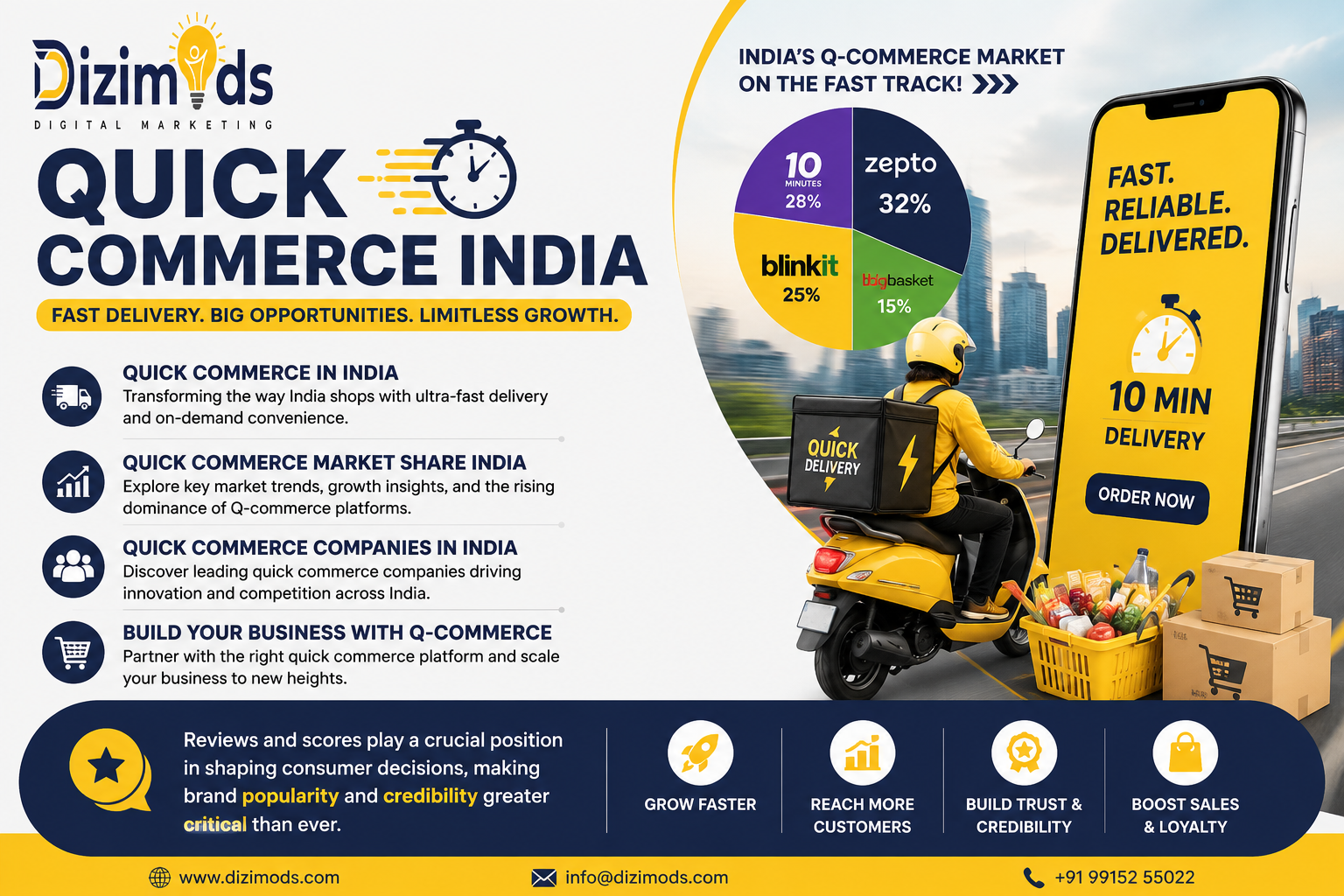
Quick Commerce in India has transformed the way consumers shop for everyday essentials. Unlike traditional eCommerce, where deliveries may take one or more days, quick commerce (Q-commerce) focuses on delivering products within 10 to 30 minutes. The growing demand for convenience, widespread smartphone usage, digital payments, and improved logistics has made India one of the fastest-growing quick commerce markets in the world.
From groceries and medicines to personal care products, electronics, and daily essentials, quick commerce platforms are redefining customer expectations by offering ultra-fast delivery and a seamless shopping experience. For businesses, this presents an excellent opportunity to reach customers quickly, increase sales, and expand into new markets.
What Is Quick Commerce?
Quick commerce is a modern form of eCommerce that focuses on delivering products within minutes rather than days. It relies on strategically located dark stores, local warehouses, advanced inventory management, and efficient last-mile delivery networks.
Unlike traditional online shopping, quick commerce prioritizes speed and convenience. Customers can order essential products through mobile apps and receive them almost instantly.
Popular product categories include:
- Groceries
- Fresh fruits and vegetables
- Dairy products
- Snacks and beverages
- Personal care products
- Household essentials
- Baby care products
- Pet supplies
- Medicines
- Small electronics
Growth of Quick Commerce in India
India's quick commerce industry has experienced remarkable growth over the past few years. Increasing internet penetration, smartphone adoption, and changing consumer lifestyles have fueled demand for faster delivery services.
Major cities such as Delhi, Mumbai, Bengaluru, Hyderabad, Pune, Chennai, and Kolkata have become key markets for quick commerce platforms. Consumers increasingly prefer ordering daily essentials online instead of visiting physical stores, making quick commerce an essential part of urban living.
The industry continues to expand into Tier-2 and Tier-3 cities as logistics infrastructure improves and customer demand grows.
Why Quick Commerce Is Growing Rapidly
Several factors contribute to the rapid growth of quick commerce in India:
Changing Consumer Behavior
Modern consumers value speed and convenience. Busy lifestyles have increased demand for instant delivery of groceries and daily essentials.
Smartphone Penetration
Millions of Indians use smartphones for shopping, making quick commerce apps easily accessible to a large customer base.
Digital Payments
UPI, mobile wallets, and online banking have simplified online purchases, encouraging more consumers to shop through quick commerce platforms.
Improved Logistics
Advanced supply chain management, AI-powered inventory systems, and optimized delivery routes enable faster order fulfillment.
Urbanization
Rapid urban growth has increased demand for convenient shopping solutions, especially in metropolitan areas.
Benefits of Quick Commerce for Businesses
Businesses can leverage quick commerce platforms to increase their market reach and improve customer satisfaction.
Key advantages include:
- Faster product delivery
- Increased online visibility
- Higher customer satisfaction
- Improved repeat purchases
- Better inventory turnover
- Access to new customer segments
- Higher order frequency
- Increased revenue opportunities
- Competitive market advantage
- Stronger brand recognition
Quick commerce helps businesses serve customers more efficiently while enhancing the overall shopping experience.
Popular Quick Commerce Platforms in India
Several leading companies have established themselves in India's growing quick commerce sector.
Popular platforms include:
- Blinkit
- Zepto
- Swiggy Instamart
- BigBasket Now
- Flipkart Minutes
- Amazon Fresh (selected locations)
These companies continue expanding their delivery networks while introducing new services to meet rising customer expectations.
How Quick Commerce Works
The quick commerce process is designed for speed and efficiency.
Typical workflow includes:
- Customer places an order through the mobile app.
- The nearest dark store receives the order.
- Store staff quickly pick and pack the products.
- Delivery partners collect the order.
- GPS-optimized routes ensure rapid delivery.
- Customers receive products within 10–30 minutes.
Technology plays a critical role in minimizing delivery time while maintaining inventory accuracy.
Role of Technology
Technology powers every aspect of quick commerce.
Advanced tools include:
- Artificial Intelligence (AI)
- Machine Learning
- Demand forecasting
- Inventory management software
- Route optimization
- Real-time order tracking
- Data analytics
- Automated warehouse systems
These technologies improve operational efficiency while reducing delivery costs.
Business Opportunities in Quick Commerce
The rapid growth of quick commerce creates opportunities for businesses across multiple industries.
Manufacturers can:
- Reach new customers
- Increase product visibility
- Launch new products quickly
- Improve brand awareness
Retailers can:
- Expand online sales
- Reduce dependency on physical stores
- Improve customer retention
- Increase repeat purchases
Startups can leverage quick commerce to introduce innovative products and scale rapidly.
Challenges Facing Quick Commerce
Despite its rapid growth, the industry faces several challenges:
- High delivery costs
- Intense market competition
- Inventory management complexity
- Profitability concerns
- Logistics infrastructure
- Customer acquisition expenses
- Last-mile delivery efficiency
- Product availability
Successful companies address these challenges through technology, efficient operations, and strategic partnerships.
Future of Quick Commerce in India
The future of quick commerce in India looks promising. As consumer expectations continue evolving, businesses are expected to invest further in automation, artificial intelligence, and faster logistics.
Emerging trends include:
- Expansion into smaller cities
- AI-powered demand forecasting
- Hyperlocal delivery networks
- Sustainable packaging
- Electric delivery vehicles
- Drone delivery trials
- Personalized shopping experiences
- Improved customer loyalty programs
With increasing investments and technological advancements, quick commerce is expected to become an integral part of India's retail ecosystem.
Why Businesses Should Invest in Quick Commerce
Businesses that embrace quick commerce gain a competitive advantage by meeting modern customer expectations.
Benefits include:
- Faster order fulfillment
- Higher customer satisfaction
- Improved operational efficiency
- Increased online sales
- Better customer retention
- Stronger competitive positioning
Partnering with leading quick commerce platforms enables businesses to scale faster while reaching a broader audience.
Conclusion
Quick Commerce in India is revolutionizing the retail industry by offering consumers ultra-fast access to everyday essentials and transforming how businesses operate. Powered by advanced technology, efficient logistics, and growing digital adoption, quick commerce has become one of the fastest-growing sectors in the Indian eCommerce market. Businesses that integrate with quick commerce platforms can improve customer satisfaction, expand their reach, and drive long-term growth. As the industry continues to evolve, investing in quick commerce will be a strategic move for companies looking to stay competitive and meet the rising demand for speed, convenience, and exceptional customer experiences.



 Dutch
Dutch
 Indian
 English
 French
 Arabic
 Spanish
 Portuguese
 Deutsch
 Turkish
 Italiano
 Russian
 Romaian
 Portuguese (Brazil)
 Greek
Greek
