


How KOL Mapping Is Evolving with Data and AI Technologies
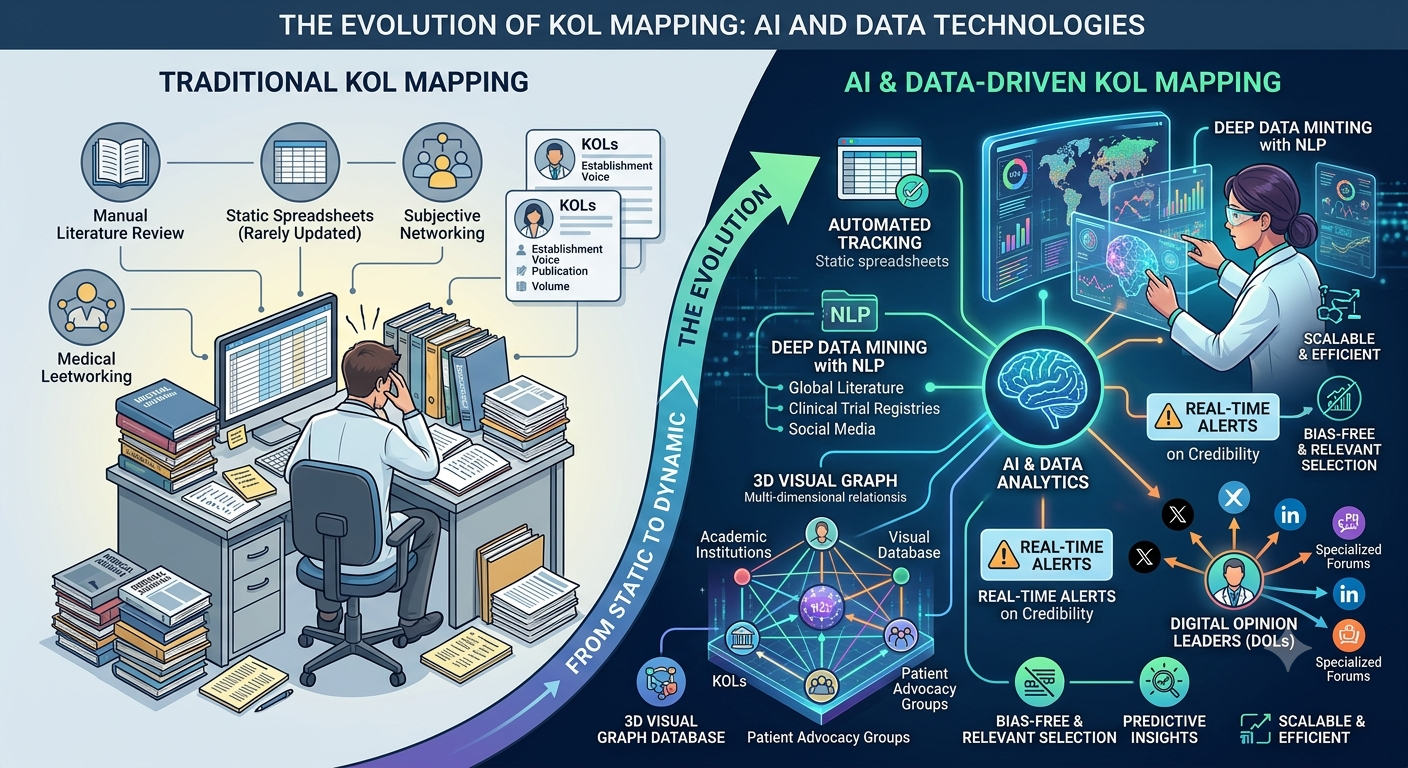
Key opinion leaders (KOLs) encourage industry peers to use new medical treatments. They also disseminate novel clinical research insights. As a result, KOLs are integral to shaping global healthcare policies. That also means that identifying the right KOLs is non-negotiable for pharmaceutical, biotechnology, and medical device companies. Doing so effectively ensures successful product launches even when markets seem somewhat unfavorable. This post will describe how KOL mapping has changed, and whether new AI and data technologies promise further advancements in this activity.
Executive Summary
-
Strategic Importance of KOLs: Integrating key opinion leaders into your content and thought leadership strategy helps sustain market penetration.
-
The AI and Data Shift: Rapid advancements in artificial intelligence and the explosion of healthcare data impact KOL mapping.
-
Evolution of KOL Mapping: It used to be static. However, most manual processes are more dynamic than ever. Thus, healthcare firms can be more strategic from a go-to-market (GTM) perspective.
The Limitations of Traditional KOL Mapping Approaches
Finding the right thought leaders had subjective elements. Besides, manual literature reviews used to be central. Existing industry relationships also had weightage. For example, medical affairs teams would go through medical journals. They had to attend conferences and network with guests on the lists. Finally, they would then use that data, build static spreadsheets, and rarely update them.
Therefore, the manual approach was restrictive. Overcoming related critical limitations basically means abandoning that time-consuming, past-based workflow with modern, automated, and regularly updated systems.
Yes, established, highly visible voices matter. However, as a result, companies often miss emerging leaders or localized influencers when they stop at fewer KOLs. AI-enhanced KOL analytics and identification allow for decreased human errors. Additionally, inherent biases no longer adversely impact KOL selection.
The Data & AI Revolution: Welcoming the New Ways to Shortlist KOLs
Fortunately, the healthcare and related domains stand to gain a lot from machine learning and AI-enhanced strategies. Today’s advanced KOL identification and mapping processes leverage algorithms that serve context-readiness, eliminate delays, and optimize reports.
Modernization now involves making sense of extensive unstructured datasets at unprecedented speeds and scale.
On the one hand, healthcare and pharmaceutical providers can leverage AI-powered natural language processing (NLP) tools. They will ingest millions of data points from global medical literature. From clinical trial registries to patent filings, new sources are available where NLP allows for mixed content interpretations. So, you can find KOLs that specialize in:
-
Treatment interventions and prescription guidelines
-
Healthcare-specific social media platforms
-
Patient rights and medical education
-
Public awareness of rare diseases
-
Digital/telemedicine innovations
-
Responsible clinical practices
Parallel Processing: AI and Human Collaborate for KOL Profile Discovery
-
First, by analyzing diverse sources without losing contextual insights, AI identifies hidden patterns.
-
Secondly, human analysts would validate the uncovered connections.
-
Next, AI helps simulate how partnering with a KOL would deliver marketing benefits and strengthen networking.
-
From publication volume to international and regional recognitions, multiple ways to assess a KOL’s legitimacy exist. With AI and healthcare data analytics, the process takes minutes instead of months.
-
If some KOLs lose their niche focus or industry peers develop negative perceptions of them due to controversies, healthcare teams will receive AI-powered alerts. Thus, you can dissociate with those KOLs whose credibility has taken a huge hit.
How AI and Data Solutions Unlock Dynamic Network Ecosystems
Linear ranking systems could be misleading. That is why healthcare IT & data services are embracing multi-dimensional network mapping. Their modern analytics tools create visual graph databases. Afterward, stakeholders can decode the complex web of relationships between healthcare professionals, academic institutions, and patient advocacy groups. Consequently, this network analysis reveals primary KOLs.
More importantly, it demonstrates influence flows that impact what the broader medical community considers valid. Additionally, the rise of AI facilitates the identification of digital opinion leaders (DOLs).
DOLs could lack an extensive traditional publication history. However, they possess a massive reach. Their influence across major platforms (X, LinkedIn, etc.) and specialized medical Q&A forums is impossible for you to ignore. Thus, tracking these real-time digital footprints with AI and customized KOL mapping workflows is highly beneficial.
It allows pharmaceutical companies to adapt their engagement strategies. That happens in less time but with greater care.
Conclusion
The healthcare industry, extending to pharmaceutical and medical device companies, must stop wasting resources on manual KOL identification. This era necessitates AI-assisted, data-backed, and omnichannel mapping precision when it comes to finding relevant KOLs and DOLs.
New KOL mapping standards call for dynamic visualizations and tracking. They also involve network analyses, where you can clearly see who is most influential when multiple domain experts show KOL tendencies. Thus, healthcare and life sciences leaders can be more selective about their KOL collaborations. The three main factors are:
-
Automated Tracking: AI replaces outdated, subjective spreadsheets. So, insights are near-instant and bias-free.
-
Deep Data Mining: NLP tools analyze global literature. At the same time, the border scope does not undermine niche experts.
-
Dynamic Networks: Multi-dimensional mapping tracks both traditional KOLs and emerging digital talent.
These 3 examples of KOL mapping modernization ensure your go-to-market strategy remains resilient. That is why connecting to the voices shaping medical innovations worldwide becomes less arduous and more rewarding.
-
- Digital Agency
- Literie
- Location de voitures
- Restaurant
- Restaurant
- Mode
- Mode
- Information
- Marketing
- Tourisme
- Développement
- Découverte
- Législation
- Gastronomie
- Pâtisserie
- Evento
- Art
- Causes
- Crafts
- Dance
- Drinks
- Film
- Fitness
- Food
- Juegos
- Gardening
- Health
- Inicio
- Literature
- Music
- Networking
- Otro
- Party
- Religion
- Shopping
- Sports
- Theater
- Wellness
 Spanish
 Indian
 English
 French
 Arabic
 Portuguese
 Deutsch
 Turkish
 Dutch
Dutch
 Italiano
 Russian
 Romaian
 Portuguese (Brazil)
 Greek
Greek
