


Saudi Arabia Hotel Industry Growth: Key Statistics and Market Insights for 2026
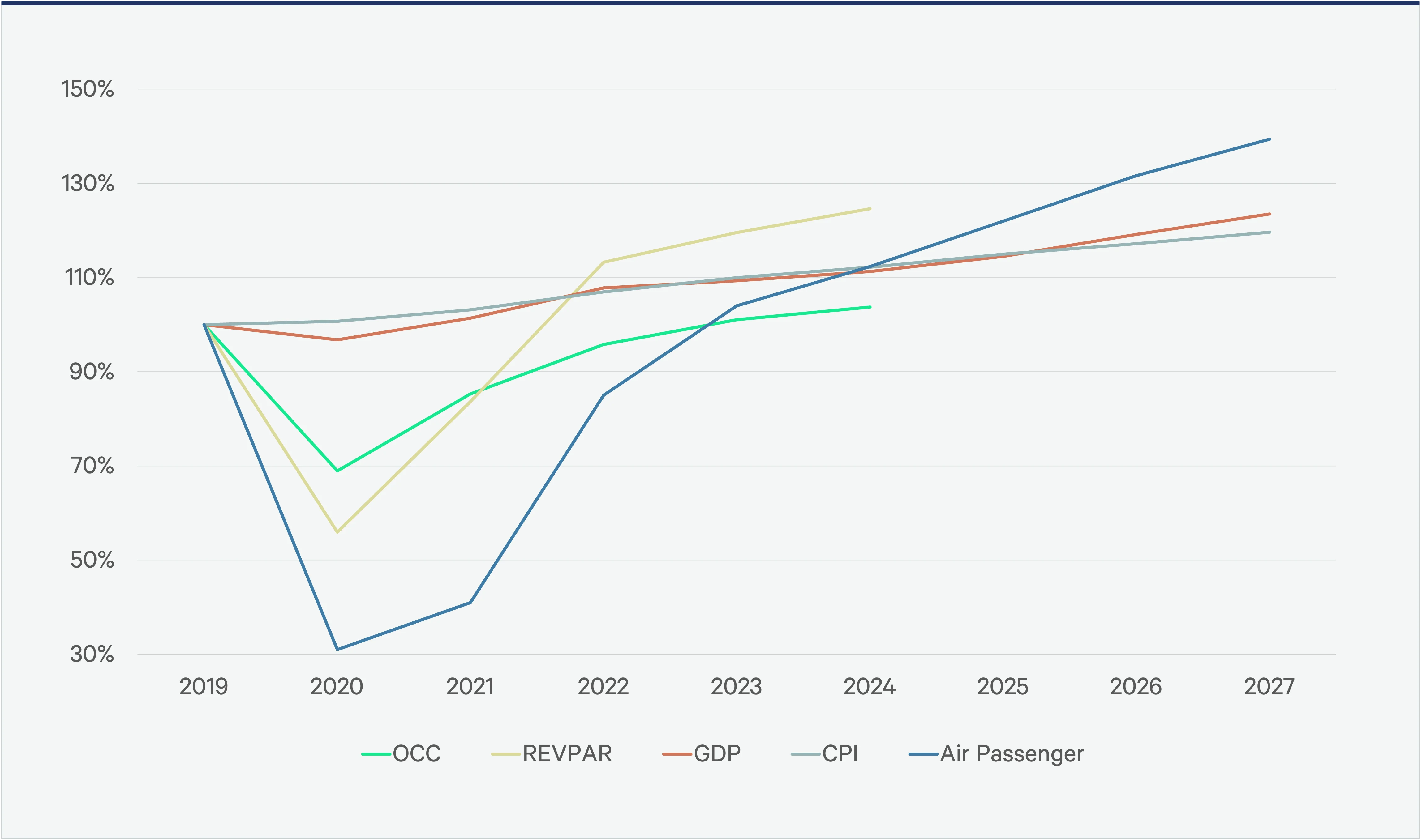
Saudi Arabia is rebuilding its hospitality industry from the ground up. The Kingdom’s hotel market is already very established, with 171,650 rooms in operation. 94,500 more rooms are in advanced planning, and some are under construction.
In 2025, the travel and tourism sectors contributed $178 billion to the Kingdom’s GDP. These numbers are expected to grow significantly in 2026 and years beyond.
This article talks about the key numbers and what they tell you about Saudi Arabia’s hospitality market growth in the coming years.
How Fast Is the Saudi Arabia Hotel Industry Growing in 2026?
In 2025, the market was valued at USD 27.14 billion and is expected to reach USD 29.02 billion in 2026. By 2031, the numbers will cross USD 40.58 billion, representing a CAGR of 6.93%. Saudi Arabia remains the largest hotel market among all GCC countries. It holds 68.1% of the combined GCC hotel revenue in 2026.
What separates Saudi Arabia from other high-growth markets is the quality of demand driving it:
-
32% expansion in travel and tourism in 2024
-
29.7 million international visitors in 2024, up 8% year-on-year
-
86.2 million domestic tourists in 2024, a 5% rise on 2023
-
Tourism now represents 11.5% of GDP, the highest in the region (WTTC)
-
Non-religious international travelers now account for 59% of international arrivals, up from 44% in 2019
These figures highlight a structural shift in Saudi Arabia’s tourism base, where domestic travel is now providing the foundation for year-round occupancy stability, while international demand is increasingly seasonal and event-driven.
Saudi Arabia Hotel Market Statistics: Supply and Pipeline for 2026
The scale of the pipeline indicates that Saudi Arabia is transitioning from a supply-constrained market to a supply-absorbing market phase, where timing of openings and positioning will significantly impact asset performance over the next 3–5 years.
Current Room Supply
Saudi Arabia’s hotel stock stands at 171,650 rooms as of late 2025. The supply is projected to grow to 18% by 2027.
The pipeline totals more than 358,000 planned hotel rooms. Approximately 94,500 keys are either under construction or in advanced planning stages.
City-Level Hotel Room Supply
|
City |
Supply (Approx.) |
2026–27 Outlook |
|
Makkah |
~90,000 keys |
Large giga-project wave incoming |
|
Riyadh |
~25,600 keys |
+19% growth to 30,330 keys by 2027 |
|
Jeddah |
25,000+ keys |
Strong pipeline; selective ADR pressure |
|
Madinah |
10,000+ keys |
Anchored by Umrah demand |
This distribution highlights a clear imbalance: while Makkah and Riyadh are entering high-density development phases, secondary cities remain underbuilt, creating uneven pricing power across the Kingdom.
The Saudi Arabia Hotel Development Pipeline in 2026: What's Actually Opening?
Saudi Arabia is expected to open 20,000+ new hotel rooms annually in 2026 and 2027. In Makkah, more than 5,000 new keys are expected in 2026, including major developments near the Holy Mosque.
The mega-project pipeline driving long-term supply remains significant:
-
Rua Al Haram: 70,000+ keys (Makkah)
-
Rua Al Madinah: 47,000+ keys
-
Masar Makkah: 41,000+ keys (USD 26.6bn project)
-
Red Sea Global: 3,000+ keys, with Phase 1 resorts now operational
In May 2025, Wyndham and Le Park Concord revealed a 100-hotel Super 8 development plan over 10 years, with initial deliveries in 2026. HMH confirmed a 460-room flagship project in Makkah.
Chain hotels make up 57.74% of the market in 2025. The segment is forecast to expand at an 11.62% CAGR through 2031. Global brands such as Marriott, Hilton, IHG, and Accor are driving this growth.
Hotel Occupancy, ADR, and RevPAR in Saudi Arabia: 2026 Performance Reality
What Is the Hotel Occupancy Rate in Saudi Arabia?
National hotel occupancy averaged 62.3% in the first half of 2025. For the full year, it is projected to stay around 60–62%. Peak event and pilgrimage weeks often push occupancy above 90%. This creates one of the widest seasonal gaps in global markets.
Which City Has the Highest Hotel Occupancy in Saudi Arabia?
Makkah consistently leads during the Hajj and Umrah seasons. In 2024, Saudi Arabia hosted 1.8 million Hajj pilgrims and 35.7 million Umrah pilgrims. This is the highest international pilgrim count ever recorded. Makkah's ADR peaks above SAR 650 during these periods.
Riyadh delivers stronger year-round occupancy stability due to corporate demand and a growing MICE sector. Around 82% of its hotel pipeline is concentrated in the luxury and upper-upscale categories.
What Is RevPAR for Hotels in Saudi Arabia?
Here’s the key detail that headline market size figures don’t capture:
-
In the first half of 2025, nationwide ADR reached SAR 822 (~USD 219) with a 1.9% year-on-year increase.
-
RevPAR is approximately USD 115–120 nationally.
-
For 2026, Jeddah and Riyadh RevPAR are forecast to rise by an average of 4.2%. This is a significant upgrade from the +1.5% forecast made in November 2025 (CoStar/STR, February 2026).
-
STR data shows that Saudi Arabia’s national RevPAR is expected to decline slightly compared to 2025. This is due to supply absorption pressure, even as Riyadh and Jeddah see improving performance.
The Oversupply Pressure:
There are 316 hotel projects currently under construction, creating a risk of ADR compression. The mid-scale segment is especially vulnerable as luxury supply expands. In Riyadh and Jeddah, higher supply is expected to slightly reduce RevPAR in 2028. Hotels without strong yield management will feel this most.
The impact of current construction activity will not be immediate but phased. Between 2026 and 2027, the market will primarily absorb new inventory. However, by 2028, mid-scale and undifferentiated assets in Riyadh and Jeddah are expected to experience measurable ADR compression as competition intensifies.
Saudi Arabia Hotel Investment: Where Is Capital Flowing in 2026?
Saudi Arabia hotel investment has scaled faster than most markets globally:
-
2023 hotel deal value: exceeded $1.5 billion
-
2024 hotel investment announcements: $3.0+ billion in capital expenditure
-
Riyadh's pipeline alone: $10+ billion in announced projects
-
Vision 2030 tourism investment target: $100+ billion by 2030
The luxury segment is absorbing most of the investment. Around 75% of new supply falls into luxury, upper-upscale, and upscale categories. By 2030, this is expected to rise to 76% of total rooms. This reflects the Kingdom’s focus on high-value tourism.
The Underserved Opportunity: Tier-2 Leisure Cities
While capital concentrates on Riyadh and Makkah, domestic travellers are increasingly choosing secondary destinations, and supply hasn't caught up. Knight Frank data shows:
-
24% of Saudi domestic travellers chose Abha
-
22% chose Taif
-
20% chose Al-Ula
These highland and heritage markets have limited quality supply, and demand is increasing. For branded serviced-apartment operators and mid-scale chains, this is where the uncrowded opportunity sits in 2026.
Final Words!
Saudi Arabia’s hotel market is becoming more selective. Performance is now driven more by location and positioning than overall demand growth. Riyadh and Makkah are the main winners, while AlUla, Taif, and Abha show emerging potential. Mid-scale, undifferentiated hotels in oversupplied cities face pressure on ADR and RevPAR.
For investors and developers, precision matters more than scale in this market. Hospitality consulting support from firms like Finisya helps identify strong opportunities and avoid weak segments.
- Digital Agency
- Literie
- Location de voitures
- Restaurant
- Restaurant
- Mode
- Mode
- Information
- Marketing
- Tourisme
- Développement
- Découverte
- Législation
- Gastronomie
- Pâtisserie
- Мероприятие
- Art
- Causes
- Crafts
- Dance
- Drinks
- Film
- Fitness
- Food
- Игры
- Gardening
- Health
- Главная
- Literature
- Music
- Networking
- Другое
- Party
- Religion
- Shopping
- Sports
- Theater
- Wellness
 Russian
 Indian
 English
 French
 Arabic
 Spanish
 Portuguese
 Deutsch
 Turkish
 Dutch
Dutch
 Italiano
 Romaian
 Portuguese (Brazil)
 Greek
Greek
