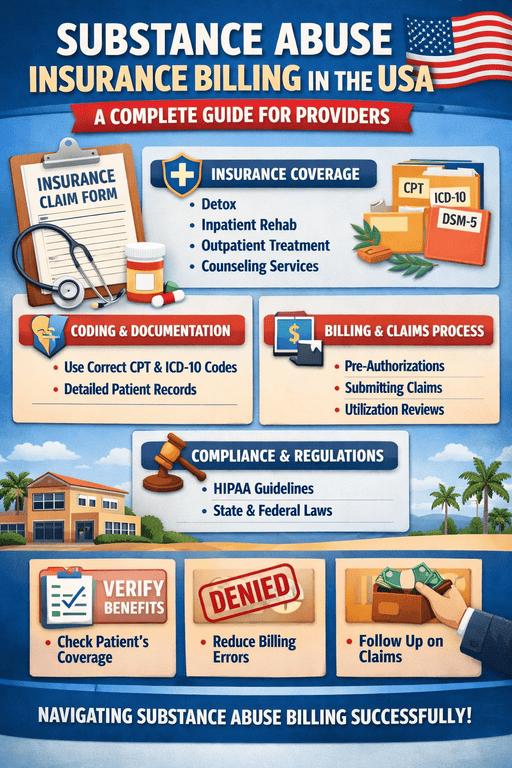
Behavioral healthcare providers play a vital role in helping people recover from addiction, but delivering quality care is only part of the job. Behind every successful treatment program is a billing process that ensures providers are paid correctly for the services they deliver. This is where substance abuse billing and coding becomes essential.
In the USA, addiction treatment billing is more complex than many other medical specialties. Providers must understand coding guidelines, insurance policies, documentation requirements, and compliance standards to avoid claim denials and payment delays.
Whether you manage a private practice, outpatient clinic, rehabilitation center, or behavioral health facility, understanding the fundamentals of substance abuse billing can improve your financial performance while supporting quality patient care.
Why Substance Abuse Billing and Coding Matters
Substance use disorder (SUD) treatment involves multiple services, including assessments, counseling, therapy sessions, medication-assisted treatment (MAT), detoxification, and ongoing recovery support. Each service must be documented and coded correctly before it can be billed to an insurance payer.
Accurate billing helps providers:
- Receive timely reimbursement
- Reduce claim denials
- Maintain regulatory compliance
- Improve cash flow
- Minimize audit risks
- Focus more on patient care
Errors in coding can lead to delayed payments, rejected claims, or even compliance issues during payer audits.
Understanding the Basics of Substance Abuse Billing and Coding
Substance abuse billing combines clinical documentation with standardized coding systems used by insurance companies.
The primary coding systems include:
ICD-10-CM Diagnosis Codes
ICD-10 codes identify the patient's diagnosis and medical condition.
Examples may include:
- Alcohol use disorder
- Opioid use disorder
- Cannabis dependence
- Stimulant-related disorders
- Nicotine dependence
The diagnosis code should accurately reflect the patient's documented condition and severity.
CPT Codes
Current Procedural Terminology (CPT) codes describe the healthcare services performed.
Common behavioral health services include:
- Initial evaluations
- Individual psychotherapy
- Group therapy
- Family counseling
- Medication management
- Screening and assessment services
Selecting the correct CPT code depends on factors such as service type, duration, and provider qualifications.
HCPCS Codes
Healthcare Common Procedure Coding System (HCPCS) codes are commonly used for:
- Medication-assisted treatment
- Certain injectable medications
- Supplies
- Specialized behavioral health services
Many Medicare and Medicaid programs require HCPCS codes for specific treatments.
Services Commonly Billed in Addiction Treatment
Substance abuse treatment programs often include a combination of medical and behavioral services.
Some of the most frequently billed services include:
- Intake assessments
- Comprehensive psychiatric evaluations
- Individual counseling
- Group therapy
- Family therapy
- Intensive outpatient programs (IOP)
- Partial hospitalization programs (PHP)
- Medication-assisted treatment (MAT)
- Urine drug testing
- Care coordination
- Follow-up visits
- Telehealth behavioral health appointments
Each service has unique billing requirements, making proper documentation extremely important.
Documentation: The Foundation of Clean Claims
Insurance companies expect documentation to fully support every billed service.
A complete patient record typically includes:
- Medical necessity
- Treatment goals
- Diagnosis
- Provider notes
- Session length
- Treatment plan
- Patient progress
- Date of service
- Provider signature
Incomplete documentation often results in denied claims even when the treatment itself was appropriate.
Good documentation also protects providers during payer reviews and compliance audits.
Common Billing Challenges in Behavioral Health
Substance abuse treatment providers frequently encounter billing difficulties because insurance requirements vary between payers.
Some of the most common challenges include:
Authorization Requirements
Many insurance plans require prior authorization before approving treatment services.
Missing authorization can result in claim denials even when care was medically necessary.
Time-Based Coding
Many psychotherapy services depend on session length.
Incorrect reporting of treatment duration may cause reimbursement issues.
Medical Necessity
Payers review whether services were appropriate based on the patient's diagnosis and clinical condition.
Proper documentation should clearly explain why treatment was necessary.
Coordination of Benefits
Patients sometimes have multiple insurance plans.
Correct coordination helps prevent duplicate billing and payment delays.
Frequent Policy Changes
Behavioral health billing rules continue to evolve, requiring providers to stay updated with payer guidelines and coding revisions.
Best Practices for Accurate Substance Abuse Billing and Coding
Successful behavioral health organizations follow consistent billing procedures that reduce errors and improve collections.
Some proven best practices include:
Maintain Detailed Clinical Documentation
Every treatment session should accurately describe:
- Patient condition
- Clinical observations
- Interventions provided
- Patient response
- Future treatment recommendations
Verify Insurance Before Treatment
Confirm:
- Active coverage
- Benefits
- Copayments
- Deductibles
- Authorization requirements
Insurance verification helps reduce unexpected billing problems.
Submit Claims Promptly
Timely claim submission reduces reimbursement delays and avoids missed filing deadlines.
Perform Regular Coding Reviews
Internal audits help identify coding errors before claims are submitted.
Routine reviews also improve staff education and compliance.
Stay Updated on Coding Changes
Behavioral health coding standards change regularly.
Providers should continually monitor updates affecting:
- CPT codes
- ICD-10 codes
- HCPCS codes
- Medicare policies
- Commercial insurance guidelines
Compliance Is More Than Correct Coding
Billing accuracy is only one part of compliance.
Behavioral healthcare organizations should also focus on:
- HIPAA privacy regulations
- Proper documentation standards
- Fraud prevention
- Accurate claim submission
- Internal billing audits
- Secure patient record management
Maintaining compliance protects both patients and healthcare organizations from unnecessary legal and financial risks.
The Role of Technology in Modern Behavioral Health Billing
Technology has significantly improved the billing process for addiction treatment providers.
Modern billing software can assist with:
- Eligibility verification
- Coding support
- Electronic claim submission
- Denial tracking
- Payment posting
- Reporting
- Revenue analysis
Electronic Health Records (EHRs) also improve documentation consistency by integrating clinical notes directly with billing workflows.
Although technology reduces manual work, human review remains essential to ensure coding accuracy and compliance.
How Professional Billing Support Can Improve Practice Performance
Many behavioral health providers partner with experienced billing specialists to simplify reimbursement management.
Professional medical billing services can help organizations:
- Reduce administrative workload
- Improve first-pass claim acceptance
- Identify coding errors
- Speed up reimbursements
- Track denied claims
- Monitor payer performance
Likewise, expert medical coding services ensure that diagnosis and procedure codes accurately reflect the care documented by clinicians, reducing compliance risks and supporting proper reimbursement.
Many organizations also benefit from reliable credentialing support to ensure providers are enrolled with insurance networks, allowing claims to be processed without unnecessary delays.
When these services are integrated into a broader revenue cycle management strategy, healthcare organizations often experience stronger financial stability, improved operational efficiency, and better visibility into their reimbursement performance.
Companies such as 247 Medical Billing Services assist healthcare providers by supporting accurate billing workflows, coding accuracy, payer compliance, and efficient revenue cycle operations while allowing clinicians to devote more attention to patient care.
Looking Ahead
Behavioral healthcare continues to expand as more individuals seek treatment for substance use disorders across the USA. At the same time, insurance requirements, coding standards, and compliance expectations continue to evolve.
Providers who invest in accurate documentation, ongoing coding education, regular compliance reviews, and efficient billing processes are better positioned to reduce denials, improve reimbursement, and maintain financial stability. A well-managed billing system not only supports the success of the practice but also helps ensure that patients continue receiving the treatment they need without unnecessary administrative obstacles.
Frequently Asked Questions
1. What is substance abuse billing and coding?
Substance abuse billing and coding is the process of assigning standardized diagnosis and procedure codes for addiction treatment services and submitting insurance claims for reimbursement.
2. Which coding systems are used for substance abuse treatment?
Providers typically use ICD-10-CM diagnosis codes, CPT procedure codes, and HCPCS codes when applicable for medications, supplies, and specialized services.
3. Why is documentation important in substance abuse billing?
Documentation demonstrates medical necessity, supports the selected codes, reduces claim denials, and helps providers remain compliant during insurance audits.
4. What causes the most claim denials in behavioral health billing?
Common reasons include incorrect coding, missing documentation, lack of prior authorization, insurance eligibility issues, and incomplete patient information.
5. Does medication-assisted treatment require special billing considerations?
Yes. Medication-assisted treatment often involves specific diagnosis codes, procedure codes, HCPCS codes, and payer-specific documentation requirements depending on the medication and treatment setting.
6. How can providers improve reimbursement for substance abuse treatment?
Providers can improve reimbursement by verifying insurance eligibility, maintaining accurate documentation, coding correctly, submitting claims promptly, monitoring denials, and performing regular billing audits.
7. Why do many behavioral health practices outsource billing services?
Many practices choose outsourced billing support to improve coding accuracy, reduce administrative burden, speed up claim processing, strengthen compliance, and optimize overall reimbursement performance.



 English
 Indian
 French
 Arabic
 Spanish
 Portuguese
 Deutsch
 Turkish
 Dutch
Dutch
 Italiano
 Russian
 Romaian
 Portuguese (Brazil)
 Greek
Greek
