


I Packed My Bag, Booked a Cab, and Saw India in Three Cities — Here's What Actually Happened
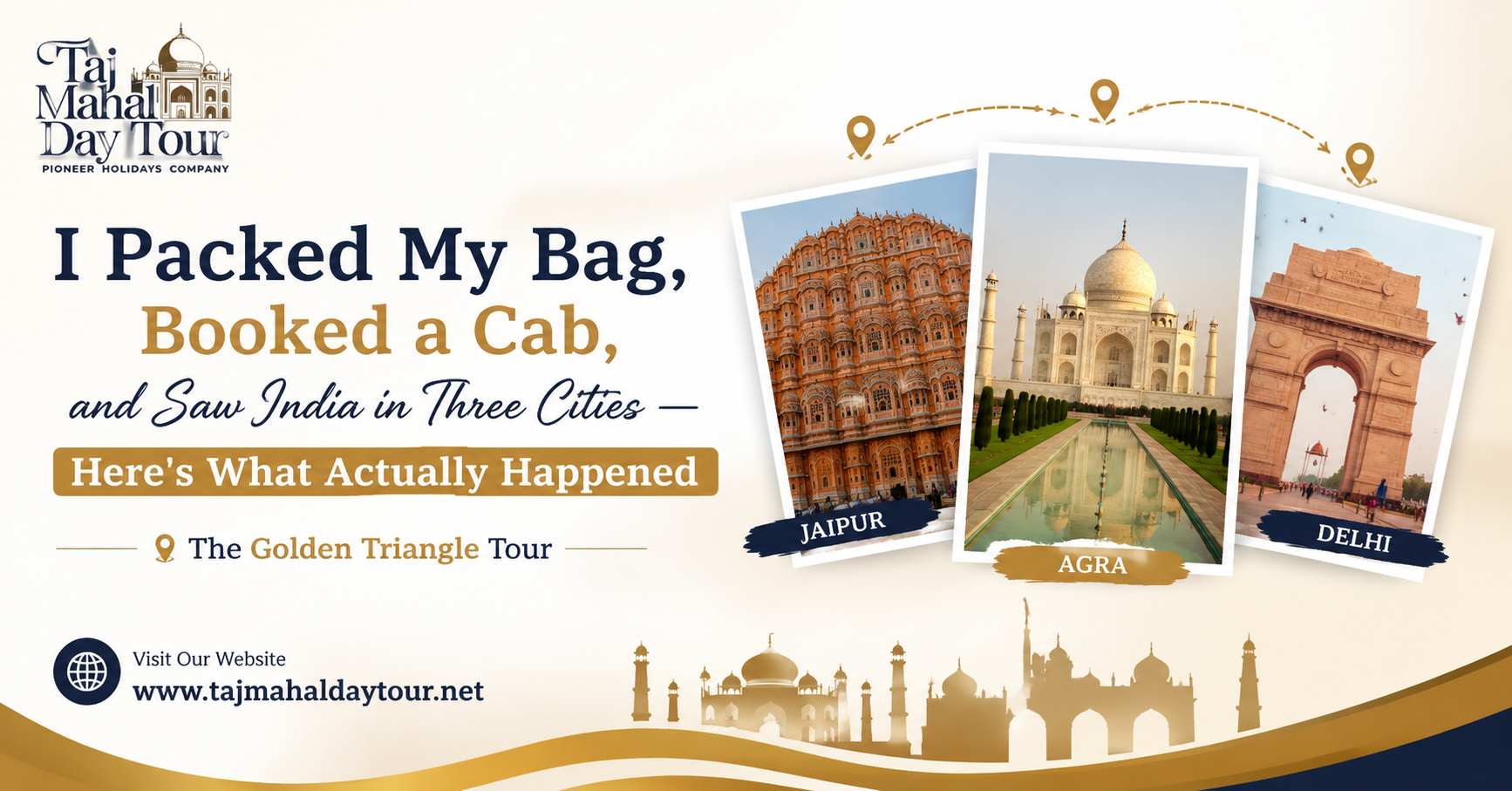
India is loud, colorful, chaotic, and absolutely beautiful. But if you are visiting for the first time — or even the second — deciding where to go can feel overwhelming. Someone at my hostel back in 2022 said, "Just do the triangle." I had no idea what she meant. Two days later, I was standing in front of the Taj Mahal with my jaw on the floor, and I finally understood.
The Golden Triangle Tour India covers three cities: Delhi, Agra, and Jaipur. These three cities form a rough triangle on the map, and together they give you a slice of everything — Mughal history, Rajput architecture, street food, crowded markets, quiet temples, and sunsets that don't look real. This route has been popular for decades, but every traveler who does it has a slightly different story. Here is mine, along with everything practical you need to plan your own trip.
Why These Three Cities? What Makes the Triangle Work?
Not every route works for every traveler. Some people want beaches, some want mountains. But the reason the Golden Triangle route stays so popular is simple — it is efficient and rewarding at the same time.
Delhi, Agra, and Jaipur are all connected by road and rail. The distances between them are manageable — roughly 200 to 250 kilometers between each pair of cities. You can do all three in five to six days without feeling rushed, or you can stretch it to ten days if you want to slow down and actually feel each place.
More importantly, each city is different enough from the others that you never feel like you are repeating yourself. Delhi is a metropolis with layers of old and new sitting right on top of each other. Agra is quieter, more focused, almost entirely shaped by the presence of one monument. Jaipur is colorful and warm, with a different cultural texture than the other two.
Delhi — Where the Trip Actually Begins
I landed at Indira Gandhi International Airport at 6 in the morning. The city was already moving. That is something you learn quickly about Delhi — it does not really sleep.
My first day I did what most first-timers do. I went to the Red Fort. I walked through Chandni Chowk. I ate a plate of chole bhature that cost me eighty rupees and tasted better than anything I had eaten in months. The lanes of Old Delhi are narrow and honestly a little overwhelming, but that chaos is part of it. Rickshaws squeezing past vegetable carts, chai stalls on every corner, the smell of cardamom and diesel mixing in the air.
The second half of the day, I took the metro south toward Humayun's Tomb. This is where Old Delhi gives way to a different mood. The garden tomb is quieter, greener, and genuinely stunning. It also helps that not as many tourists make it here compared to the Red Fort, so you can actually sit and look at it without getting bumped by a selfie stick.
If you want to stay somewhere centrally located with good connectivity to all three cities, the team at tajmahaldaytour.net can help you plan the logistics so you are not wasting half a day figuring out trains and transfers.
Do not skip: Jama Masjid in the evening light. India Gate for a late evening walk. And at least one proper Delhi street food meal — whether it is chaat in Connaught Place or a paratha in Karim's lane.
The Drive to Agra — and That First Glimpse of the Taj
I took a cab from Delhi to Agra early in the morning. The Yamuna Expressway is smooth and fast, and on a good day you reach in about three hours. I timed it deliberately to arrive before noon, because I had read that the light is softer in the morning.
The Taj Mahal entry process is organized now. You buy your ticket, you leave your bag in a locker, you walk through a security check. And then you pass through the main gate.
I am going to be honest with you. I have seen thousands of photos of the Taj Mahal. I knew what it looked like. I thought I was prepared. I was not prepared.
When you walk through that sandstone archway and the Taj appears framed in the arch, there is a moment where your brain simply does not process what it is seeing. It is too white. It is too symmetrical. It almost does not look like a real building — it looks like something painted onto the sky. I stood there for probably three full minutes without moving.
The Taj Mahal was built by Mughal emperor Shah Jahan in memory of his wife Mumtaz Mahal, who died during childbirth in 1631. Construction took roughly twenty-two years and involved around twenty thousand workers. Every surface is inlaid with semi-precious stones — carnelian, lapis lazuli, jade, crystal. The calligraphy around the arches is designed to appear uniform even though the letters actually get slightly larger toward the top, an optical illusion built by 17th century craftsmen.
Standing inside, you see a marble screen around the tombs. The actual graves are in a chamber below. The whole building is set on a raised marble platform with four minarets at the corners. The minarets lean slightly outward — deliberately — so that in the event of an earthquake, they would fall away from the main structure rather than onto it.
I stayed for about four hours. Long enough to walk behind the main building to the riverbank, sit on the bench that Princess Diana made famous, and eat my lunch outside the gate.
Agra Fort is also worth two to three hours if you have them. Shah Jahan was later imprisoned here by his son Aurangzeb, and he spent his final years looking at the Taj from his window. That detail made the whole visit hit differently for me.
Fatehpur Sikri — The Ghost City Between Agra and Jaipur
Most people skip Fatehpur Sikri. I almost did. But the cab driver talked me into stopping, and I am glad he did.
Fatehpur Sikri is a UNESCO World Heritage Site about forty kilometers from Agra. It was built by Emperor Akbar in the late 1500s as his capital city, but it was abandoned after only fourteen years — historians debate whether it was a water shortage or a military campaign that pulled Akbar away, but the result is the same: an entire Mughal city, nearly intact, sitting empty on a ridge.
The palace complex is huge and red. Sandstone architecture, carved lattice screens, vast open courtyards. The Friday Mosque here is one of the largest in India, and the tomb of Sufi saint Salim Chishti at its center draws thousands of pilgrims. I watched a family tie a thread around the marble screen of the tomb and whisper a prayer. The contrast between the abandoned royal palaces and this still-living place of worship was striking.
Jaipur — The Pink City and Everything Inside It
Jaipur hit me differently than Delhi and Agra. It felt more relaxed, more residential somehow, even though it is still a large city. The roads are wide. The old city has a pinkish-orange terracotta color that apparently came from a citywide repainting ordered to welcome Prince Albert of Wales in 1876.
The Amber Fort is the main event here, and it deserves that status. You approach it from a road that winds up a hillside, and the fort gets larger and more impressive as you climb. Inside, it is a series of palaces built by different rulers over centuries, each one layering into the next. The Sheesh Mahal — Hall of Mirrors — is covered in tiny mirror pieces set into the plaster ceiling. When you shine a single candle inside, the whole room becomes stars.
The City Palace in the heart of Jaipur's old city is still partially home to the royal family of Jaipur. There is a museum section open to visitors with miniature paintings, manuscripts, and weapons from the royal collection. The Jantar Mantar next door is an eighteenth-century astronomical observatory with enormous stone instruments — sundials and angle measurers built to track the movement of stars. The largest sundial in the world is here, and it can tell time accurate to two seconds.
Hawa Mahal — the Palace of Winds — is the iconic pink facade you see in every Jaipur photograph. It was built in 1799 so that women of the royal household could observe street life without being seen. The facade has 953 small windows arranged in a honeycomb pattern. It looks like a theatrical backdrop from the outside, and from the inside, the windows frame the street below in hundreds of tiny pictures.
The Golden Triangle Tour India ends here for most travelers, but Jaipur also offers a gateway to Rajasthan if you want to keep going. Pushkar, Jodhpur, and Udaipur are all reachable.
Practical Things Nobody Tells You
Best time to visit: October through March. November and February hit a sweet spot — not too cold, not too hot. April through June is very hot. July through September is monsoon season, which is beautiful in some ways but can disrupt travel.
How long you actually need: Five days minimum. Seven to eight is comfortable. Ten is relaxed.
Getting between the cities: By cab (hired car with driver) is the most flexible. Trains are cheaper and often comfortable — the Gatimaan Express between Delhi and Agra is fast and reliable. Book trains through the IRCTC website or app in advance.
Accommodation: Delhi has options at every price point. In Agra, staying near the Taj Mahal gate area saves time. In Jaipur, the old city area puts you close to most sights.
Money: Most major places now accept cards, but carry cash in smaller denominations for street food, auto rickshaws, and smaller shops.
Guides: Hiring a local guide at each monument makes a real difference. The stories behind the buildings are what make them memorable, and a good guide brings them to life. The team at tajmahaldaytour.net arranges licensed guides who are genuinely knowledgeable.
What the Golden Triangle Tour India Actually Teaches You
I came home from this trip with about eight hundred photographs and a full notebook. But the things I remember most are not the monuments. They are the chai seller near the Agra Fort who told me his father had sold chai there too. The children playing cricket in a lane in Old Delhi at dusk. The smell of jasmine garlands being sold at the entrance of the Amber Fort.
The monuments are extraordinary, truly. But they work as anchors for a larger experience — of movement, of conversation, of getting slightly lost and finding something better than what you were looking for.
The Golden Triangle is called a triangle because of geography. But what it really is, is a story told in three chapters. Delhi is the introduction — complex, layered, a little overwhelming. Agra is the emotional center — quieter, more focused, built around a single act of grief turned into beauty. Jaipur is the resolution — warmer, more colorful, opening outward into the desert.
You can do this trip once and call it done. Or you can do it again and find a completely different trip underneath the same geography. Most people who have done it once go back.
FAQs — Golden Triangle Tour India
Q: How many days are enough for the Golden Triangle Tour India? A: Five days is the minimum if you want to see the main highlights without feeling rushed. Seven to eight days lets you spend proper time in each city and include a stop at Fatehpur Sikri. Ten days gives you room to slow down and explore neighborhoods, markets, and day trips.
Q: What is the best starting point — Delhi, Agra, or Jaipur? A: Most travelers start in Delhi because of its international airport connections. From Delhi you go to Agra, then continue to Jaipur, and either fly out of Jaipur or return to Delhi. This clockwise route works well logistically.
Q: Is it better to travel by train or by car? A: Both have advantages. The Gatimaan Express from Delhi to Agra takes about two hours and is comfortable. Hired cars (with a driver) give you flexibility to stop at places like Fatehpur Sikri between cities. Many travelers use trains for one leg and a car for another.
Q: What should I not miss in each city? A: In Delhi — Red Fort, Humayun's Tomb, Jama Masjid, and at least one meal in Old Delhi. In Agra — Taj Mahal (spend at least three hours), Agra Fort, and optionally Fatehpur Sikri on the way out. In Jaipur — Amber Fort, City Palace, Jantar Mantar, and Hawa Mahal.
Q: Is the Taj Mahal worth all the hype? A: Yes. Almost every traveler who visits says the same thing — that photographs do not prepare you for seeing it in person. The scale, the whiteness, the symmetry, and the detail work all combine into something that is genuinely hard to describe. Go in the morning for the best light and smaller crowds.
Q: How do I book a Golden Triangle tour package? A: You can book through specialized tour operators who handle transport, guides, and accommodation. tajmahaldaytour.net offers tailored day tours and full packages covering the triangle route, with licensed guides and organized logistics so you spend your time seeing things rather than arranging them.
Q: Is the Golden Triangle safe for solo travelers? A: Yes, generally. These are among the most visited tourist routes in India, so infrastructure, signage, and tourist services are well established. As with any travel, use common sense — keep copies of your documents, use pre-paid cabs or app-based rides, and stay aware of your surroundings in crowded areas.
Q: What is the entry fee for the Taj Mahal? A: Entry fees change periodically and are different for Indian citizens and foreign nationals. As of recent years, the fee for foreign visitors has been around 1100 INR. Always verify current fees on the Archaeological Survey of India website before your visit.
Q: Can I do the Golden Triangle in three days? A: You can cover the basics, but it would be very rushed and you would spend a lot of your time in transit rather than at the sites. Five days is a much better minimum. If you truly only have three days, prioritize Agra and one city between Delhi and Jaipur.
Q: What is the best time of day to visit the Taj Mahal? A: Sunrise is magical — the light is golden and the crowds are thinner. The Taj is also open on full moon nights for ticketed moonlight viewing, which is a rare and atmospheric experience. Midday in summer is the hardest time — very hot and the light is harsh for photographs.
Q: Do I need a visa to visit India? A: Most international travelers need a visa to visit India. India offers an e-Visa (electronic visa) for citizens of many countries, which can be applied for online before travel. Always check current requirements based on your nationality on the official Indian government visa portal.
- Digital Agency
- Literie
- Location de voitures
- Restaurant
- Restaurant
- Mode
- Mode
- Information
- Marketing
- Tourisme
- Développement
- Découverte
- Législation
- Gastronomie
- Pâtisserie
- مناسبة
- Art
- Causes
- Crafts
- Dance
- Drinks
- Film
- Fitness
- Food
- الألعاب
- Gardening
- Health
- الرئيسية
- Literature
- Music
- Networking
- أخرى
- Party
- Religion
- Shopping
- Sports
- Theater
- Wellness
 Arabic
 Indian
 English
 French
 Spanish
 Portuguese
 Deutsch
 Turkish
 Dutch
Dutch
 Italiano
 Russian
 Romaian
 Portuguese (Brazil)
 Greek
Greek
