


From Forts to Taj: A 6-Day Journey Through India's Most Iconic Triangle
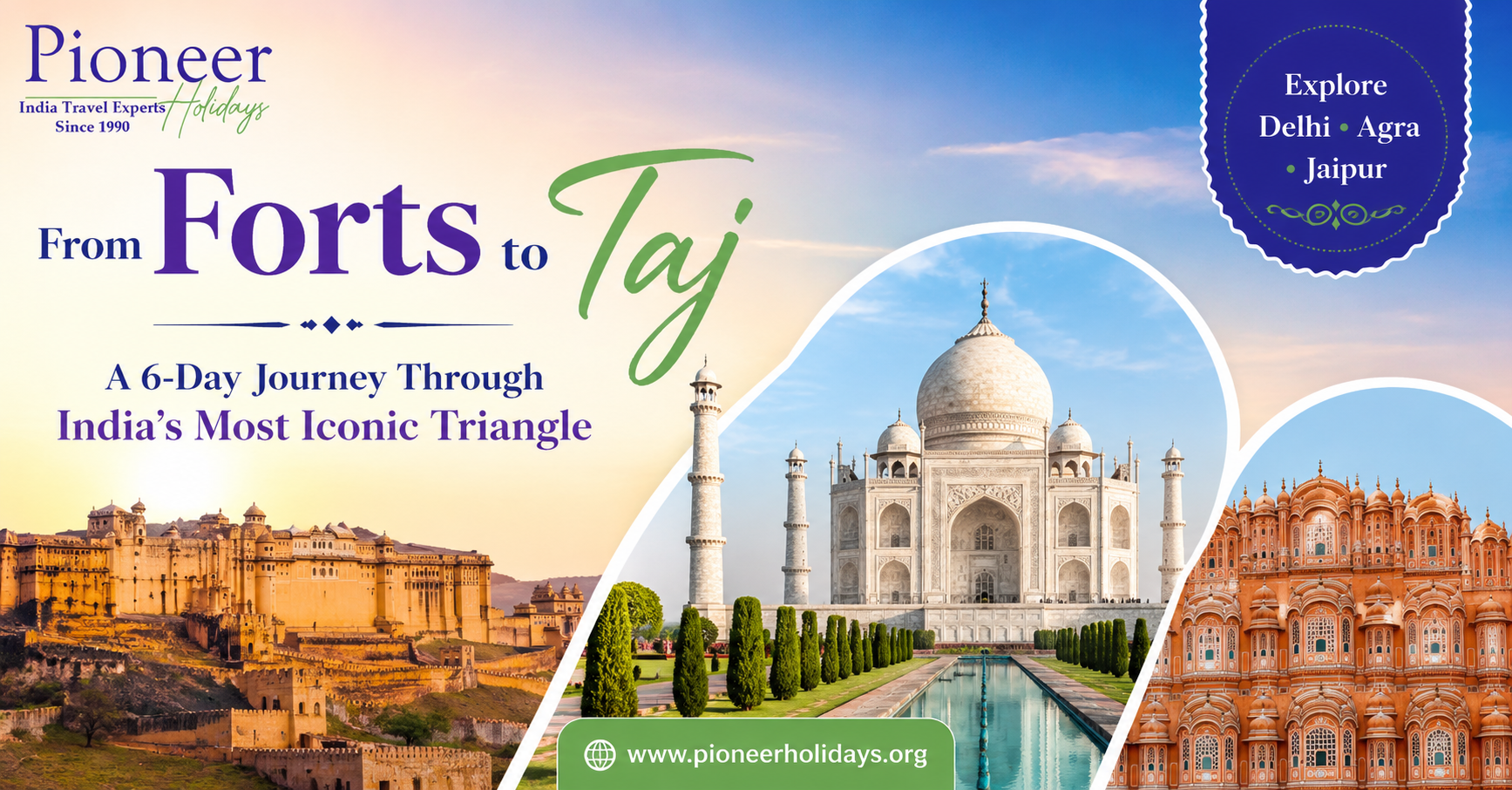
India has a way of getting under your skin. The noise, the colour, the dust, the kindness of strangers — it all blends into something you carry home with you long after the trip is over. And if there is one route that captures all of this at once, it is the India Golden Triangle tour 6 days — a loop through Delhi, Agra, and Jaipur that has been turning first-time visitors into lifelong India lovers for decades.
Six days is not a long time. But on this route, it is enough. Enough to stand before the Taj Mahal at sunrise and feel genuinely speechless. Enough to get lost in the lanes of Old Delhi. Enough to watch the sun go down over Jaipur's amber skyline and think — I could stay here forever.
This blog is your honest, human guide to doing this journey the right way.
Why This Route Works So Well
Most people coming to India for the first time ask the same question: where do I even start? India is enormous, layered, and wildly diverse. Trying to see too much too fast leads to exhaustion, not joy.
The Delhi–Agra–Jaipur triangle solves this problem neatly. The three cities sit within a few hours of each other, connected by good roads and trains. Each one has its own character — Delhi is loud and layered, Agra is intimate and emotional, Jaipur is theatrical and warm. Together, they give you a real cross-section of North India without burning you out.
And six days? It is the sweet spot. Enough time to go slow, to eat well, to sit somewhere beautiful without checking the clock every five minutes.
Day 1 — Delhi: Step Into the Chaos, Then the Calm
Your journey begins in Delhi, and Delhi does not ease you in gently. It hits you immediately — the traffic, the vendors calling out, the smell of street food mixing with incense and exhaust. It is overwhelming for about twenty minutes, and then somehow it becomes addictive.
Old Delhi first. Head to Chandni Chowk in the morning before the heat builds. Walk through the spice market at Khari Baoli, where sacks of turmeric, chilli, and dried herbs sit piled high in doorways. Eat a paratha at one of the old shops that has been serving the same recipe for generations. This part of Delhi has been a trading hub since the 17th century, and you can feel that history in every crowded lane.
From there, visit Jama Masjid — one of the largest mosques in India. Climb the minaret if you can, because the view over Old Delhi from the top is something you will not forget.
In the afternoon, shift pace completely. Move to New Delhi, which was designed by the British architect Edwin Lutyens in the early 20th century. Wide boulevards, red sandstone government buildings, and the iconic India Gate — a war memorial that feels both grand and quietly moving. Nearby, Humayun's Tomb is worth at least an hour. It predates the Taj Mahal and is actually one of the inspirations for it, which becomes obvious the moment you walk in.
End your first day with dinner somewhere in Connaught Place or Khan Market. Have butter chicken if you have not yet — and even if you have.
Day 2 — Delhi: Monuments, Markets, and One More Morning
Delhi deserves a full second day. There is too much here to rush.
Start at the Red Fort, which is the defining image of Mughal power in India. Built by Emperor Shah Jahan in the 17th century, its red sandstone walls stretch for nearly 2.5 kilometres. Inside, there are palaces, gardens, and pavilions that still carry the elegance of what was once the most powerful empire in Asia.
After the Red Fort, walk or take an auto-rickshaw to Raj Ghat — the memorial to Mahatma Gandhi. It is a simple black marble platform set in quiet gardens, and the contrast with the busy city around it gives the place a particular stillness.
In the afternoon, if you have the energy, visit Qutub Minar — a 73-metre medieval tower that is the oldest standing minaret in India. The surrounding complex is a beautiful ruin of mosques, pillars, and iron columns, set in a garden that feels almost peaceful.
Evenings in Delhi are best spent at a local market. Dilli Haat in South Delhi is a craft market where artisans from every state sell their work — textiles, pottery, jewellery, paintings. It is a good place to pick up gifts, or just to see the sheer range of what India makes.
Day 3 — Delhi to Agra: The Drive, the Arrival, the First Glimpse
Today you leave Delhi and head to Agra — about 200 kilometres southeast, a roughly 3 to 4 hour drive depending on traffic. Many travellers take the Gatimaan Express train, which covers the distance in under 2 hours and is comfortable and scenic.
Arrive in Agra by mid-morning if you can, because you want your first visit to the Taj Mahal to be in good light, not at midday when the heat flattens everything.
Nothing prepares you for it. You can see photographs a hundred times, read descriptions, watch videos — and still, when you walk through the main gate and the whole structure comes into view, there is a moment of genuine silence. It is bigger than you imagined. More white. More symmetrical. It floats, somehow.
The Taj Mahal was built by Emperor Shah Jahan between 1631 and 1648, as a mausoleum for his wife Mumtaz Mahal, who died during childbirth. Twenty thousand workers spent seventeen years building it. The white marble was sourced from Rajasthan, the inlaid gemstones from across Asia and the Middle East.
Give yourself at least two hours here. Walk around it. Sit by the reflecting pool. Look at the detail work up close — the calligraphy, the flower patterns carved in stone, the way the light changes on the surface throughout the day.
In the afternoon, visit Agra Fort — another Shah Jahan construction, and just as impressive in its own way. From one of the upper towers, you can see the Taj Mahal in the distance, and the view has real emotional weight when you know the history: Shah Jahan was later imprisoned in this fort by his own son, and spent his final years looking across the river at the tomb he built for his wife.
Agra nights are best spent quietly. Have dinner at a rooftop restaurant with a Taj view if possible — there are several good ones.
Day 4 — Agra to Jaipur via Fatehpur Sikri
Today is a travel day, but not a wasted one. The drive from Agra to Jaipur is around 230 kilometres, and along the way sits one of the most atmospheric stops on the entire route: Fatehpur Sikri.
This is a ghost city. Emperor Akbar built an entire capital here in the 1570s — palaces, courtyards, a great mosque, residential quarters — and then abandoned it within fifteen years, most likely due to water shortage. The sandstone structures are still standing, almost perfectly preserved, because no one has lived here since.
Walking through Fatehpur Sikri feels like stepping into something that was left mid-sentence. The Buland Darwaza — the gate built to commemorate Akbar's victory in Gujarat — is one of the tallest gateways in the world, and it is breathtaking. The Panch Mahal, a five-storey pavilion with 176 columns, gives a view over the whole complex.
After Fatehpur Sikri, continue to Jaipur. You will arrive in the evening, and that is a fine time for your first impression of the city. The old town glows at night, and the streets near the City Palace area are alive with vendors, lights, and the general electricity that Jaipur seems to carry constantly.
Day 5 — Jaipur: The Pink City at Full Tilt
Jaipur earns its name. The old city really is painted in shades of terracotta pink — a tradition started in 1876 when the city was painted to welcome the Prince of Wales. The colour stuck, and today it gives Jaipur a visual identity unlike anywhere else in India.
Start early at Amber Fort, about 11 kilometres from the city centre. This is the best fort on the entire route — a massive complex of palaces, temples, and halls built into a hillside above a lake. You can reach the main gate on foot, by jeep, or (if you choose) by elephant. The Sheesh Mahal — Hall of Mirrors — inside the fort is extraordinary: thousands of small mirror pieces embedded in the ceiling and walls, which catch light and scatter it in every direction.
Back in the city, visit the Hawa Mahal — the Palace of Winds, which is the image most people associate with Jaipur. It is actually a five-storey facade rather than a full palace, built so that royal women could observe street life without being seen. The 953 small windows, each with a stone screen, create a honeycomb effect that is genuinely unique.
City Palace is worth a few hours. Part of it is still used by the Jaipur royal family, but a large section is open as a museum — and the museum is excellent, with royal costumes, weapons, art, and carriages spread across beautifully maintained courtyards.
In the afternoon, give yourself time to shop. Jaipur is one of the best places in India to buy textiles, gemstones, block-printed fabric, blue pottery, and leather goods. Johari Bazaar for jewellery, Bapu Bazaar for fabric and bangles, and the lanes around Tripolia Gate for antiques and handicrafts.
End the day with dinner somewhere traditional. Dal baati churma is the dish to try — a Rajasthani speciality of wheat dumplings, lentils, and a sweet crumbled pastry. It tastes like nothing else.
Day 6 — Jaipur: One Last Morning, Then Home
Your last day. Keep it slow.
If you woke up early on any day, make it this one. Go to the Jantar Mantar — Jaipur's 18th-century astronomical observatory, built by Maharaja Jai Singh II. It looks like abstract sculpture, but each structure is actually a functional scientific instrument: sundials, zodiac instruments, a device for tracking stars. It is genuinely strange and wonderful, and most visitors do not give it enough time.
After Jantar Mantar, if you have a few hours left, visit the Jal Mahal — the Water Palace, which sits in the middle of a lake on the road back toward the city. You cannot go inside, but you can stand on the embankment and watch it. In the early morning light, with mist on the water, it is one of the quieter beautiful things on this whole journey.
Then — a last cup of chai, a final walk through the market, maybe one more piece of jewellery you did not need but could not resist. And then the journey back to Delhi, or onward to wherever comes next.
Practical Notes Worth Knowing
Best time to go: October through March is ideal. The weather is cool, the air is clear, and the light is good for photographs. Avoid April through June (extreme heat) and July through September if you prefer dry weather, though the monsoon has its own beauty.
Getting around: Trains between cities are comfortable and scenic. Within cities, app-based cabs (Ola, Uber) are easy and safe. For full flexibility, many travellers hire a driver for the whole six days — this is often the most comfortable option and lets you stop whenever you want.
Planning help: If you want someone to handle the logistics — hotels, drivers, entry tickets, routes — pioneerholidays.org specialises in exactly this kind of itinerary and can put together a seamless trip without the stress of organising it yourself. It is worth reaching out early, especially for travel during peak season.
Food safety: Eat at busy restaurants and avoid raw vegetables or street food that has been sitting out. Bottled water only. That said — do not be paranoid. Street food done right is some of the best you will eat anywhere.
What to pack: Light, breathable clothes, a scarf (useful for temple visits), comfortable walking shoes, sunscreen, and patience. The patience is the most important thing.
FAQs — India Golden Triangle Tour 6 Days
Q: Is 6 days enough for the Golden Triangle? Yes, 6 days is genuinely enough if you plan it well. You get 2 days in Delhi, 1.5 in Agra, and 2.5 in Jaipur — which covers all the major sites without feeling rushed. It is actually one of the most popular durations for this route.
Q: What is the best way to travel between the three cities? Trains are the most efficient and comfortable option. The Gatimaan Express from Delhi to Agra is particularly good. For Agra to Jaipur or Jaipur back to Delhi, trains or a hired car both work well depending on your schedule and budget.
Q: How much does the India Golden Triangle tour 6 days cost? It varies widely based on accommodation and travel style. Budget travellers can do it for around $50–70 USD per day including stays, food, and transport. Mid-range comes to roughly $100–150 per day. A comfortable, well-organised trip through an agency like pioneerholidays.org typically sits in the mid-to-upper range and removes all the planning stress.
Q: Is it safe to travel this route as a solo traveller? Yes, this is one of the safest and most well-trodden tourist routes in India. There is strong tourist infrastructure throughout. Solo women travellers should take the same sensible precautions they would anywhere — stick to public areas at night, use app-based transport, and keep your hotel's number saved.
Q: Do I need a visa to visit India? Most nationalities need a visa. India's e-Visa system is straightforward and can be applied for online. It is typically approved within 3–5 working days. Check the official Indian government e-Visa portal for your specific country.
Q: What is the single most important thing to do on this trip? Watch the Taj Mahal at sunrise. Arrive before the gates open, get inside early, and stand in front of it in the first light of the morning before the crowds arrive. Everything else on this route is excellent — but that moment is in a different category entirely.
Q: Can I extend beyond 6 days? Absolutely. Common extensions include Varanasi (one of the oldest living cities in the world), Ranthambore National Park (for tiger safaris), or Pushkar (a small pilgrimage town near Ajmer with a famous camel fair in November). Any of these can be added on without much difficulty.
Six days. Three cities. One of the most rewarding routes on earth. The India Golden Triangle tour 6 days is not just a tourist circuit — it is a proper introduction to a country that will make you want to come back.
- Digital Agency
- Literie
- Location de voitures
- Restaurant
- Restaurant
- Mode
- Mode
- Information
- Marketing
- Tourisme
- Développement
- Découverte
- Législation
- Gastronomie
- Pâtisserie
- Event
- Art
- Causes
- Crafts
- Dance
- Drinks
- Film
- Fitness
- Food
- Games
- Gardening
- Health
- Home
- Literature
- Music
- Networking
- Other
- Party
- Religion
- Shopping
- Sports
- Theater
- Wellness
 English
 Indian
 French
 Arabic
 Spanish
 Portuguese
 Deutsch
 Turkish
 Dutch
Dutch
 Italiano
 Russian
 Romaian
 Portuguese (Brazil)
 Greek
Greek
