


Roads, Forts & Marble — A 6-Day Journey Through India's Most Iconic Triangle
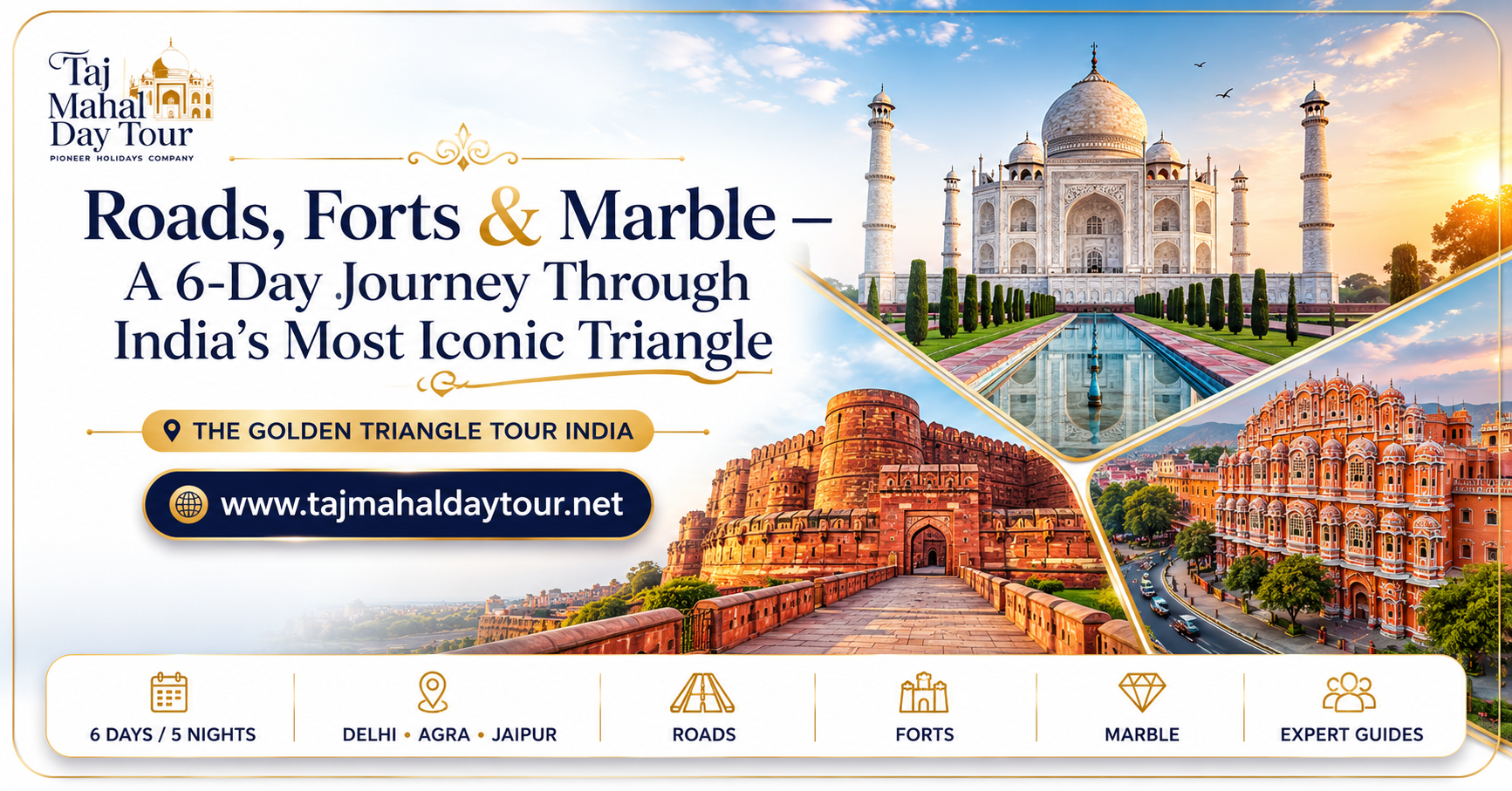
There are trips you plan. And then there are trips that stay with you long after the bags are unpacked, the clothes are washed, and life goes back to normal. My India golden triangle tour 6 days was the second kind.
I had no grand expectations. I had heard about Delhi, Agra, and Jaipur from friends, relatives, travel blogs, and YouTube videos. I thought I knew what I was walking into. Spoiler: I didn't. Not even close.
This blog is not a dry itinerary. It is what I actually saw, felt, ate, and sometimes argued about with my travel partner. I want you to read this and feel like you are sitting across from me at a chai stall, and I am telling you everything — the beauty, the chaos, the emotion, and yes, the one time I almost cried in front of a 400-year-old monument.
Day 1 — Delhi: The City That Hits You First
We landed in Delhi on a Tuesday morning. The air had that familiar sharpness — a mix of dust, diesel, and something faintly floral that I still cannot explain. Our hotel was near Connaught Place, and by 10 AM, we were already out on the streets.
Delhi does not ease you in. It throws you straight into the deep end.
We started at Humayun's Tomb — a place I had seen in textbooks but never truly understood until I stood in its garden and looked at that massive red sandstone structure rising against a pale blue sky. The symmetry of the place is almost unsettling. Every arch mirrors another arch. Every pathway leads somewhere intentional. The Mughals were clearly not people who did things halfway.
From there, we moved to the Qutub Minar. I had a funny moment here. I was trying to photograph the minar from a specific angle, walking backwards to fit it into my frame, and I nearly sat on a family's picnic spread. The mother looked at me with the kind of patience that only someone who has raised three children can possess. I apologized three times. She laughed once. Delhi people are like that — they have seen everything.
The evening was Old Delhi. Chandni Chowk at dusk is an experience I cannot translate into any language properly. The lanes are narrow, the smells are layered, the sounds are constant, and somehow in the middle of all of this, there is a peace. We ate at a tiny shop that had been making the same daal makhani recipe for over 80 years. The owner told us this with the confidence of someone announcing a Nobel Prize. He was right to be confident. It was extraordinary.
We went to bed that night full, a little overwhelmed, and genuinely excited for what was next.
Day 2 — The Road to Agra
The drive from Delhi to Agra on the Yamuna Expressway is about 3 to 3.5 hours depending on traffic. We left early — 6 AM — and the highway was golden with early morning light. Fields stretched out on both sides, and occasionally a peacock would stand by the road as if posing for a painting.
I want to mention something nobody tells you about the India golden triangle tour 6 days experience. The drive itself is part of the journey. The chai stops at roadside dhabas, the truck art you see painted on vehicles, the occasional group of schoolchildren in uniforms walking along a path — these are not background details. They are the actual story of India, running parallel to the monuments.
We reached Agra by mid-morning.
Day 3 — Agra: That Moment in Front of the Taj
I am going to be honest with you. I had quietly prepared myself to be underwhelmed by the Taj Mahal. I had seen so many photographs, so many films, so many paintings. I thought nothing could possibly match the hype anymore.
I was wrong.
When you walk through the main gateway — that tall red sandstone arch — and the Taj Mahal appears in full view at the end of a long reflecting pool, something happens in your chest. I don't have a scientific word for it. My travel partner, who is not generally an emotional person, grabbed my arm and didn't say anything for nearly two minutes. We just stood there.
The white marble changes colour with light. In the morning it is cool and almost bluish-white. By midday it turns bright and almost blinding. At sunset, it takes on a faint gold and pink that makes no sense unless you are standing there yourself. We stayed long enough to see two of these transitions and I would have stayed for the third if we didn't have more to see.
After the Taj, we visited Agra Fort — a massive red sandstone complex that tells the military and political story of the Mughal empire in stone and mortar. There is a tower inside from which Shah Jahan, in his final years under house arrest, could see the Taj Mahal in the distance. That detail hit me harder than I expected. Architecture as love letter, and then as comfort to a man who had lost everything.
We booked our Agra segment through tajmahaldaytour.net, and the guide they provided was exceptional. He didn't just recite facts. He told us stories — personal ones, about the craftsmen whose descendants still live in Agra, about the moonlight viewings that used to happen before modern access restrictions, about how the inlay work in the marble is done using a technique called Pietra Dura that no one has fully replicated since the 17th century.
We had dinner near the Taj Ganj area. Simple food. A rooftop. A view of the Taj under partial moonlight. I am not exaggerating when I say it was one of the best evenings of my life.
Day 4 — Fatehpur Sikri and the Road to Jaipur
On the way from Agra to Jaipur, we made a stop that many people skip and really shouldn't: Fatehpur Sikri.
This is a ghost city built by Emperor Akbar in the 1570s, abandoned within decades, and left in an almost miraculous state of preservation. The scale of the place is extraordinary. The Buland Darwaza — the gateway — is one of the largest entrance arches in the world and you feel every inch of it when you are standing at its base.
There is a mosque inside, the Jama Masjid, where thousands of people come to tie threads on a latticed marble screen at the tomb of the Sufi saint Salim Chishti. People come here to make wishes. The combination of the spiritual energy and the architectural precision of the space is something I kept returning to in my mind for days afterward.
From Fatehpur Sikri, we continued to Jaipur — a drive of about 3.5 hours through Rajasthan's landscape, which begins to shift and feel different from the moment you cross into the state. The light changes. The colours of the buildings change. Even the roadside shops look different.
We arrived in Jaipur in the evening and the city welcomed us with traffic, noise, and the kind of energy that makes you feel like something is always about to happen.
Day 5 — Jaipur: The Pink City Does Not Disappoint
Jaipur earned its nickname honestly. The old city buildings genuinely are painted in a warm terracotta pink — a colour that Maharaja Ram Singh II had them painted in 1876 to welcome the Prince of Wales. The effect, especially in the early morning before the streets get busy, is magical.
We started at the Amber Fort, which sits on a ridge about 11 kilometres from the city centre. The approach by road, as the fort reveals itself in stages along the hillside, is one of the great visual moments of this journey. Inside, the Sheesh Mahal — the Hall of Mirrors — is exactly as extraordinary as it sounds. A single flame reflected across thousands of tiny mirror pieces. The whole ceiling turns into stars. It is the kind of detail that makes you think about the human impulse to create beauty for its own sake.
Then City Palace, still partly home to the royal family of Jaipur. The museum sections are well-curated and the scale of the complex is impressive. There is a silver urn in one of the halls that is listed as the largest silver object in the world. It was used to carry Gangajal — holy water from the Ganges — for a king who refused to drink any other water while travelling abroad.
The Hawa Mahal — the Palace of Winds — is technically only one room deep. It was built so that the women of the royal household could observe street life and processions without being seen. From the outside it looks like an elaborate five-storey palace. From the inside, it is a single corridor of 953 small windows. There is something poetic about that — something enormous built around the idea of watching without being watched.
That evening we went to the Johari Bazaar and watched skilled craftsmen setting stones into silver jewellery on the pavement outside their shops. My travel partner bought a pair of earrings. I bought a small blue pottery bowl that I still keep on my desk.
Day 6 — Last Morning in Jaipur, Then Home
We kept the last morning slow. A walk through the old city. A long breakfast of kachori and chai. One final look at the Hawa Mahal in the morning light.
There is a particular sadness that comes at the end of a trip like this — not the sadness of something bad, but the sadness of something good ending. The India golden triangle tour 6 days format is well-designed for a reason. Six days is enough to go deep without rushing. You see three cities that each have distinct personalities, distinct histories, distinct foods. You cover empires — Mughal, Rajput, medieval, colonial. You eat food that has been made the same way for generations. You stand in front of things that make you feel genuinely small in the best possible way.
We booked the whole trip through tajmahaldaytour.net and the planning was seamless from start to finish — transfers, guides, hotel recommendations, timing advice. If you are thinking about doing this trip, I'd strongly suggest working with people who know these three cities properly rather than trying to piece it together yourself. The difference a good guide makes, especially at a place like the Taj Mahal or Amber Fort, is impossible to overstate.
On the flight back, I opened my phone to look at photographs. There were 487 of them from six days. I looked at every one.
Practical Notes Before You Go
Best time to visit: October to March. Summers are brutal in all three cities. Monsoon has its own charm but some monuments get slippery and crowded.
What to wear: Comfortable shoes are non-negotiable. You will walk more than you expect. For the Taj Mahal and Fatehpur Sikri, carry a scarf or stole to cover your head out of respect.
Currency: Keep some cash in INR for bazaars and street food. Most hotels and larger restaurants take cards.
Photography: The Taj Mahal prohibits tripods inside the main mausoleum. Sunrise entry is less crowded and the light is better.
Food safety: Eat at busy, established places. Avoid raw salads and tap water. Carry an ORS sachet just in case — heat and walking will dehydrate you faster than you expect.
Frequently Asked Questions
Q1. Is 6 days enough for the India golden triangle tour? Yes, 6 days is a well-suited duration for this circuit. You get roughly 2 days per city which allows you to see the major monuments, explore local bazaars, eat well, and absorb some of the atmosphere without feeling like you are simply checking boxes. If you have more time, you can always slow down in whichever city resonates with you most.
Q2. What is the best way to travel between Delhi, Agra, and Jaipur? Most travellers hire a private car or join an organized tour for the full circuit. Trains are also an option — the Gatimaan Express between Delhi and Agra is fast and scenic. However, a private vehicle gives you the most flexibility, especially for stops like Fatehpur Sikri between Agra and Jaipur.
Q3. How much does a 6-day golden triangle tour typically cost? Costs vary widely based on accommodation category and travel style. Budget travellers can manage on ₹4,000–6,000 per day. Mid-range travel with comfortable hotels and a guide runs ₹8,000–15,000 per day. Luxury options go higher. Entry fees for monuments are separate and relatively modest.
Q4. Is the golden triangle safe for solo travellers and foreign tourists? Yes, these three cities are among the most visited in India and are well-equipped for tourists. Basic precautions — keeping an eye on your belongings in crowded bazaars, using registered guides, sticking to well-reviewed transport — apply as they would anywhere. Women travelling solo have done this circuit safely, though having a trusted contact or tour operator is always reassuring.
Q5. Can I do the Taj Mahal sunrise visit on this itinerary? Absolutely, and it is highly recommended. The Taj opens before sunrise and the early morning light on white marble is a genuinely different visual experience from midday. The crowds are also significantly thinner in the first hour after opening.
Q6. What are the must-eat foods on this route? In Delhi: daal makhani, parathas from Chandni Chowk, chaat. In Agra: petha (the sweet is iconic to the city), Mughlai biryani, bedai-sabzi for breakfast. In Jaipur: dal baati churma, kachori with sabzi, laal maas if you eat non-vegetarian.
Q7. Do I need a guide for each city or can I explore independently? You can explore independently but a good guide adds enormous value, particularly at Agra and Jaipur where the historical context is rich and not always explained well on standard notice boards. Sites like the Taj Mahal and Amber Fort reveal layers of detail — architectural, personal, political — that a knowledgeable local guide will bring alive in a way that no app or brochure fully manages.
- Digital Agency
- Literie
- Location de voitures
- Restaurant
- Restaurant
- Mode
- Mode
- Information
- Marketing
- Tourisme
- Développement
- Découverte
- Législation
- Gastronomie
- Pâtisserie
- Veranstaltung
- Art
- Causes
- Crafts
- Dance
- Drinks
- Film
- Fitness
- Food
- Spiele
- Gardening
- Health
- Startseite
- Literature
- Music
- Networking
- Andere
- Party
- Religion
- Shopping
- Sports
- Theater
- Wellness
 Deutsch
 Indian
 English
 French
 Arabic
 Spanish
 Portuguese
 Turkish
 Dutch
Dutch
 Italiano
 Russian
 Romaian
 Portuguese (Brazil)
 Greek
Greek
