


From Delhi to Agra to Jaipur: A 6-Day Journey Through India's Most Iconic Cities
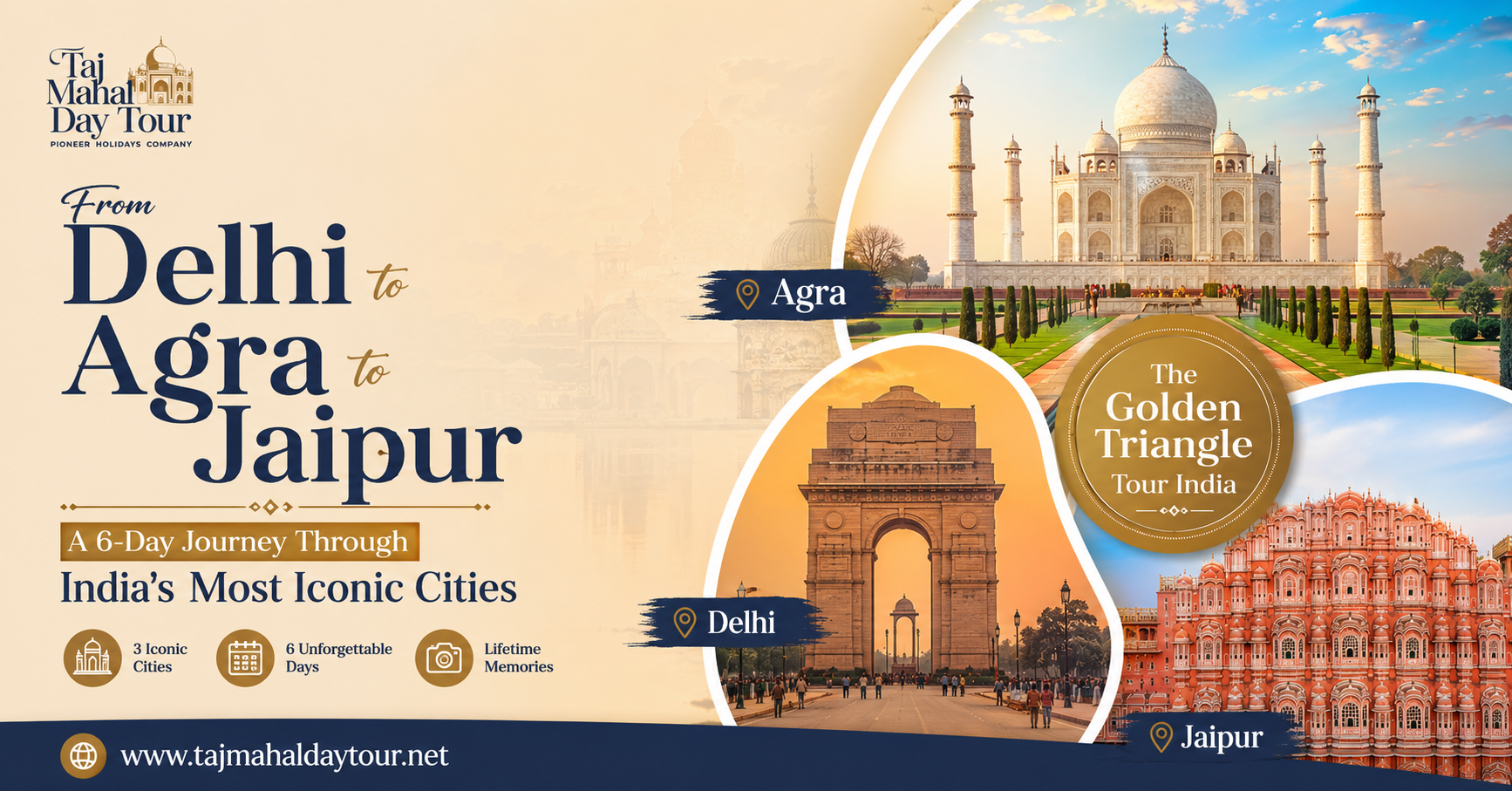
India is one of those countries that stays with you long after you leave. The smells, the colors, the noise, the kindness of strangers — it all adds up to something that is hard to describe but impossible to forget. And if you are visiting India for the first time, there is no better way to start than the India Golden Triangle Tour 6 Days itinerary. Three cities, six days, and a lifetime of memories.
This route connects Delhi, Agra, and Jaipur — three cities that together tell the story of India better than any book ever could. Mughal emperors, Rajput warriors, street food legends, and the most photographed building on the planet — it is all here, and it is all waiting for you.
What Is the Golden Triangle?
The "Golden Triangle" is the name given to the travel circuit connecting Delhi, Agra, and Jaipur. On a map, these three cities form a rough triangle, each roughly 200 to 250 kilometers apart from the other. This makes travel between them convenient and manageable, even for first-time visitors to India.
Each city has its own personality. Delhi is the capital — loud, layered, and full of contradictions. Agra is quieter but carries the weight of one of the world's greatest love stories in stone. Jaipur is painted pink and carries the pride of Rajasthan in every wall, fort, and bazaar. Together, they give you a complete picture of India: ancient and modern, humble and grand, chaotic and deeply spiritual.
Day 1 — Arriving in Delhi: A City That Never Stops
Your India Golden Triangle Tour 6 Days begins in Delhi. If this is your first time, the city will hit you all at once — the traffic, the temples, the street food stalls, the auto-rickshaws weaving through lanes that seem too narrow for anything with wheels.
Start your first day gently. Check into your hotel and rest for a few hours. In the evening, head to Connaught Place, Delhi's central business and shopping district, for a walk and dinner. Try some street chaat at the nearby vendors or sit down at one of the many restaurants serving everything from tandoori chicken to South Indian dosas.
Delhi runs on energy, and you will need yours for the days ahead.
Day 2 — Old Delhi and New Delhi: Two Worlds, One City
Day two is a full Delhi day, and there is no shortage of things to see.
Start in Old Delhi, the historic heart of the city built by Mughal Emperor Shah Jahan in the 17th century. Visit the Red Fort (Lal Qila), a massive sandstone fortress that served as the main residence of the Mughal emperors for nearly 200 years. Walk through the Chandni Chowk market, one of the oldest and busiest markets in Asia. The lanes here sell everything — spices, silver jewelry, wedding clothes, street food, and electronics — all crammed into a space that feels like it belongs to another century.
Stop at the Jama Masjid, India's largest mosque, built in 1656. The scale of it is humbling. Climb the minarets if you wish — the view over Old Delhi from the top is extraordinary.
In the afternoon, shift to New Delhi, the city planned by the British in the early 20th century. Visit Humayun's Tomb, a stunning Mughal garden tomb and a UNESCO World Heritage Site. Many people do not know that this building was one of the inspirations for the Taj Mahal. Walk through Lodhi Garden nearby — a park full of medieval tombs where locals jog and families picnic on weekend mornings.
End your day at India Gate, the war memorial arch that stands at the heart of New Delhi's grand ceremonial boulevard. In the evening, the area fills with families, couples, and children playing. It is a lovely, relaxed way to close a full day.
Day 3 — Delhi to Agra: Enter the World of the Taj Mahal
On the morning of Day 3, you leave Delhi and head to Agra, around 200 kilometers south. The drive takes roughly 3 to 4 hours by road, or you can take the fast Gatimaan Express train, which covers the distance in under two hours and is a comfortable and scenic option.
Agra greets you with one expectation: the Taj Mahal. And it will not disappoint.
Arrive in time for the afternoon visit to the Taj Mahal. Most visitors think the early morning is the only good time, but the late afternoon light — golden, soft, and warm — is equally beautiful. The white marble changes color as the sun moves, shifting from bright white at noon to a gentle amber and pink as evening approaches.
Take your time here. Walk around the central platform, look at the intricate inlay work on the walls — tiny pieces of precious stone set into marble in patterns of unbelievable delicacy. Read about Shah Jahan, who built this monument as a tomb for his wife Mumtaz Mahal, who died in 1631. The grief in the story makes the beauty of the building even more moving.
After the Taj Mahal, visit the nearby Agra Fort, another UNESCO World Heritage Site, where Shah Jahan spent the final years of his life as a prisoner of his own son — able to see the Taj Mahal from his window but never able to visit his wife's tomb again.
Have dinner in Agra and rest for the night.
Day 4 — Agra: Fatehpur Sikri and the Baby Taj
Day 4 gives you more time in Agra before the road takes you toward Jaipur.
Start the morning with a visit to Itmad-ud-Daulah's Tomb, often called the "Baby Taj." Built slightly before the Taj Mahal, this is the tomb of a Mughal nobleman and is considered a transition point between earlier Mughal architecture and the full-blown marble masterpiece that came after it. It is smaller, quieter, and far less crowded — which means you can really look at the craftsmanship up close.
Then drive about 40 kilometers to Fatehpur Sikri, a ghost city built by Emperor Akbar in the 16th century. He built it as his capital, lived there for 14 years, and then abandoned it — historians believe due to water shortages. Today it stands almost perfectly preserved, a city of red sandstone palaces, courtyards, and a magnificent mosque. Walking through it feels like stepping into a history book.
Return to Agra for lunch, then begin the road journey toward Jaipur. The drive takes around 4 to 5 hours. You can also break it up by stopping at Bharatpur Bird Sanctuary, especially if you are visiting between October and March — the wetlands here host thousands of migratory birds and are a UNESCO World Heritage Site.
Arrive in Jaipur by evening and check in to your hotel.
Day 5 — Jaipur: The Pink City of Rajasthan
Jaipur is a feast for the eyes. The old walled city is painted in shades of terracotta-pink, a tradition dating back to 1876 when the Maharaja had the city painted to welcome the visiting Prince of Wales. That color has stuck ever since, and today it defines the city's personality.
Start your Jaipur day with Amber Fort (Amer Fort), perched on a hillside about 11 kilometers from the city center. This is one of the finest examples of Rajput architecture in India — a fort that looks like it grew out of the mountain itself. The interiors are covered in mirror mosaics, painted plasterwork, and carved marble. Climb up on foot or take an elephant or jeep ride up the cobbled ramp. The views from the top over the surrounding hills and lakes are stunning.
Back in the city, stop at the Hawa Mahal (Palace of Winds) — the most photographed building in Jaipur. Its five-story facade is made up of 953 tiny windows designed so the women of the royal household could watch street life below without being seen. From the outside, it looks like a honeycomb built for queens.
Walk through the City Palace complex, home to the royal family of Jaipur — they still live in part of it today. The museum inside displays royal carriages, weapons, costumes, and art. Just outside the palace walls is the Jantar Mantar, an 18th-century astronomical observatory full of giant stone instruments used to measure time and celestial positions. It looks like abstract sculpture, but it all actually works.
Spend the evening exploring the Johari Bazaar and Bapu Bazaar — Jaipur's famous markets for gemstones, silver jewelry, block-printed textiles, leather shoes, and handicrafts. Jaipur is famous across India for its shopping, and you will understand why within minutes of walking these lanes.
Day 6 — Jaipur to Delhi: The Final Morning
Your last full day on the India Golden Triangle Tour 6 Days begins with a visit to the Nahargarh Fort, which sits on the ridge of the Aravalli Hills above Jaipur. The fort itself is interesting, but the main reason to come here is the view — looking out over the entire city spread below you, with the desert plains stretching beyond. It is one of the best views in all of Rajasthan.
After this, take a relaxed drive back to Delhi. The journey takes about 5 hours by road. You can also fly — Jaipur airport has frequent daily flights to Delhi, taking just under an hour.
Back in Delhi, you have a free evening to pick up last-minute souvenirs at Dilli Haat — an open-air craft bazaar run by the Delhi government, where artisans from all over India sell their work directly. It is a wonderful final stop.
Why Book Your Golden Triangle Tour with Tajmahaldaytour.net
Traveling a circuit like this requires planning — booking hotels, hiring reliable drivers, arranging guides who actually know their subject, and building a pace that lets you enjoy each place rather than rush through it. That is exactly what Tajmahaldaytour.net does.
They specialize in the Golden Triangle route and know every road, every shortcut, every best-light moment at the Taj Mahal, every hidden lane in Chandni Chowk, and every reliable restaurant along the way. Their drivers are experienced, their guides are knowledgeable, and their itineraries are built for real travelers — not just tourists.
Whether you are traveling solo, as a couple, or with family, Tajmahaldaytour.net can customize the pace and experience to fit what you actually want from your trip.
Practical Information
Best Time to Visit: October to March is the most comfortable season. Winters in North India (December–January) can be cool, especially at night, but the days are clear and pleasant. Avoid May and June when temperatures in Agra and Jaipur can exceed 45°C.
Getting Around: Private car with driver is the most flexible and recommended option for the Golden Triangle. Trains work well for the Delhi–Agra leg. Flights are available between all three cities if you want to save time.
Currency: Indian Rupee (INR). ATMs are widely available. Most hotels and larger shops accept cards, but carry cash for markets and small vendors.
Visa: Most nationalities can apply for an Indian e-Visa online, valid for 30 to 90 days depending on your citizenship.
What to Pack: Comfortable walking shoes, light breathable clothing, a scarf or shawl (required to enter mosques and temples), sunscreen, and a small day bag.
FAQs — India Golden Triangle Tour 6 Days
Q1: Is 6 days enough for the Golden Triangle? Yes, 6 days is a comfortable amount of time to cover Delhi, Agra, and Jaipur without feeling rushed. You get 2 days in Delhi, 2 days in Agra, and 2 days in Jaipur, which gives you time to see the major sights and also wander, shop, and eat properly.
Q2: What is the best way to travel between the three cities? A private car with a driver is the most popular and convenient option, especially for families and couples. For the Delhi–Agra route, the Gatimaan Express train is also excellent — fast, clean, and comfortable.
Q3: How much does a Golden Triangle tour cost? The cost depends on the level of accommodation and whether you book a package or travel independently. Budget travelers can complete the tour for $400–$600 USD, while mid-range packages with good hotels typically run $800–$1,500 USD per person. Luxury options go significantly higher.
Q4: Is the Golden Triangle safe for solo travelers? Yes. Delhi, Agra, and Jaipur are among the most visited tourist destinations in India and are well set up for solo travelers, including solo women travelers. As with any destination, standard precautions apply — use registered taxis or pre-booked transport, keep valuables secure, and stay aware in crowded areas.
Q5: When is the best time to visit the Taj Mahal? Sunrise is the most famous time to visit — the light is soft and the crowds are manageable in the early morning. However, the late afternoon (around 4–5 PM) is equally beautiful as the sun turns the marble golden. The Taj Mahal is closed on Fridays.
Q6: Can I extend the India Golden Triangle Tour beyond 6 days? Absolutely. Many travelers add Varanasi, Ranthambore National Park (tiger safari), Pushkar, or Udaipur to the route. Ranthambore is especially popular as it is roughly on the road between Agra and Jaipur. Tajmahaldaytour.net can help you customize any extension.
Q7: Is it necessary to hire a guide at each monument? It is not mandatory, but it makes a big difference. A good guide at the Taj Mahal, Amber Fort, or Red Fort can bring the history alive in a way that no sign or audio tour can match. Most reputable tour operators, including Tajmahaldaytour.net, include knowledgeable English-speaking guides in their packages.
Q8: What should I not miss on the Golden Triangle? Beyond the obvious highlights (Taj Mahal, Red Fort, Amber Fort), do not miss the street food in Chandni Chowk, a sunset at Nahargarh Fort in Jaipur, the quieter beauty of Itmad-ud-Daulah in Agra, and an evening walk through Lodhi Garden in Delhi. These less obvious moments are often what people remember most.
Traveling is about more than checking monuments off a list. It is about the moment the light hits the Taj Mahal and you forget to take a photo because you are too busy just looking. It is about the taste of a jalebhi from a Chandni Chowk shop that has been frying them the same way for 70 years. It is about standing on the walls of Amber Fort and feeling the history beneath your feet.
That is what an India Golden Triangle Tour 6 Days gives you. Not just sights — but stories you will carry for the rest of your life.
- Digital Agency
- Literie
- Location de voitures
- Restaurant
- Restaurant
- Mode
- Mode
- Information
- Marketing
- Tourisme
- Développement
- Découverte
- Législation
- Gastronomie
- Pâtisserie
- Event
- Art
- Causes
- Crafts
- Dance
- Drinks
- Film
- Fitness
- Food
- Games
- Gardening
- Health
- Home
- Literature
- Music
- Networking
- Other
- Party
- Religion
- Shopping
- Sports
- Theater
- Wellness
 English
 Indian
 French
 Arabic
 Spanish
 Portuguese
 Deutsch
 Turkish
 Dutch
Dutch
 Italiano
 Russian
 Romaian
 Portuguese (Brazil)
 Greek
Greek
