Projection welding is a highly efficient resistance welding process widely used in mass production environments where strong, repeatable, and high-precision joints are required. It is especially valuable in automotive, electrical, heavy machinery, and appliance manufacturing, where multiple welds must be completed in a short cycle time with consistent quality.
As global manufacturing continues to move toward automation and high-volume production, projection welding has become a critical joining technology for OEMs and factory engineers seeking improved productivity, reduced operational costs, and superior weld reliability.
Heron Welder is a leading provider of advanced resistance welding systems, including projection welding machines, automation lines, welding guns, and intelligent controllers designed to meet modern industrial requirements.
What is Projection Welding?
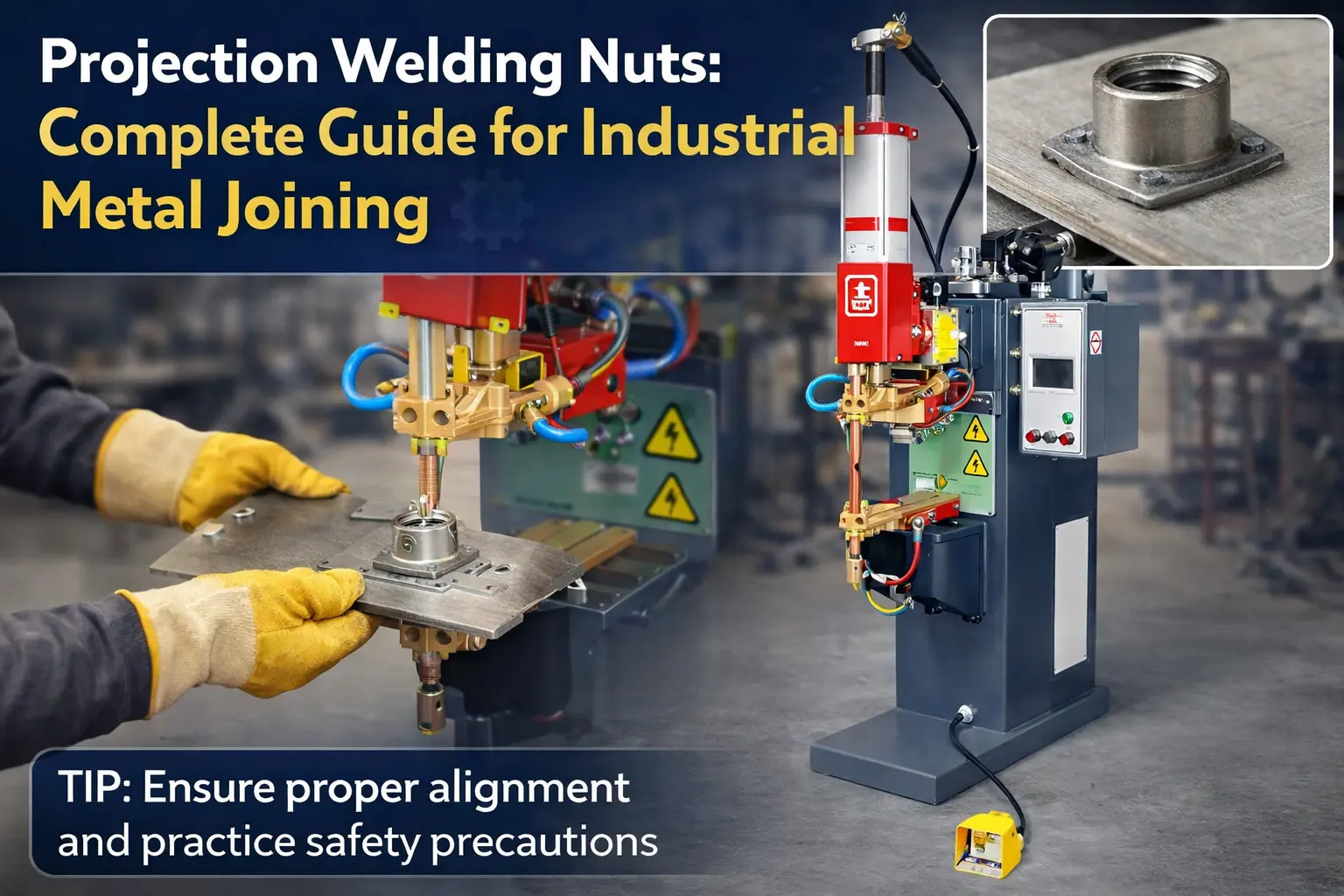
Projection welding is a variation of resistance welding in which heat is concentrated at pre-formed projections (raised points) on the surface of the workpiece. These projections act as controlled contact points that focus current and pressure, allowing multiple welds to be completed simultaneously in a single operation.
Instead of relying on electrode shape or surface contact alone, projection welding uses the geometry of the part itself to control weld location and energy distribution.
Key Principle
The process is based on three fundamental factors:
- Electrical resistance at projection points generates heat
- Applied pressure concentrates current at defined locations
- Localized melting forms strong metallurgical bonds
When current passes through the projections, heat builds rapidly, causing the projections to collapse and fuse the materials together under pressure.
Types of Projection Welding
Projection welding can be categorized based on application and part geometry:
1. Solid Projection Welding
Used when projections are pre-formed into one of the workpieces. Common in stamped sheet metal components.
2. Embossed Projection Welding
Utilizes embossed or raised features designed during part stamping for controlled welding.
3. Nut and Stud Projection Welding
Widely used in automotive manufacturing for fastening nuts, bolts, and studs to sheet metal assemblies.
4. Multi-Projection Welding
Multiple projections are welded simultaneously, increasing productivity and ensuring uniform load distribution.
Projection Welding Process: Step-by-Step
Understanding the process helps engineers optimize production and improve weld quality.
1. Part Preparation
Workpieces are designed with engineered projections using stamping or machining processes.
2. Alignment and Clamping
Components are positioned between electrodes with precise alignment.
3. Electrode Pressure Application
Controlled force is applied to ensure contact at projection points.
4. Current Flow
High electrical current is passed through the projections, generating localized heat.
5. Projection Collapse
Projections melt and collapse, forming a solid weld nugget.
6. Solidification
Pressure is maintained during cooling to ensure strong metallurgical bonding.
Advantages of Projection Welding
Projection welding offers several advantages over conventional welding methods:
High Productivity
Multiple welds can be completed in a single cycle, significantly reducing production time.
Precise Weld Location
Welds occur only at predefined projection points, ensuring consistent quality.
Reduced Electrode Wear
Compared to spot welding, electrode degradation is lower due to controlled contact areas.
Better Aesthetic Finish
Minimal surface marking makes it ideal for visible components.
Suitable for Automation
Easily integrated into robotic and automated production systems.
Projection Welding vs Spot Welding
Although both processes belong to resistance welding, they differ in key aspects:
| Feature |
Projection Welding |
Spot Welding |
| Contact Point |
Pre-formed projections |
Electrode tips |
| Number of Welds |
Multiple per cycle |
Usually single |
| Tool Wear |
Lower |
Higher |
| Setup Complexity |
Higher (part design required) |
Lower |
| Automation Suitability |
Excellent |
Excellent |
Projection welding is preferred when high-volume, repeatable production is required with multiple weld points in a single operation.
Industrial Applications of Projection Welding
Projection welding is widely used across multiple industries due to its efficiency and reliability.
Automotive Industry
- Door hinges
- Seat frames
- Brackets and fasteners
- Nut and stud attachment
Electrical Industry
- Electrical contacts
- Terminal assemblies
- Switchgear components
Appliance Manufacturing
- Refrigerator panels
- Washing machine frames
- HVAC components
Heavy Machinery
- Structural brackets
- Load-bearing assemblies
- Reinforcement joints
Fastener Manufacturing
- Nuts, bolts, washers, and studs welded to sheet metal
Key Process Parameters in Projection Welding
To achieve optimal weld quality, several parameters must be carefully controlled:
Welding Current
Higher current ensures sufficient heat generation at projection points.
Welding Time
Short, controlled time prevents overheating and material distortion.
Electrode Force
Ensures proper contact and controls projection collapse.
Projection Design
Geometry determines weld strength and consistency.
Material Properties
Electrical resistance and thermal conductivity influence weld behavior.
Best Practices for High-Quality Projection Welding
Manufacturers can improve weld consistency by following these practices:
- Use uniform projection geometry for balanced current flow
- Maintain clean surfaces to reduce resistance inconsistencies
- Optimize electrode alignment to prevent uneven pressure
- Select appropriate welding parameters for material type
- Implement regular electrode maintenance schedules
- Use automated systems for repeatability in mass production
Role of Automation in Projection Welding
Modern manufacturing increasingly relies on automation to improve efficiency and reduce human error. Projection welding is highly compatible with robotic systems and automated production lines.
Automated projection welding systems offer:
- Real-time monitoring of weld quality
- Adaptive control of current and force
- Reduced cycle time
- Integration with production line PLC systems
- Improved traceability and data logging
Heron Welder specializes in designing fully automated resistance welding solutions that integrate projection welding machines with advanced controllers, robotic arms, and production line systems. These solutions are tailored for OEMs and high-volume manufacturers seeking scalable and efficient welding operations.
Equipment Used in Projection Welding
A typical projection welding setup includes:
- Projection welding machine (MFDC or AC type)
- Precision electrodes
- Welding controller system
- Cooling system for electrodes
- Fixture and tooling system
- Automation interface (for robotic integration)
Modern systems often include digital monitoring for weld consistency and defect detection.
Common Challenges and Solutions
Uneven Weld Strength
Caused by inconsistent projection design or misalignment.
Solution: Standardize projection geometry and improve fixture accuracy.
Excessive Electrode Wear
Occurs due to high current or poor cooling.
Solution: Optimize cooling systems and electrode materials.
Incomplete Weld Formation
Due to insufficient current or pressure.
Solution: Adjust welding parameters and ensure proper surface contact.
Future of Projection Welding in Manufacturing
As industries move toward smart manufacturing and Industry 4.0 systems, projection welding is evolving with:
- AI-based weld monitoring
- Adaptive process control systems
- Energy-efficient MFDC welding technology
- Fully automated robotic welding cells
- Data-driven quality assurance systems
These advancements are making projection welding even more reliable, scalable, and suitable for precision manufacturing environments.
FAQs About Projection Welding
1. What materials are suitable for projection welding?
Projection welding works well with low-carbon steel, stainless steel, aluminum alloys, and coated metals depending on system configuration.
2. Why is projection welding preferred in automotive manufacturing?
It allows multiple welds in a single cycle, reduces production time, and ensures high repeatability in mass production.
3. How does projection design affect weld quality?
Projection shape and size directly influence heat concentration, weld strength, and consistency.
4. Can projection welding be automated?
Yes, it is highly suitable for automation and is commonly used in robotic production lines.
5. What industries benefit most from projection welding?
Automotive, appliance manufacturing, electrical systems, and heavy machinery industries benefit the most.
Conclusion
Projection welding is a powerful and efficient resistance welding process designed for high-volume, precision-driven manufacturing. Its ability to deliver multiple consistent welds in a single cycle makes it a preferred solution for modern industrial production lines.
With increasing demand for automation and productivity, manufacturers require advanced welding systems that ensure quality, speed, and reliability.
Heron Welder provides cutting-edge projection welding machines and integrated automation solutions designed to meet the evolving needs of OEMs, engineers, and industrial manufacturers worldwide.
Request a Customized Welding Solution
If you are looking to improve production efficiency, reduce welding cycle time, or implement automated projection welding systems in your factory, Heron Welder offers customized engineering solutions tailored to your application needs.
Contact Heron’s technical team to request a quote or consultation for advanced projection welding and automation systems.



 English
 Indian
 French
 Arabic
 Spanish
 Portuguese
 Deutsch
 Turkish
 Dutch
Dutch
 Italiano
 Russian
 Romaian
 Portuguese (Brazil)
 Greek
Greek
