


What Is an AI Outbound Calling System and How Does It Work?
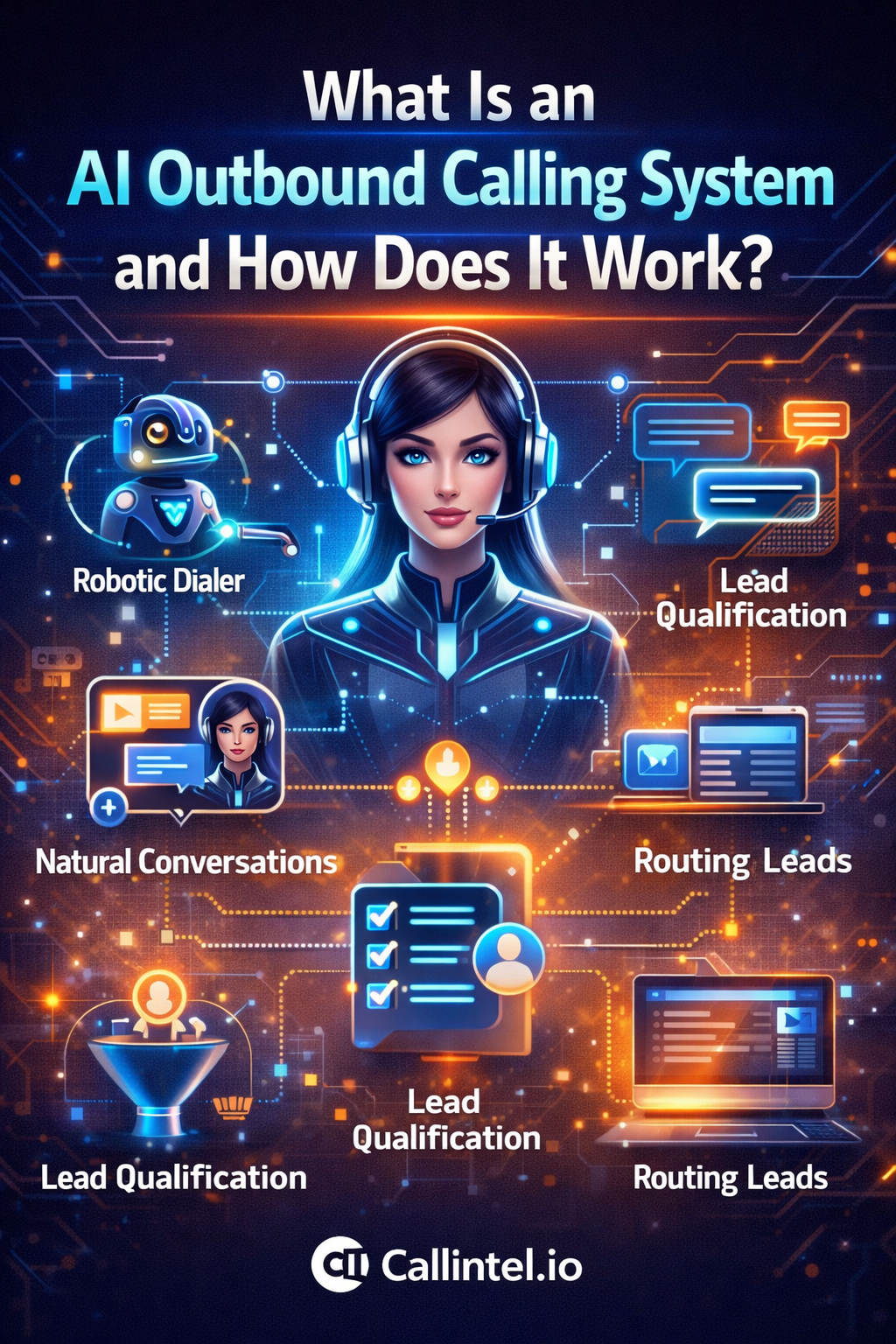
Businesses today are under constant pressure to reach more leads, follow up faster, and convert conversations into revenue. But traditional outbound calling is slow, expensive, and hard to scale. Sales teams can only make a limited number of calls in a day, and manual follow-ups often lead to missed opportunities.
This is where an AI outbound calling system changes the game.
An AI-powered calling platform can automate large parts of outbound communication, helping businesses contact leads, qualify prospects, book appointments, send reminders, and handle repetitive conversations without depending only on human agents. Platforms like CallIntel.io position their AI voice agents for both inbound and outbound calls, lead qualification, appointment booking, 24/7 availability, and escalation of complex conversations to human agents.
What Is an AI Outbound Calling System?
An AI outbound calling system is a software platform that uses artificial intelligence to make outgoing phone calls and interact with people in a natural, conversational way. Instead of relying only on pre-recorded robocalls or manual dialing by agents, modern AI outbound calling tools can understand spoken responses, reply intelligently, gather information, and move the conversation toward a business goal.
These systems are commonly used for:
-
Lead qualification
-
Sales outreach
-
Appointment scheduling
-
Payment reminders
-
Customer follow-ups
-
Survey calls
-
Re-engagement campaigns
Unlike older automated dialers, modern AI outbound calling solutions are designed to sound more human-like and respond dynamically during a conversation. CallIntel describes its platform as AI-powered calling that manages inbound and outbound calls, qualifies leads around the clock, and accelerates sales cycles.
How Does AI Outbound Calling Work?
At a basic level, an AI outbound calling system follows a workflow like this:
1. It receives a contact list or trigger
The system starts with a list of leads, customers, or event-based triggers. For example, a business may want to call new leads from a CRM, remind customers about appointments, or follow up after a form submission.
2. It places outbound calls automatically
The platform dials numbers at scale without requiring a human rep to manually make each call. This is one of the main reasons businesses adopt AI outbound calls for higher efficiency and faster response times.
3. It speaks with the customer using AI voice technology
Once the person answers, the AI voice agent introduces itself, explains the purpose of the call, and continues the conversation based on the customer’s responses. This is usually powered by a stack involving speech recognition, language understanding, decision logic, and text-to-speech systems. Research on telecom-focused real-time voice agents highlights this kind of pipeline using streaming ASR, LLM-based conversational intelligence, and real-time TTS for interactive calling experiences.
4. It understands and responds in real time
A strong AI outbound calling system does more than read a script. It interprets intent, answers common questions, collects data, and guides the user to the next step.
For example, if the call is for lead qualification, the AI may ask:
-
Are you interested in learning more?
-
What is your budget?
-
When would you like a demo?
-
Should I schedule a callback with a sales specialist?
5. It updates systems and workflows
After the call, the platform can log call outcomes, update CRM records, trigger follow-up sequences, book appointments, or hand off hot leads to a human sales rep.
6. It escalates when needed
Not every call should stay fully automated. When a conversation becomes complex, sensitive, or high-intent, the best systems route the call to a human. CallIntel says its smart routing system escalates complex calls to human agents while businesses retain control over escalation rules and call reviews.
Key Technologies Behind AI Outbound Calling
To understand how AI outbound calling works, it helps to break the system into its core parts:
Speech Recognition
This converts the customer’s spoken words into text.
Natural Language Understanding
This helps the system figure out the meaning and intent behind what the person says.
Conversation Logic
This determines what the AI should say next based on business rules, scripts, goals, or knowledge sources.
Text-to-Speech
This converts AI-generated responses into natural-sounding voice output.
Integrations
The system often connects with CRMs, calendars, helpdesks, and internal tools so that every AI outbound call leads to an action.
Benefits of an AI Outbound Calling System
1. Higher call volume without hiring more agents
AI can place and handle many calls simultaneously, which helps businesses scale outreach without growing headcount at the same pace. CallIntel’s blog says human agents making roughly 50–80 calls per day can be replaced by AI systems that handle outreach at much larger scale.
2. Faster lead response
Speed matters in sales. An AI system can call new leads almost instantly after a form submission or inquiry.
3. 24/7 availability
Unlike traditional teams, AI voice agents can operate outside business hours. CallIntel presents its AI agents as available 24/7 for lead qualification and customer engagement.
4. Lower operational costs
An AI outbound calling system can reduce repetitive workload for human teams, allowing them to focus on high-value conversations.
5. Consistent messaging
Every call follows approved business logic, reducing inconsistency in sales or service communication.
6. Better lead qualification
AI can ask structured questions, score responses, and send only qualified leads to the human team. CallIntel specifically highlights outbound calling for contacting potential customers and recognizing human responses as part of lead qualification workflows.
Common Use Cases for AI Outbound Calls
Businesses use AI outbound calls in many ways, including:
Sales outreach
AI can contact new leads, introduce products, qualify interest, and set appointments.
Appointment reminders
Healthcare, salons, clinics, and service businesses can reduce no-shows with proactive reminders. CallIntel’s healthcare content specifically mentions outbound reminders, confirmations, and rescheduling support.
Payment reminders
Finance, utilities, and subscription businesses can automate reminder calls.
Customer feedback and surveys
AI can collect post-service feedback at scale.
Re-engagement campaigns
Businesses can reconnect with inactive customers or old leads.
Event confirmations
AI can confirm attendance, remind registrants, or provide event details.
AI Outbound Calling vs Traditional Outbound Calling
Traditional outbound teams are valuable, but they face limits. Human reps need breaks, work fixed hours, and can only handle one live call at a time. They also spend a lot of time on repetitive conversations that do not require deep expertise.
An AI outbound calling system is better suited for repetitive, high-volume, first-touch communication. Human reps are still essential for negotiation, relationship-building, and complex objections. The strongest approach is often hybrid: AI handles qualification and routine outreach, while human reps step in for the most important conversations.
That hybrid model is also how CallIntel presents its solution. AI handles inbound and outbound engagement, while complex calls can be transferred to human agents.
How CallIntel.io Fits In
If you are exploring an AI outbound calling system for your business, CallIntel.io is one of the platforms in this space focused on AI-powered voice automation. According to its site, CallIntel offers AI voice agents for inbound and outbound calls, lead qualification, appointment booking, customer support, and smart call routing for escalation. It also states that its platform supports compliance requirements such as TCPA, GDPR, and HIPAA.
This makes CallIntel relevant for businesses that want to:
-
automate outbound lead follow-ups
-
qualify prospects faster
-
reduce missed opportunities
-
support customers around the clock
-
combine AI efficiency with human handoff when needed
What to Look for in an AI Outbound Calling Platform
Before choosing any AI outbound calling tool, consider these factors:
Conversation quality
Does the AI sound natural and handle real back-and-forth conversations well?
CRM and workflow integration
Can it connect to your sales and support stack?
Escalation controls
Can it transfer important or difficult calls to humans smoothly?
Compliance
Does the provider support the regulations relevant to your business and region?
Reporting and analytics
Can you track call outcomes, qualification rates, bookings, and conversions?
Industry fit
Does the system support your use case, whether sales, healthcare, ecommerce, or support?
Final Thoughts
An AI outbound calling system helps businesses automate outbound communication in a way that is faster, more scalable, and more efficient than traditional calling alone. From lead qualification to appointment reminders and customer follow-ups, AI outbound calling is becoming a practical solution for companies that want to improve response time and reduce manual effort.
The real value of AI outbound calls is not just automation. It is the ability to combine speed, consistency, and intelligent conversations at scale. And when paired with human escalation for complex cases, platforms such as CallIntel.io show how businesses can modernize phone outreach without losing control of the customer experience.
- Digital Agency
- Literie
- Location de voitures
- Restaurant
- Restaurant
- Mode
- Mode
- Information
- Marketing
- Tourisme
- Développement
- Découverte
- Législation
- Gastronomie
- Pâtisserie
- Evento
- Art
- Causes
- Crafts
- Dance
- Drinks
- Film
- Fitness
- Food
- Jogos
- Gardening
- Health
- Início
- Literature
- Music
- Networking
- Outro
- Party
- Religion
- Shopping
- Sports
- Theater
- Wellness
 Portuguese (Brazil)
 Indian
 English
 French
 Arabic
 Spanish
 Portuguese
 Deutsch
 Turkish
 Dutch
Dutch
 Italiano
 Russian
 Romaian
 Greek
Greek
