


Nobody Will Tell You This About Buying Wholesale Leather Purses in Bulk
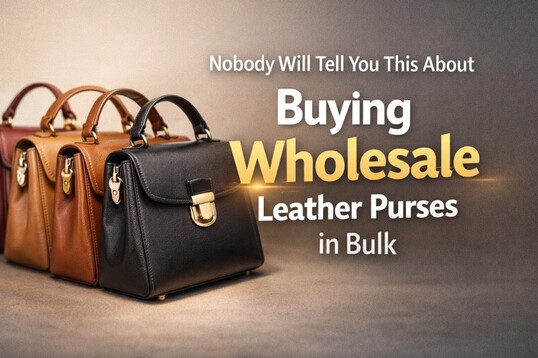
Most wholesale buying guides tell you the same things. Check the quality. Verify the minimums. Request a sample. Compare prices. That's not bad advice. It's just incomplete, and the gaps in it are exactly where most bulk leather purse orders go sideways.
The things nobody volunteers upfront are the things that cost brands the most. The material grade that looks identical in a photo to the one above it but ages completely differently in a customer's hands. The supplier communication pattern that's fine before the order and unresponsive during it. The sample that was produced by the best hands in the factory and the bulk run that wasn't. The hardware spec that everyone assumed and nobody confirmed.
This piece covers what the standard advice leaves out, the specific, uncomfortable truths about buying wholesale leather purses in bulk that experienced buyers know and first-timers figure out the expensive way.
The Leather Grade Problem Nobody Talks About Directly
Walk into most wholesale conversations and ask about leather quality and you'll hear the same answer: premium, high-quality, genuine leather. Every supplier uses these words. None of them mean the same thing. And almost none of them will volunteer the distinction unless you force the question.
Here's what the words actually mean in practice.
Full-grain leather is the top layer of the hide with the natural surface intact. The grain pattern is real, the fiber structure is dense, and the material develops a patina, a deepening richness of color and character, with daily use over time. It's the most durable grade and the most expensive. A full-grain leather purse carried every day for three years looks better at year three than it did at purchase. That aging story is one of the most powerful brand assets in the accessories market, and it's only available in full-grain.
Top-grain leather has had the surface sanded to remove natural imperfections, then finished with a coating. It looks cleaner and more uniform than full-grain, which is actually a quality downgrade disguised as consistency. The sanding removes the dense outer fiber layer that gives full-grain its durability. The surface coating wears through over time. Top-grain doesn't develop a patina, it develops wear patterns.
Genuine leather is a term that covers a range of lower-grade materials, often split from the inner layers of the hide and processed heavily to look like something it isn't. It's the most widely used grade in the mid-to-low price point wholesale market and the one most often described as "premium" by suppliers who are hoping you won't push for details.
When you're evaluating suppliers for leather purses wholesale in bulk, the question that separates the grades is specific: what layer of the hide is this from and how has the surface been finished? A supplier with quality material answers immediately. A supplier deflecting to "premium" or "high-quality" without specifics is usually working in the grades that don't hold up to scrutiny.
The brand consequence of getting this wrong at bulk volume is significant. A hundred customers carrying your branded leather purse through its first year and watching the surface coat crack at the stress points is a hundred specific, product-grounded reasons to never buy from your brand again. Getting the grade right at the sourcing stage is the single most important decision in this category, and it's the one most buyers accept a vague answer on.
Brands building a leather purse program that can hold its quality promise should look at the leather purses wholesale options at Rays Creations, where the leather grade conversation happens upfront, with specifics, before anything else is discussed.
What Your Supplier Won't Say About Sample vs. Production Quality
Here's the thing about samples that nobody who wants your business is going to tell you: the sample environment and the production environment are fundamentally different, and almost every factory produces better in the first than in the second.
Samples are made by the most experienced hands in the facility. They're produced with care, with attention to detail, with the knowledge that this unit will be evaluated and compared directly against what was promised. Bulk production runs at volume, at pace, on machinery that's been running for hours, from materials drawn from stock that may vary across a batch. The gap between what a great sample looks like and what average production looks like varies by manufacturer, and it's almost always larger than the sample alone would suggest.
The way to see this gap before you've paid for it is the production reference request. Ask your supplier for multiple finished units from a previous bulk run of the same style. Not a showcase sample. Not three handpicked units from the best batch. Multiple random units from an actual production run, different positions in the run, ideally from the beginning, middle, and end. Look at those units together. Are the stitching pattern and tension consistent across all of them? Is the hardware finish identical? Is the leather surface treatment uniform? Are the card slots the same depth?
Inconsistency across production units is not a catastrophic quality problem on its own. Every production run has some variance. What you're evaluating is the range of that variance and whether it falls within a standard your brand can stand behind. A supplier who shows you production units readily and whose variance range is narrow has a real production quality system. A supplier who deflects this request, offers to send you their best sample, assures you that their production is consistent, is showing you the gap with that deflection.
Rays Creations produces leather purses, bags, and apparel with a spec process that bridges the sample-to-production gap intentionally, written specs, mid-production checks, and a quality standard that applies to the full run rather than just the evaluation unit.
Bulk Laptop Bags: The Functional Failure Nobody Puts in a Catalog
Bulk laptop bags are one of the few accessories categories where a quality failure isn't just a brand disappointment, it's a customer liability. A bag that fails to protect a laptop doesn't generate a return request. It generates a claim, a review with a photo of the damaged screen, and the kind of brand story that's very hard to walk back once it's indexed.
This doesn't get said in supplier catalogs because it's not in anyone's interest to say it. But it's the reason quality investment in this category is non-negotiable in a way that it isn't in fashion accessories.
The padding density question is the most important functional specification for bulk laptop bags and the one most brands accept the most vague answer on. Foam density is measured in pounds per cubic foot. High-density foam, typically 2.5 to 4 lb/ft³, maintains its shape under compression and recovers after impact. Low-density foam compresses easily, doesn't recover well, and after a few months of daily carrying, has compressed to a fraction of its original thickness. By that point, the sleeve is thinner than it looks from the outside, and the laptop it's supposed to protect is sitting against a layer of fabric with minimal cushioning.
Ask your bulk laptop bag supplier for the foam density specification in the laptop sleeve. Write it down. Put it in the spec sheet. Confirm it on the pre-production sample by pressing firmly on the sleeve and feeling how it responds, high-density foam resists compression and bounces back, low-density foam gives easily. The difference in feel is unmistakable once you know what you're checking.
Zipper specification for laptop bags needs the same level of confirmation. Main compartment zippers on a daily-carry bag need to be rated for the frequency and load of real use. YKK brand zippers with the appropriate size rating for the bag's weight class are the baseline. Unbranded zippers on a bag carrying expensive equipment are a specification gap worth closing before bulk production.
Brands building a professional accessories program where one product failure becomes a public brand event should look at the bulk laptop bags options at Rays Creations, where foam density, zipper specification, and load-bearing construction are confirmed in the spec rather than assumed in the design.
Quality Tote Bags Wholesale: The Canvas Weight Conversation Nobody Starts
Quality tote bags wholesale requires a canvas weight conversation that almost no supplier initiates on your behalf, because lighter canvas costs less to produce, and without the buyer asking specifically, the default spec is almost always the most economical one rather than the most appropriate one for the product's intended use.
Canvas weight is measured in ounces per square yard. This number determines almost everything about how a tote bag performs in daily use, whether it holds its shape under load, whether the handles feel secure or flimsy, whether the bag looks substantial on a retail shelf or thin and forgettable. The range in the wholesale market runs from roughly 4 ounces at the promotional end to 16 ounces and above for heavy-duty canvas.
Most promotional tote bags sit at 6 ounces or below. They look fine flat, photograph acceptably, and serve their purpose as a single-use brand impression vehicle. They also stretch with load, develop permanent wrinkles within months of regular use, and have handles that feel like they'd fail under a heavy grocery run. For a brand positioning its tote bag as a retail product rather than a giveaway, this weight range doesn't hold the story.
Quality tote bags wholesale for retail use typically starts at 10 to 12 ounces. At this weight, the bag holds its body under load, the handles have enough material weight to feel secure, and the base structure doesn't collapse sideways when set down. At 14 ounces and above, the canvas has enough weight to maintain shape even partially loaded and to develop the kind of structured presence that makes a retail tote look like it was worth what it costs.
Ask your supplier what canvas weight they're quoting. If they don't know immediately, that's useful information. If they quote below 10 ounces for a product you're positioning as a retail item, that's a spec conversation worth having before you've placed the order. The cost difference between a 6-ounce and a 12-ounce canvas at bulk pricing is smaller than the brand cost of selling a tote that customers describe as flimsy in their reviews.
Handle bar-tacking is the second thing nobody mentions until it fails. Bar tacks, the dense, short stitching reinforcement applied at the base of handles where they attach to the bag body, are the difference between handles that hold under daily load and handles that pull away from the fabric within a season. Ask specifically whether bar tacks are in the spec. A supplier who knows what bar tacks are and confirms they're standard is a supplier who's thought about handle failure mode. One who doesn't know the term has told you something about how they think about construction quality.
Brands building a tote program for retail sale rather than promotional use should look at the quality tote bags wholesale options at Rays Creations, where canvas weight and handle construction are specified at the order stage rather than defaulted to the cheapest available option.
Wholesale Clothing Manufacturers: What Nobody Tells You About Multi-Category Quality
The thing most wholesale clothing manufacturers don't volunteer about their multi-category capabilities is that quality standards are not automatically consistent across every product they offer, and the category they added most recently, or serve least frequently, is almost always the one where the production process is thinnest and the quality variance is highest.
This is the quiet truth behind most multi-category manufacturer relationships that disappoint. The manufacturer was genuinely excellent at what they built their reputation in, usually apparel, sometimes leather goods, and adequate at the category they expanded into to attract more business. Nothing in their catalog or their sales conversation highlights this distinction. They list both categories with equal confidence. The difference shows up in the production units.
The evaluation approach that catches this: ask the same specific questions about both categories. For wholesale clothing manufacturers who also produce leather bags, ask the same production process questions about their leather goods that you'd ask about their apparel. What's the mid-production inspection process for leather bags? What's their rejection threshold for leather surface consistency across a run? How do they handle hardware color variance across units? If they answer the leather questions with the same specificity as the apparel questions, the process depth is probably comparable. If the apparel answers are detailed and the leather answers are general, you've found the category boundary.
Then ask for bulk production examples in both categories, multiple units from previous runs of both a garment and a bag. Hold them at the same time. Evaluate the finishing standard, the hardware consistency, the material quality signal. If both categories feel like they came from the same quality philosophy, they probably did. If one feels considered and the other feels adequate, trust that impression.
The reason this matters for brand building specifically is the product line coherence argument. A brand whose jacket and bag look like they came from two different quality philosophies sends a message to customers who notice it, that the brand hasn't figured out what it stands for across its whole range. That's a brand maturity problem that's almost invisible from inside the brand and fairly obvious from outside it.
Growing brands building across apparel and accessories should look at wholesale clothing manufacturers like Rays Creations, who produce leather goods, bags, wallets, and apparel with consistent quality standards across every category, not just the one they're best known for.
The Communication Pattern That Predicts a Bad Bulk Order
This is the one nobody talks about because it's uncomfortable to say directly: the quality of a supplier's communication before your first order tells you almost nothing about their communication during it.
Pre-order communication is sales communication. Suppliers are responsive, helpful, detailed, and available. They want the order. Once the order is placed and production begins, the communication dynamic changes. The supplier has your deposit. The urgency that made them responsive is no longer present in the same way.
The communication pattern that predicts a bad bulk order isn't slow pre-order response, it's what happens when you ask specific questions about the production process. Does the supplier answer mid-production process questions with specifics or generalities? Can they tell you exactly who your point of contact is during production and what their response time commitment is? Do they have a proactive communication cadence, scheduled updates, milestone confirmations, or does all communication require you to initiate it?
Suppliers who have built their operations around producing consistent quality have communication processes that support production oversight. They send update emails at production milestones without being asked. They flag material substitutions before making them rather than explaining them after delivery. They respond to mid-production questions same-day because the questions aren't unusual to them, brands who care about quality ask these questions, and a supplier used to working with quality-focused brands expects them.
Suppliers who haven't built their operations this way communicate fine when it costs them nothing and go quiet when you need them most, during the production window where catching and correcting a problem is still possible.
The way to evaluate communication quality before committing isn't to ask a supplier "how's your communication?" It's to ask a detailed process question and see how they respond. Ask what the mid-production quality check looks like on a leather purse run and who sends you the update. The quality of that answer predicts the quality of everything that follows.
What Rays Creations Tells You That Others Don't
Rays Creations is at 2 Vanderbilt Parkway, Dix Hills, NY 11746. They produce leather purses, bags, wallets, laptop bags, totes, crossbody bags, duffles, and a full apparel line from one manufacturing operation. The conversations they're willing to have, leather grade specifics, foam density confirmation, mid-production inspection processes, production reference examples, are the ones this article is about.
Reach them at 516-528-5820 or [email protected].
The Expensive Education Has an Alternative
Most brands learn the things in this piece through experience, usually one bad bulk order that cost more than the unit savings justified and left them with a clearer understanding of what to ask next time.
The alternative is asking the questions before the first order rather than after it. Not the polite questions that get polite answers, but the specific ones: what layer of hide, what foam density, what canvas weight, what mid-production inspection process, what does a production reference look like across multiple units. The suppliers worth working with answer all of them. The ones who can't are worth finding out about before you're managing their inventory problem as your own.
That's the education this article is for. Use it before the order and save the tuition.
- Digital Agency
- Literie
- Location de voitures
- Restaurant
- Restaurant
- Mode
- Mode
- Information
- Marketing
- Tourisme
- Développement
- Découverte
- Législation
- Gastronomie
- Pâtisserie
- Event
- Art
- Causes
- Crafts
- Dance
- Drinks
- Film
- Fitness
- Food
- Games
- Gardening
- Health
- Home
- Literature
- Music
- Networking
- Other
- Party
- Religion
- Shopping
- Sports
- Theater
- Wellness
 English
 Indian
 French
 Arabic
 Spanish
 Portuguese
 Deutsch
 Turkish
 Dutch
Dutch
 Italiano
 Russian
 Romaian
 Portuguese (Brazil)
 Greek
Greek
