


Understanding Dual Power Supply Systems: A Complete Guide for Engineers and Technicians
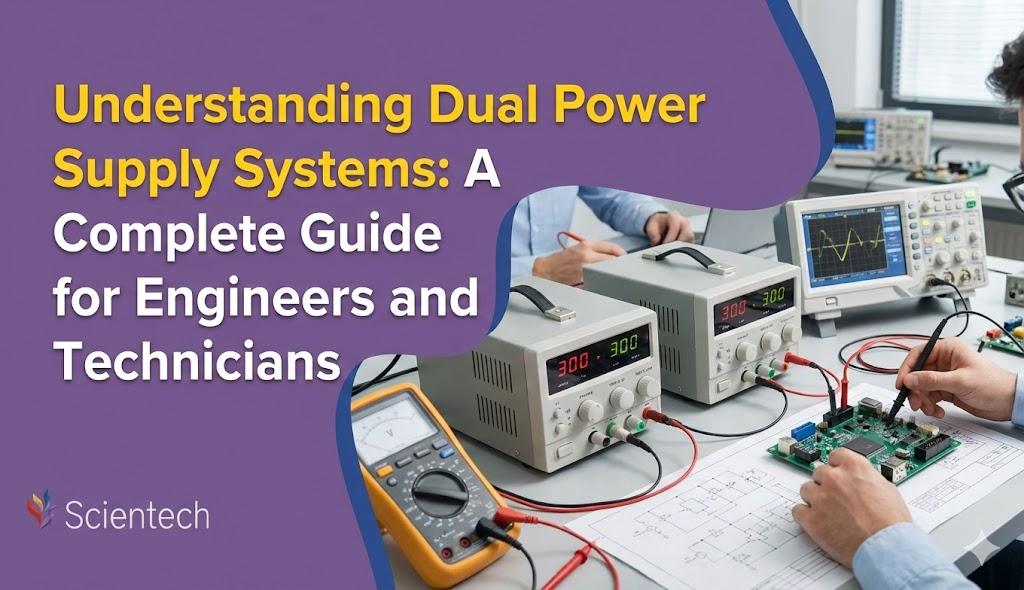
In modern electronics, stable and flexible power delivery is critical for performance, safety, and accuracy. Whether you're working in R&D, manufacturing, education, or repair labs, a dual power supply is one of the most essential tools on your bench.
From powering analog circuits to testing op-amps and microcontrollers, a dual DC power supply offers versatility that a single-output unit simply cannot match. In this blog, we’ll explore what a dual regulated power supply is, how it works, where it’s used, and why it’s indispensable in professional and educational environments.
4075 DC Dual Power Supply is engineered to operate in both Constant Voltage (CV) and Constant Current (CC) modes, making it ideal for laboratory experiments, industrial applications, and field testing. Its compact design, lightweight construction, and low power dissipation ensure efficient performance while delivering stable DC output for both analog and digital circuit testing.
An integrated automatic current overload protection circuit restricts the maximum output current to 2 A, safeguarding connected devices. The unit features two separate 3-digit LED displays,one for voltage and one for current,allowing clear and precise monitoring. The displays can be switched simultaneously between either of the two DC output channels.
The Scientech 4075 offers excellent line and load regulation and incorporates multiple protective mechanisms to ensure reliable and uninterrupted operation.
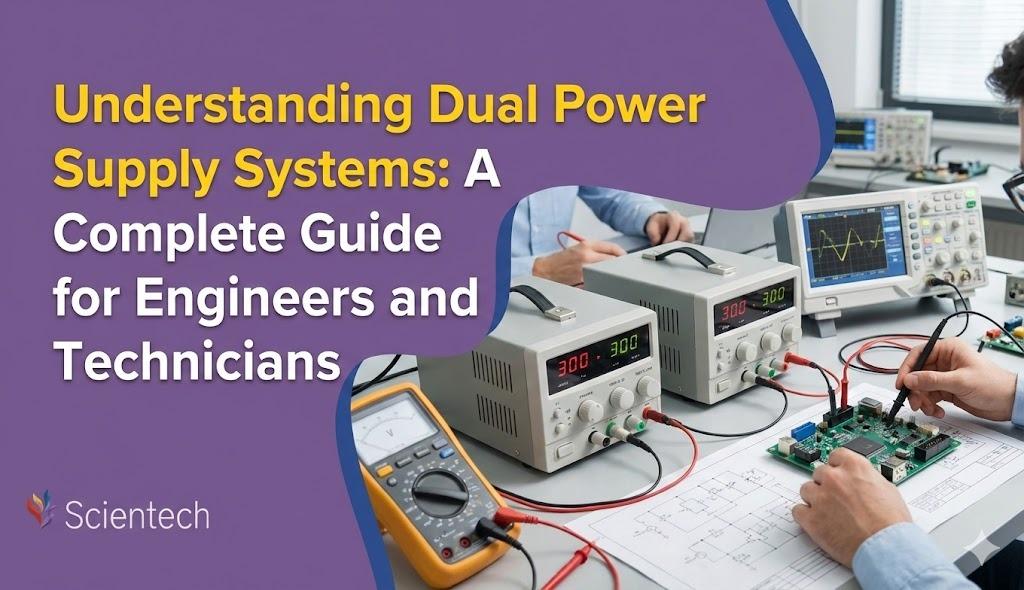
What Is a Dual Power Supply?
A dual power supply is a power source that provides two separate output voltages from a single unit. These outputs can operate independently or be configured together depending on the application.
Typically, it offers:
-
Two adjustable DC outputs (e.g., 0–30V each)
-
Independent current control
-
Series and parallel tracking modes
-
Stable voltage regulation
Unlike a single-output supply, a dual DC power supply enables engineers to power circuits that require both positive and negative voltages simultaneously.
How a Dual DC Power Supply Works
A dual DC power supply contains two separate voltage regulator circuits within one enclosure. These regulators can be used:
-
Independently – Each output is adjusted separately.
-
In Series Mode – Outputs combine to create higher voltage (e.g., ±15V).
-
In Parallel Mode – Outputs combine to increase current capacity.
For example:
-
Output 1: +12V
-
Output 2: -12V
-
Ground: Common reference
This configuration is especially useful for analog electronics and operational amplifier circuits.
What Is a Dual Regulated Power Supply?
A dual regulated power supply is a power source that provides two independent DC outputs, both of which are electronically controlled to maintain a stable voltage and current,even when input voltage or load conditions change.
Unlike an unregulated supply, where voltage can fluctuate under varying loads, a regulated system continuously adjusts its internal circuitry to deliver consistent output performance. This makes it ideal for precision electronics work.
Why Regulation Matters
Regulation ensures:
-
Minimal voltage fluctuation – Output voltage remains stable even if the load current changes.
-
Reduced ripple and noise – Cleaner DC output improves measurement accuracy and circuit reliability.
-
Overload protection – Prevents excessive current draw that could damage components.
-
Current limiting for circuit safety – Allows users to set a maximum current threshold to protect sensitive devices.
In a dual regulated configuration, both outputs are stabilized separately. They can be used independently or configured in series to create positive and negative voltage rails (e.g., ±12V or ±15V), which are common in analog circuit design.
Where Dual Regulated Power Supplies Are Used
Regulated supplies are essential when testing and developing sensitive electronic systems such as:
-
Microcontrollers – Require stable voltage for accurate logic operation.
-
Sensors – Many sensors are highly sensitive to voltage variation.
-
Audio circuits – Noise and ripple can introduce distortion.
-
Communication modules – Voltage instability can cause signal errors or data loss.
Key Features of Modern Dual Power Supply Units
Modern laboratory-grade dual power supply systems are designed for precision, flexibility, and safety. Whether you’re working in R&D, PCB testing, or academic labs, today’s dual DC power supply units come equipped with advanced features that improve performance and protect sensitive electronics.
1. Adjustable Voltage & Current
Allows precise control of voltage and current for both channels, making the dual DC power supply suitable for sensitive testing.
2. Digital Display
LCD or LED screens show real-time voltage and current readings for accurate monitoring.
3. Current Limiting Protection
Prevents damage during short circuits by switching to constant current mode.
4. Tracking Mode
Enables both outputs to operate together in series (higher voltage) or parallel (higher current).
5. Overvoltage & Overcurrent Protection
Ensures safe and stable operation, especially when using a dual regulated power supply for delicate components.
Why Choose a Dual Regulated Power Supply?
A dual regulated power supply offers several practical advantages for electronics testing and development.
Greater Flexibility
You can power two separate circuits at the same time or configure the outputs in series to create bipolar voltages (e.g., ±12V or ±15V) for analog applications.
Improved Accuracy
Because it’s regulated, the output voltage remains stable with minimal ripple and voltage drop,ensuring reliable and repeatable test results.
Space Efficiency
One dual DC power supply replaces two individual single-output units, saving valuable bench space.
Cost-Effective
Purchasing one integrated dual power supply is typically more economical than buying two separate regulated supplies.
Safer Testing Environment
Built-in protections such as current limiting and overvoltage protection reduce the risk of damaging both your circuit and the equipment.
For laboratories, R&D teams, and production environments, a dual regulated power supply delivers precision, flexibility, and safety in one compact solution.
Technical Specifications
|
Specification |
Details |
|
DC Output |
0–30 V continuously adjustable using coarse and fine controls |
|
Current Limit |
0–3 A continuously adjustable |
|
Setting Resolution |
Voltage: 100 mV Current: 10 mA |
|
Stability |
2.5 mV at 30 V / 3 A |
|
Recovery Time |
≤ 50 μs |
|
Load Regulation |
± (0.05% + 10 mV) |
|
Line Regulation |
± (0.05% + 10 mV) |
|
Temperature Coefficient |
± (0.05% + 5 mV / °C) |
|
Ripple & Noise |
≤ 1 mVrms |
|
Display |
3-digit seven-segment LED display for voltage and current |
|
Accuracy |
± (1% + 1 digit) |
|
Over-Range Indication |
Flashing “OR” LED |
|
Output Floating |
Switchable from front panel |
|
Protection |
Built-in overheat, overvoltage, overload, and short circuit protection |
|
Insulation (Chassis) |
>10 MΩ (chassis to output terminals at 500 V DC) >50 MΩ (chassis to AC plug at 500 V DC) |
|
Power Supply |
230 V ±10%, 50/60 Hz |
|
Operating Temperature |
0–40°C, up to 80% RH |
|
Dimensions (mm) |
W 198 × D 278 × H 90 |
|
Weight |
Approx. 4.5 kg |
Conclusion
A dual power supply is more than just a lab accessory,it’s a foundational tool for electronics development and testing. Whether you're building prototypes, diagnosing circuits, or conducting research, a dual regulated power supply ensures stability, flexibility, and safety.
Investing in a reliable dual DC power supply enhances productivity, reduces risk, and improves experimental accuracy. For engineers, technicians, educators, and innovators, it remains an essential component of any well-equipped workspace.
If you're setting up or upgrading your lab, make sure a high-quality dual power supply is at the top of your equipment list.
Reliable 0–30V dual DC power supply with constant current and voltage modes, digital display, overload protection, and excellent line regulation.
- Digital Agency
- Literie
- Location de voitures
- Restaurant
- Restaurant
- Mode
- Mode
- Information
- Marketing
- Tourisme
- Développement
- Découverte
- Législation
- Gastronomie
- Pâtisserie
- Evento
- Art
- Causes
- Crafts
- Dance
- Drinks
- Film
- Fitness
- Food
- Juegos
- Gardening
- Health
- Inicio
- Literature
- Music
- Networking
- Otro
- Party
- Religion
- Shopping
- Sports
- Theater
- Wellness
 Spanish
 Indian
 English
 French
 Arabic
 Portuguese
 Deutsch
 Turkish
 Dutch
Dutch
 Italiano
 Russian
 Romaian
 Portuguese (Brazil)
 Greek
Greek
