


How Does an RS-485 to Ethernet Converter Solve Common Industrial Communication Problems
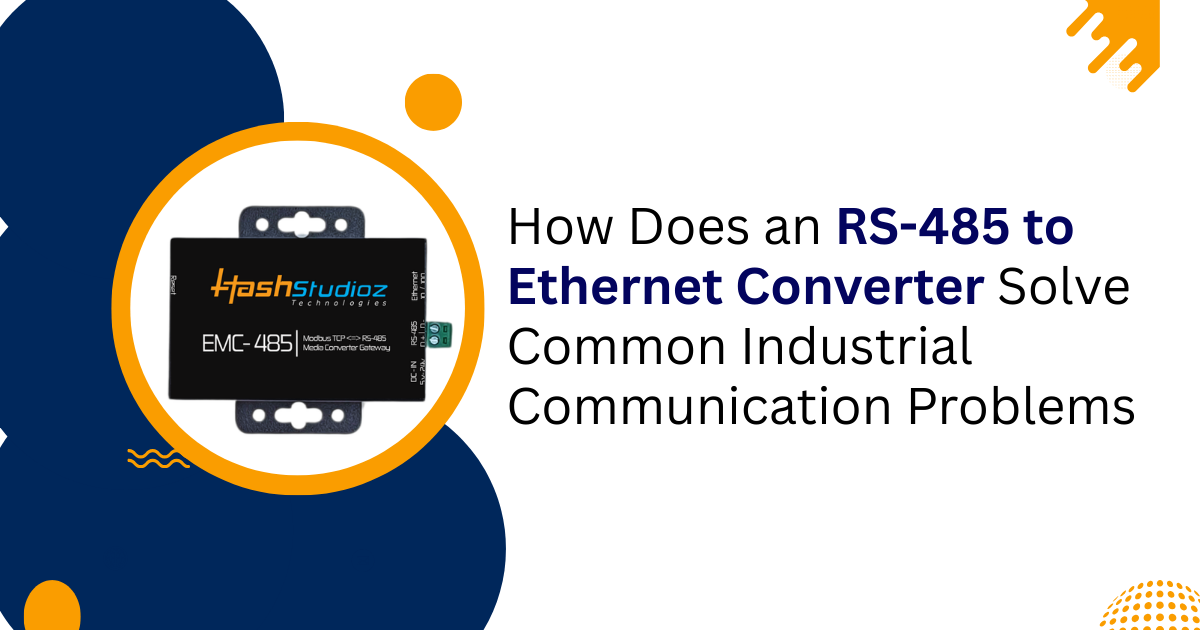
Industrial environments rely heavily on effective communication between devices for reliable operation, monitoring, and control. The ability to transfer data between sensors, controllers, and monitoring systems can impact productivity, efficiency, and safety. However, communication in industrial settings often faces several challenges, such as long distances, electromagnetic interference, and compatibility between different types of devices.
One solution to these challenges is the RS-485 to Ethernet Converter, commonly referred to as an RS-485 to LAN Converter. This device bridges the gap between the RS-485 communication standard—widely used for industrial control systems—and Ethernet-based networks, which are ubiquitous in modern computing. By converting the RS-485 signals to Ethernet, these converters solve many communication problems that industrial systems often encounter.
What Is an RS-485 to Ethernet Converter?
An RS-485 to Ethernet Converter is a device that translates the RS-485 communication protocol into Ethernet-based communication. RS-485 is a widely used standard in industrial systems for long-distance, differential data transmission. Ethernet, on the other hand, is a standard used in most office and industrial networks. The converter essentially acts as an interface, allowing RS-485 devices to communicate over Ethernet networks.
There are two primary types of these converters:
-
RS-485 to Ethernet Converter: This device allows RS-485 devices to send and receive data over an Ethernet network.
-
RS-485 to LAN Converter: Another term used interchangeably with RS-485 to Ethernet Converter, emphasizing its ability to connect to LAN (Local Area Networks).
By converting RS-485 signals to Ethernet, these converters enable devices like sensors, meters, and controllers—typically isolated on their own RS-485 networks—to connect seamlessly to modern Ethernet-based industrial networks.
Key Features
-
Protocol Conversion: The converter facilitates communication between devices using different protocols (RS-485 and Ethernet).
-
Remote Access: With Ethernet connectivity, remote monitoring and control become possible.
-
Long-Distance Communication: Ethernet networks support longer distances compared to traditional RS-485 communication.
-
Data Integrity: Provides reliable and error-free data transmission, even over long distances.
Common Industrial Communication Problems
Before diving into how an RS-485 to Ethernet Converter solves these challenges, it's essential to understand some of the primary communication problems that industrial systems face:
1. Distance Limitations
RS-485 can effectively transmit data over long distances (up to 4,000 feet or 1,200 meters). However, over such long distances, signal degradation and data loss can occur. Additionally, traditional RS-485 networks require special wiring to maintain integrity over extended distances.
2. Electromagnetic Interference (EMI)
Industrial environments are prone to electromagnetic interference from heavy machinery, motors, and electrical systems. This interference can corrupt signals, causing data loss or incorrect readings. RS-485 offers some resistance to EMI, but it’s still vulnerable in high-interference environments.
3. Device Compatibility
Industrial systems often consist of a mix of devices that use different communication standards. Integrating new devices into legacy systems can be challenging when devices use different protocols, such as Modbus RTU (over RS-485) and Modbus TCP (over Ethernet).
4. Limited Network Flexibility
RS-485 networks are typically point-to-point or multipoint, meaning each device is directly connected via a bus. This limited network topology can be restrictive, especially as industrial systems scale and more devices need to be added.
5. Remote Access Challenges
Traditionally, accessing data from RS-485 devices remotely has been difficult. RS-485 signals are not natively designed to travel over the internet or corporate networks, limiting remote monitoring and control capabilities.
How Does an RS-485 to Ethernet Converter Solve These Problems?
An RS-485 to Ethernet Converter offers a practical solution to many of the communication challenges listed above. Below, we discuss how these converters help to solve common industrial communication problems:
1. Overcoming Distance Limitations
RS-485 has a 4,000-foot range, limiting large installations. Ethernet extends this with fiber optics, allowing distances up to 40 kilometers, enabling remote monitoring in large facilities without requiring extensive rewiring.
2. Mitigating Electromagnetic Interference (EMI)
Industrial environments often face EMI that disrupts communication. Ethernet's shielding and twisted-pair cables, used in RS-485 to Ethernet converters, offer better protection, ensuring reliable data transmission despite external interference from machinery.
3. Improving Device Compatibility
Older systems use RS-485, while newer ones use Ethernet. RS-485 to Ethernet converters bridge this gap, enabling seamless communication between legacy devices and modern Ethernet-based systems, eliminating the need for costly upgrades or replacements.
4. Enhancing Network Flexibility and Scalability
RS-485 networks suffer from limited, complex bus topologies. Ethernet supports more scalable, flexible star or tree configurations, allowing easier device addition and management, helping businesses expand without significant rewiring or network limitations.
4. Enabling Remote Monitoring and Control
Ethernet enables remote access, unlike RS-485's local limitations. RS-485 to Ethernet converters allow monitoring over LAN or internet, facilitating remote diagnostics and control for geographically dispersed systems, such as energy substation networks.
Practical Use Cases of RS-485 to Ethernet Converters
1. Industrial Automation
In industrial automation, the ability to connect and control devices like sensors, actuators, and controllers over a wide area is crucial. RS-485 to Ethernet Converters allow these devices to be monitored and controlled over the factory’s existing Ethernet infrastructure, reducing the need for additional wiring and infrastructure.
2. Smart Grid Systems
Smart grid systems use a variety of devices, such as smart meters, transformers, and relays, that communicate over RS-485 networks. RS-485 to Ethernet Converters can bridge the gap between these devices and the central management system, allowing for real-time monitoring and control of the grid over Ethernet.
3. Building Automation
Building automation systems (BAS) often use RS-485 networks for communication between devices like HVAC systems, lighting controls, and fire alarms. RS-485 to Ethernet Converters enable these systems to be integrated with modern Ethernet-based networks, allowing for centralized control and remote monitoring.
Conclusion
The RS-485 to Ethernet Converter offers a reliable solution to many of the communication challenges faced in industrial environments. By bridging the gap between RS-485 and Ethernet-based systems, these converters enable remote access, improve network scalability, and help integrate legacy systems with modern control networks.
Frequently Asked Questions
1. How does it address distance limitations in RS-485 networks?
RS-485 networks are typically limited to about 1,200 meters for reliable communication. An RS-485 to Ethernet converter extends connectivity by transmitting data over Ethernet, which can cover much greater distances via LAN, WAN, or even the Internet, eliminating the need for signal repeaters and complex cabling.
2. Can an RS-485 to Ethernet converter improve network reliability?
Yes. Industrial networks often experience noise and interference, especially in electrically harsh environments. Converting RS-485 signals to Ethernet allows the use of shielded Ethernet cables, better grounding, and advanced error-checking mechanisms inherent to Ethernet, which collectively enhance network stability and reduce data loss.
3. Does it enable communication between devices using different protocols?
Indirectly, yes. While the converter doesn’t automatically translate all protocols, it allows RS-485 devices to communicate with Ethernet-based systems using compatible protocols (like Modbus TCP/IP). This makes integration of legacy serial devices into modern SCADA or IoT platforms much easier.
4. How does it simplify network management and monitoring?
RS-485 networks require point-to-point or multidrop wiring, making troubleshooting challenging. By converting to Ethernet, all devices can be monitored from a central location using standard networking tools, IP addressing, and web-based dashboards, simplifying maintenance and reducing downtime.
5. Can multiple RS-485 devices communicate over a single Ethernet network?
Absolutely. The converter allows multiple RS-485 devices to share a single Ethernet connection through IP-based routing. This reduces the amount of cabling, avoids complex serial network topologies, and enables simultaneous communication with multiple devices from a single control system.
- Digital Agency
- Literie
- Location de voitures
- Restaurant
- Restaurant
- Mode
- Mode
- Information
- Marketing
- Tourisme
- Développement
- Découverte
- Législation
- Gastronomie
- Pâtisserie
- مناسبة
- Art
- Causes
- Crafts
- Dance
- Drinks
- Film
- Fitness
- Food
- الألعاب
- Gardening
- Health
- الرئيسية
- Literature
- Music
- Networking
- أخرى
- Party
- Religion
- Shopping
- Sports
- Theater
- Wellness
 Arabic
 Indian
 English
 French
 Spanish
 Portuguese
 Deutsch
 Turkish
 Dutch
Dutch
 Italiano
 Russian
 Romaian
 Portuguese (Brazil)
 Greek
Greek
