


Banana Flour Market Trends and Forecast 2024–2034: Unlocking Opportunities in the Global Gluten-Free Economy
The Banana Flour Market is gaining increasing prominence in the global food and nutrition landscape as consumers, manufacturers, and policymakers shift their focus toward healthier, gluten-free, and sustainable food alternatives. Derived from unripe green bananas, banana flour offers a compelling combination of nutritional benefits, functional versatility, and environmental advantages. These attributes have positioned it as a viable substitute for conventional wheat flour across a wide range of applications, from bakery and beverages to infant food and animal nutrition.
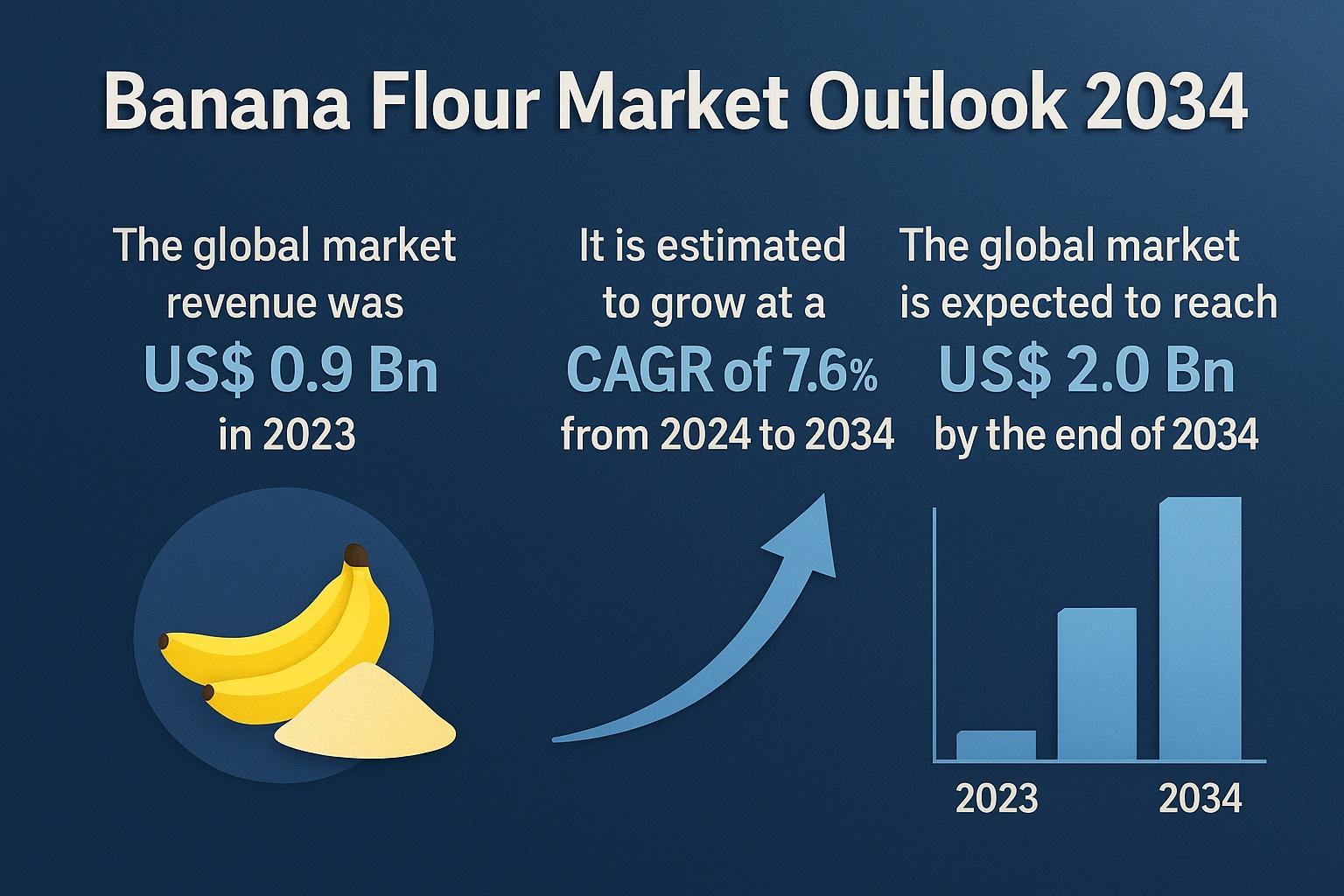
In 2023, the global banana flour market was valued at US$ 0.9 billion, reflecting steady adoption across developed and emerging economies. Looking forward, the market is projected to expand at a CAGR of 7.6% between 2024 and 2034, reaching an estimated US$ 2.0 billion by the end of 2034. This growth trajectory underscores the rising demand for alternative flours and the increasing role of banana flour in meeting modern dietary and sustainability needs.
Banana Flour: Composition, Processing, and Nutritional Value
Banana flour is produced by harvesting green bananas, followed by peeling, drying, and milling into a fine powder. The most commonly used cultivar is Cavendish (Musa acuminata), which is widely cultivated across tropical regions. The use of unripe bananas is critical, as it preserves high levels of resistant starch and dietary fiber, two of the most valuable nutritional components of banana flour.
Resistant starch functions as a prebiotic, supporting gut health by feeding beneficial bacteria in the colon. It also contributes to improved insulin sensitivity and prolonged satiety, making banana flour an appealing ingredient for weight management and metabolic health. Additionally, banana flour contains vitamins, minerals, and antioxidant polyphenols that help combat oxidative stress and support overall wellness.
From a functional perspective, banana flour closely resembles wheat flour in appearance and texture, enabling its use in both home cooking and industrial food production. When cooked, it delivers a neutral to slightly nutty flavor, allowing seamless integration into a wide variety of recipes without overpowering other ingredients.
Macro Trends Driving the Banana Flour Market
Mainstreaming of Gluten-Free Diets
The rapid mainstreaming of gluten-free diets continues to be a primary growth catalyst for the banana flour market. Once limited to individuals with celiac disease or gluten intolerance, gluten-free consumption has expanded to include health-conscious consumers seeking digestive comfort, improved energy levels, and reduced inflammation.
Banana flour’s naturally gluten-free profile, combined with its functional performance in baking and cooking, makes it an attractive option for manufacturers reformulating products to meet gluten-free standards. As gluten-free offerings become standard across retail shelves and foodservice menus, banana flour is expected to see increased incorporation into everyday food products.
Shift Toward Functional and Preventive Nutrition
Global consumers are increasingly prioritizing preventive health through diet, driving demand for functional ingredients that deliver tangible health benefits. Banana flour’s high fiber and resistant starch content align well with this trend, supporting digestive health, glycemic control, and gut microbiome balance.
The growing popularity of vegan, paleo, and plant-based diets has further strengthened banana flour’s market position. These dietary lifestyles emphasize whole, minimally processed plant foods, making banana flour a natural fit within their frameworks.
Sustainability and Circular Economy Initiatives
Sustainability considerations are reshaping food production systems worldwide, and banana flour plays a meaningful role in this transformation. In banana-producing regions, surplus or unripe bananas that may not meet fresh market standards can be converted into flour, reducing food waste and improving resource efficiency.
By extending banana shelf life from a few days to several months, banana flour production enhances supply chain resilience and supports circular economy models. These sustainability benefits are particularly significant in developing economies, where post-harvest losses remain a major challenge.
Market Constraints and Risk Factors
Despite its strong growth outlook, the banana flour market is not without constraints. Price volatility of raw bananas, transportation costs, and limited processing infrastructure in certain regions can affect production efficiency and profitability. In addition, banana flour often carries a higher price point than traditional wheat flour, which may limit adoption among price-sensitive consumers.
Consumer education remains another challenge. While awareness is growing, many potential consumers are still unfamiliar with banana flour’s culinary versatility and nutritional advantages. Addressing misconceptions related to taste and usage will be essential for broader market penetration.
Detailed Segmentation Analysis
By Source
The market is segmented into organic and conventional banana flour. Organic banana flour is experiencing strong demand, particularly in North America and Europe, where consumers prioritize organic certification, clean-label claims, and sustainable farming practices. Organic variants are commonly used in premium food products, infant nutrition, and specialty health foods.
Conventional banana flour remains the dominant segment by volume, driven by its affordability and widespread availability. It is extensively used in household cooking, foodservice applications, and large-scale food manufacturing.
By Application
Banana flour’s adaptability supports its use across diverse application areas:
-
Food Industry: The largest application segment, including bakery, snacks, pasta, and ready-to-eat foods.
-
Bakery & Snacks: Used to enhance fiber content and texture in bread, cookies, cakes, and crackers.
-
Household Use: Increasingly adopted by consumers experimenting with gluten-free cooking at home.
-
Beverages: Incorporated into smoothies, nutritional drinks, and health beverages.
-
Infant Food: Valued for its digestibility and nutrient density.
-
Pet Food and Feed Industry: Utilized to support digestive health in animal nutrition formulations.
By Distribution Channel
Indirect distribution channels dominate the banana flour market, encompassing modern trade outlets, specialty stores, convenience stores, and e-retailers. The rapid growth of e-commerce has significantly expanded access to banana flour products, particularly for organic and specialty variants. Direct sales channels are also important for supplying industrial buyers and food manufacturers.
Regional Performance and Growth Opportunities
North America: Established Market Leadership
North America represents the leading regional market for banana flour, supported by high consumer awareness of gluten-free diets and functional foods. The region’s advanced food processing infrastructure, strong retail networks, and emphasis on clean-label products have accelerated banana flour adoption.
Consumers in North America are increasingly experimenting with alternative flours for home cooking and baking, further boosting retail demand.
Asia Pacific: High-Growth Potential
Asia Pacific is expected to register the fastest growth during the forecast period. Countries such as India, the Philippines, and Indonesia benefit from abundant banana production, ensuring reliable raw material supply. Rising urbanization, growing middle-class populations, and increasing health awareness are driving demand for gluten-free and natural food products.
Government support for agricultural innovation and banana by-product utilization further strengthens the region’s growth outlook.
Europe, Latin America, and Middle East & Africa
Europe continues to show steady growth driven by demand for organic and gluten-free foods. Latin America and the Middle East & Africa are emerging markets, supported by sustainability initiatives, expanding banana cultivation, and efforts to reduce food waste while improving nutritional outcomes.
Competitive Landscape and Strategic Developments
The banana flour market is characterized by moderate competition, with both global and regional players focusing on innovation, quality improvement, and market expansion. Prominent companies include Natural Evolution Foods, Edward & Sons Trading Company, Kanegrade Ltd, NuNaturals, Zuvii, International Agriculture Group (IAG), Banatone Trinity Industries Private Limited, Miski Organics Inc., Royal Nut Company, and M-Pak Manufacturing Corporation.
Key strategies adopted by market participants include investment in research and development, expansion of product portfolios, mergers and acquisitions, and partnerships with local producers. Companies are also focusing on improving processing techniques to retain higher levels of resistant starch and enhance shelf stability.
Recent Industry Highlights
In January 2024, farmers in Embu, Kenya, transitioned to whole green banana flour production, significantly extending banana shelf life while addressing food waste and nutritional challenges. Earlier, in April 2022, iTi Tropicals launched organic green banana flour sourced from India, optimized for gluten-free packaged food applications with minimal banana flavor and high resistant starch content.
Future Outlook and Strategic Implications
The banana flour market is well-positioned for sustained growth through 2034, supported by rising gluten-free consumption, functional nutrition trends, and sustainability-driven food production. As consumer awareness continues to grow and processing technologies advance, banana flour is expected to transition from a specialty ingredient to a mainstream staple in global food systems.
Manufacturers that focus on education, innovation, and strategic partnerships will be best positioned to capitalize on emerging opportunities and meet evolving consumer expectations.
- Digital Agency
- Literie
- Location de voitures
- Restaurant
- Restaurant
- Mode
- Mode
- Information
- Marketing
- Tourisme
- Développement
- Découverte
- Législation
- Gastronomie
- Pâtisserie
- Evento
- Art
- Causes
- Crafts
- Dance
- Drinks
- Film
- Fitness
- Food
- Jogos
- Gardening
- Health
- Início
- Literature
- Music
- Networking
- Outro
- Party
- Religion
- Shopping
- Sports
- Theater
- Wellness
 Portuguese (Brazil)
 Indian
 English
 French
 Arabic
 Spanish
 Portuguese
 Deutsch
 Turkish
 Dutch
Dutch
 Italiano
 Russian
 Romaian
 Greek
Greek
