


Comparing Gold Buyers in Australia: Who Pays the Most?
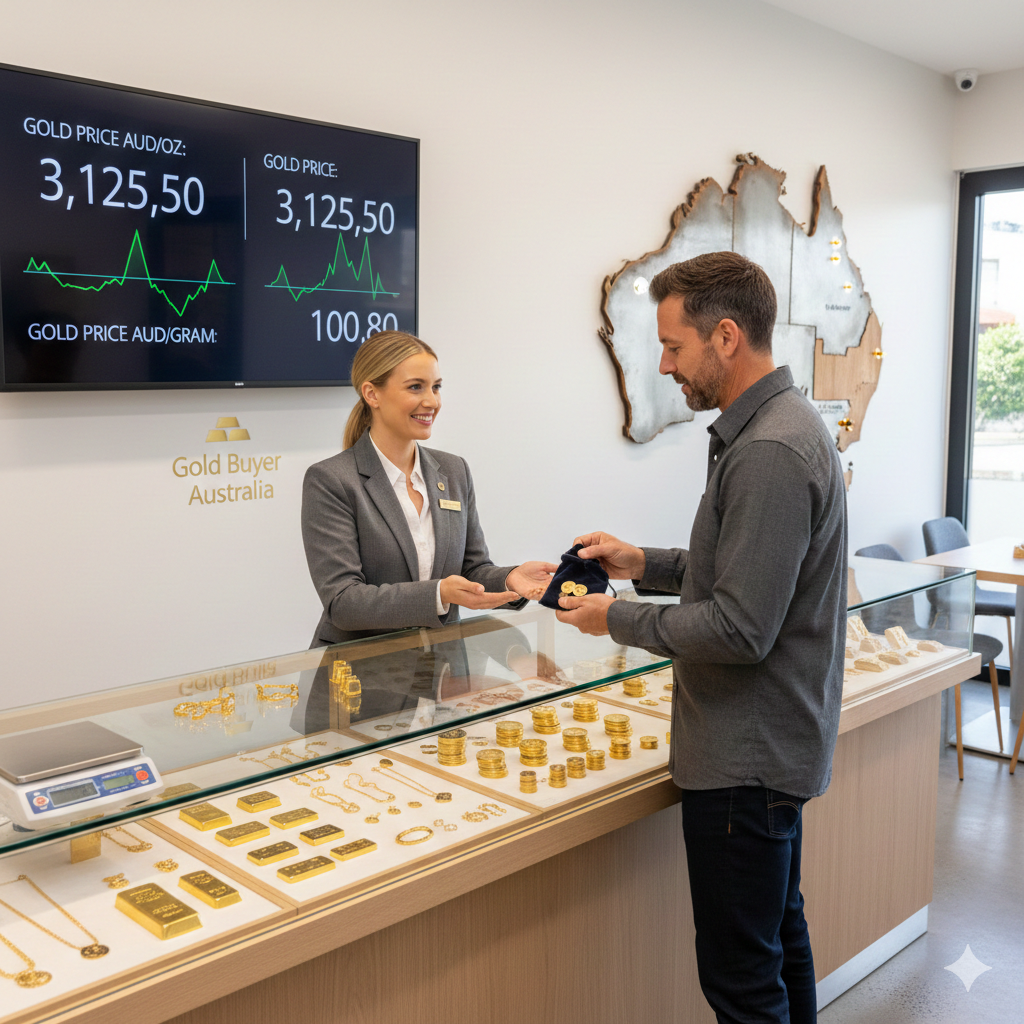
If you’re looking for a trusted gold buyer in Australia, this simple guide shows how to get the best price. I use only published facts and buyer rate pages so you can check each source yourself.
Introduction
Gold prices jumped a lot in 2025. That made many people consider selling old jewellery, coins or scrap gold. Live charts show big moves this year — which means the price you see one day can change the next.
This guide explains the main things that decide your payout, compares sample buyers (using their published rates), and gives simple steps to help you get more money.
Key Factors That Determine Your Gold Payout
Gold Purity and Weight Basics
-
Gold is paid by purity (karat) and weight (grams or ounces). Higher karat (24k) is closer to pure gold and is worth more per gram. Many Australian buyer pages show separate per-gram prices for 24k, 22k, 18k, etc. Use these tables to estimate value.
Market Spot Price Impact
-
Buyers use the market (spot) price as a base. Spot moves daily and sometimes sharply — so timing matters. You can check live spot charts and local AU prices online before you sell. Buyer Fees and Hidden Costs
-
Some buyers subtract refining, handling or postage fees from your payout. A published buyer’s “per gram” table may not include every deduction — always ask for the net payout example (after fees). Many mail-in services explain their fee approach on their websites. Extra Factors Many Sellers Forget
-
Type of item: bullion (bars/coins) usually gets closer to spot than jewellery, because jewellers must refine and remove non-gold parts.
-
Lot size: very small lots (a few grams) often see lower effective rates due to minimum fees or processing costs.
-
Payment speed & method: instant cash may come with a lower offer than bank transfer after refining.
Top Gold Buyers in Australia — Published Rates (Sample)
Note: These are published rates or price tables taken from buyer websites. They are real figures the buyers show online; consider them as starting points and confirm live prices when you sell.
Gold Buyers Melbourne — published per-gram table
This buyer publishes a detailed table showing per-gram pay-outs by karat (for example, 24k, 22k, 18k, etc.). Their site lists explicit amounts per gram so you can calculate your lot value yourself. Use their table to compare other buyers on the same karat/gram basis.
Cash for Gold Australia — national buyer with offices
A national buyer advertises offices across states and a national service. Their site promotes immediate valuations and instant payouts at branches, and they also accept shipped items. Use their local office option if you want cash on the spot.
Gold Buyers Sydney — local Sydney price table
This Sydney buyer lists per-gram rates for common karats (for example: 24k, 22k, 18k etc.) and shows when their page was last updated. Local stores often show their daily updated rates so sellers can see current offers.
Other sample buyers (mail-in / local stores)
Several Australian buyers offer mail-in packs or store drop-offs with published rate tables (e.g., Gold Buyers, Gold Buyers Central, Gold Coast Gold Buyers). These pages let you calculate how much a given weight and karat should be worth before fees.
Head-to-Head: How to Compare Offers (Use These Steps)
1) Convert all quotes to % of spot or per-gram for same karat
-
When one buyer shows $X per gram for 18k, and another shows Y, convert both to the same unit so you can compare apples to apples. Buyer tables make this simple.
2) Check for extra fees (refining, postage, admin)
-
Ask for a worked example: “If I send 10g of 18k, how much will I get after all fees?” Some mail-in services explain fees on their sites.
3) Consider speed vs price trade-off
-
Branch pickups give cash fast; refineries or online buyers that refine in bulk may pay more but take longer. Decide what matters more — speed or maximum payout.
4) Read recent customer reviews and trust signals
-
Look for shops with stable updates and many reviews. A buyer who updates their rate table daily and publishes store addresses or ABN is easier to verify. (See the sample sites referenced above.)
Real-World Examples & Lessons
Example: Using Per-Gram Tables
-
If a buyer lists $X per gram for 22k and you have 20g, multiply to get an initial gross value. Then subtract known fees (if any) to see the net. Several buyer sites publish these per-gram numbers explicitly.
Common Seller Mistakes
-
Accepting the first offer without comparing two other buyers.
-
Not checking whether the quote is gross (before fees) or net (after fees).
-
Selling mixed-metal jewellery as if it were pure — always ask for a karat test.
Smart Tips to Get Top Dollar for Your Gold
Prep Your Gold Right
-
Clean gently (soft brush, mild soap) so buyers can see hallmarks. Group items by karat if you know them. Per-gram tables on buyer sites reward correct karat classification.
Timing Your Sale
-
Watch the live spot price — when prices spike, you can get more for the same grams. Use live charts or gold price pages to check current Australian prices before you sell.
Avoid Scams and Pitfalls
-
Red flags: no written receipt, no scale shown, pressure to accept a "today only" offer. Use buyers that publish rates and have a physical address or clear mail-in policy. Many reputable sites provide clear procedures.
Conclusion — Who Pays the Most?
There is no single verified public ranking that proves one buyer always pays the most for every seller. What we can say from published rate tables and buyer pages is:
-
Bullion (coins and bars) usually fetches closer to spot than jewellery because it needs less refining.
-
Compare per-gram rates for the same karat, and ask each buyer for a clear net example (weight × karat × fee) — this finds the best offer for your specific lot.
- Digital Agency
- Literie
- Location de voitures
- Restaurant
- Restaurant
- Mode
- Mode
- Information
- Marketing
- Tourisme
- Développement
- Découverte
- Législation
- Gastronomie
- Pâtisserie
- Evenement
- Art
- Causes
- Crafts
- Dance
- Drinks
- Film
- Fitness
- Food
- Jeux
- Gardening
- Health
- Domicile
- Literature
- Music
- Networking
- Autre
- Party
- Religion
- Shopping
- Sports
- Theater
- Wellness
 French
 Indian
 English
 Arabic
 Spanish
 Portuguese
 Deutsch
 Turkish
 Dutch
Dutch
 Italiano
 Russian
 Romaian
 Portuguese (Brazil)
 Greek
Greek
