


What are stretch marks — and why do they appear
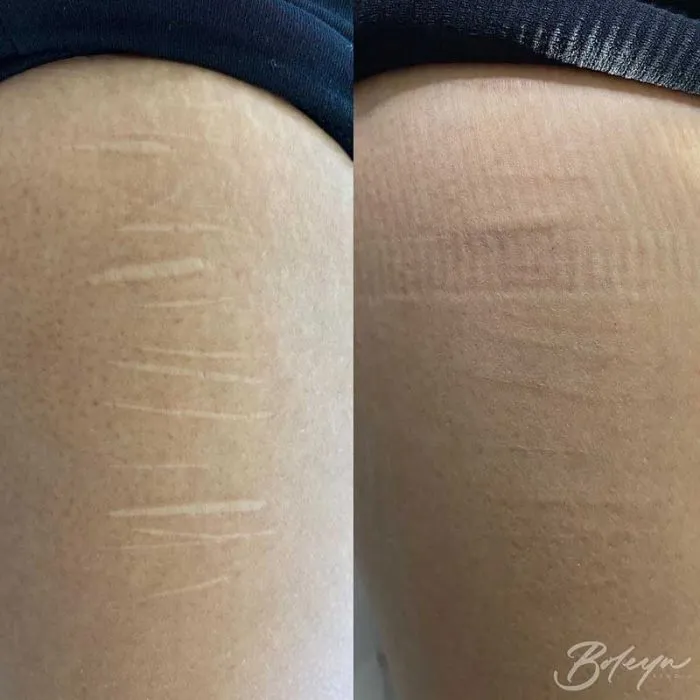
To understand camouflage, it’s first necessary to know what stretch marks are and how they form. Stretch marks (also called striae) arise when the skin undergoes rapid stretching or shrinking such as during accelerated growth (puberty), pregnancy, rapid weight gain or loss, or fast muscle growth.
Under the skin’s surface, this sudden change can cause the structural proteins — mainly collagen and elastin — that give skin its support, elasticity, and resilience to tear or rupture. As the skin heals, a scar-like mark remains: thin bands or streaks that often start as reddish, purple, pink, or dark brown (depending on skin tone).
Over time, these marks often fade to a lighter, whitish or silvery color, and may sink slightly below the skin surface, becoming more subtle — but generally remain visible forever.
Because mature stretch marks Camouflage result from a change in skin structure (not just surface discoloration), they are effectively permanent. Treating them is more about reducing their visibility than erasing them completely.
What is Stretch‑Mark Camouflage (Micropigmentation / “Skin‑Tone Tattooing”)
Enter the technique known as stretch‑mark camouflage — sometimes described as paramedical tattooing, micropigmentation, or skin‑tone tattooing. The core idea: to conceal the marks by blending them visually with surrounding skin.
Unlike traditional tattoos (which use pigment for artistic or decorative purposes), camouflage uses special pigments formulated to match the individual’s skin tone as closely as possible.
A trained technician uses a specialized device (something like a tattoo/microneedling machine) to deposit these pigments into the dermal layer of the skin — precisely where the stretch marks are visible.
The goal is not to “heal” or “erase” the stretch mark Camouflage, but to mask its appearance — specifically, to remove the contrast in color between the stretch mark and the surrounding skin so that the mark becomes much less noticeable.
How Camouflage Works — The Mechanics & Science
1. Pigment Matching & Colour Theory
Before treatment starts, the technician carefully assesses your skin tone, undertone, and the shade difference between your normal skin and the stretch-marked area. This is crucial because the pigments must closely match the surrounding skin tone to achieve a natural look.
Based on that, a custom blend of pigments is prepared. Using generic or mismatched pigments often results in unnatural appearance or visible “tattooed” patches.
2. Pigment Implantation into Dermis
Once pigment is ready, the technician uses a needling device to implant the pigment into the dermal layer of the skin (not just on the surface). Because stretch marks Camouflage involve changed skin structure, embedding pigment beneath the skin surface makes the effect semi-permanent (much longer lasting than a temporary concealer) and more natural.
3. Texture Considerations (Sometimes) & Collagen Stimulation
In many cases, stretch-mark camouflage can also help improve the visual texture of the skin. The needling action itself may stimulate skin repair processes — encouraging some collagen and elastin production over time, which can slightly soften indented or depressed scars or stretch marks.
However — and it’s important — the technique does not “erase” the stretch mark Camouflage like surgery or laser might attempt (and even then, complete removal is unlikely). Camouflage focuses on appearance — color and visibility — not on structural regeneration.
4. Gradual Improvement Over Multiple Sessions
Stretch‑mark camouflage is rarely a one‑and‑done fix. Typically, 2 to 4 sessions, spaced several weeks apart, are recommended. This gradual layering allows the pigment to integrate naturally and avoids over-saturation, ensuring a soft, realistic result.
After the first session, clients often see 30–60% improvement in appearance, but the final result — where the stretch mark becomes much less noticeable — tends to emerge only after full healing (often 3–4 weeks) and possibly after subsequent sessions.
Advantages, Limitations & What It Doesn’t Do
✅ What it can do / Advantages
Visually conceals stretch marks: By matching skin tone, camouflage makes the marks far less noticeable, boosting confidence and allowing you to wear clothing or swimwear without feeling self‑conscious.
Semi‑permanent results: Because pigment is implanted beneath the skin, the effect lasts much longer than surface‑level treatments (like makeup or self‑tanner).
Suitable for many skin tones and body areas: Works on stretch marks, scars, discoloration, and more — across arms, abdomen, thighs, buttocks, etc.
Improved skin texture (sometimes): The needling process can stimulate mild collagen production, which may soften texture and make skin look smoother, though this benefit is modest.
⚠️ What it can’t do / Limitations & caveats
It does not remove stretch marks or rebuild skin structure: The procedure does not restore collagen/elastin or “heal” the stretch mark — it only conceals it.
Results depend heavily on technician skill: Achieving a natural, well-blended result is as much art as science. Poor color matching or bad technique can leave obvious pigment or uneven skin tone.
Multiple sessions often required: One session usually only partially improves appearance; full camouflage requires patience and adherence to aftercare.
Pigment retention and aging effects: Over time, pigments may fade or shift slightly. In some cases, repeated touch-ups might be needed to maintain appearance.
Not ideal for all stretch marks: For active/red stretch marks (i.e. newer ones) or very raised scars, camouflage may be less effective or not recommended.
How Camouflage Compares to Other Treatments (Creams, Laser, Microneedling, etc.)
A quick look at how camouflage stacks up against other popular stretch-mark treatments:
Topical creams/lotions/gels: Many over-the-counter creams (moisturizers, oils, vitamin‑E cream, cocoa butter, etc.) promise stretch‑mark reduction. But research shows little consistent evidence that these significantly change mature stretch marks. At best, they may temporarily improve hydration or appearance in early-stage marks.
Medical procedures (laser, microdermabrasion, chemical peels, radiofrequency, microneedling, ultrasound, etc.): These aim to stimulate skin regeneration and collagen production, sometimes improving texture and gradually reducing visibility. These treatments may partly remodel the skin, but even such procedures rarely “erase” stretch marks completely.
Camouflage (micropigmentation): Rather than attempt to repair the skin, camouflage bypasses structural repair and deals directly with visual concealment. For many people, this makes it a more reliable, predictable, and long-lasting option — especially if the goal is appearance rather than skin regeneration.
In short: if you want more uniform skin tone and “invisibility” of stretch marks, camouflage can outperform creams and may complement regenerative therapies — but it won’t replace skin‑remodeling treatments if improving skin structure is the priority.
What to Watch Out For & What Makes a Good Candidate
✅ Good candidate profile
Stretch marks already matured (lighter/whitish, not inflamed/reddish). Many practitioners recommend waiting until marks are at least 1–2 years old for best results.
Marks that are flatter, not raised, and not too deep. Highly indented or deeply scarred areas may be harder to camouflage naturally.
Realistic expectations: camouflage will improve appearance, but won’t recreate unmarked, original skin.
⚠️ What to verify / plan for
Ensure your technician uses proper camouflage pigments (not regular tattoo ink) — pigments designed for body‑tone matching and safe for dermal implantation.
Expect to undergo multiple sessions for natural results, with adequate spacing and time for skin to heal between sessions.
Be ready for aftercare — avoiding sun exposure, scratching, friction, and other irritants while skin heals.
Understand that pigmentation may fade or change slightly over time, and you might need touch-ups — especially if your skin tone changes (e.g., tanning) or if pigment does not retain equally in all layers.
Why Camouflage Works — The Science Behind Visual Blending
At its core, stretch-mark camouflage leverages a few fundamental principles: color theory, skin anatomy, and dermal pigmentation dynamics.
Color contrast reduction — Stretch marks often appear lighter (or sometimes darker) than surrounding skin because of reduced pigmentation (melanin) or changes in skin vascularization. By implanting pigments that match the surrounding skin, camouflage eliminates that contrast, making the mark visually disappear.
Pigment embedding in the dermis — By placing pigment beneath the epidermis, the color becomes part of the skin itself (similar to a tattoo), so it moves and settles naturally as the skin moves, rather than just lying on top (as makeup or concealer would).
Mimicking natural skin appearance — When done correctly (good color match, proper depth, even distribution), the treated area behaves like normal skin under different lighting and from different angles. The illusion is not of a “tattoo,” but of uniformly pigmented skin.
Optional structural benefit — Though not guaranteed or dramatic, the needling process can sometimes stimulate mild dermal remodeling: small collagen/elastin regeneration, perhaps slightly improving skin texture along with color.
Thus, camouflage transforms how the stretch mark looks to the eye — not by healing the mark, but by altering its visibility.
Conclusion — Realistic Expectations & When Camouflage Makes Sense
Stretch marks are a natural outcome of skin stretching beyond its elasticity, and once formed, they represent a change in skin structure (disruption of collagen/elastin).
Because of that, no topical cream, lotion, or oil — even those heavily marketed for “stretch mark removal” — can reliably erase them once they’re mature. Some skincare products may help if applied very early, but the evidence for older marks is weak.
That’s where stretch‑mark camouflage (micropigmentation / skin‑tone tattooing) comes in. It doesn’t heal or remove the stretch mark — but it works by visually concealing it, blending it with the surrounding skin via custom pigments and implantation into the dermis. For many people who want a semi‑permanent, natural-looking reduction in visibility, camouflage offers a compelling option.
- Digital Agency
- Literie
- Location de voitures
- Restaurant
- Restaurant
- Mode
- Mode
- Information
- Marketing
- Tourisme
- Développement
- Découverte
- Législation
- Gastronomie
- Pâtisserie
- مناسبة
- Art
- Causes
- Crafts
- Dance
- Drinks
- Film
- Fitness
- Food
- الألعاب
- Gardening
- Health
- الرئيسية
- Literature
- Music
- Networking
- أخرى
- Party
- Religion
- Shopping
- Sports
- Theater
- Wellness
 Arabic
 Indian
 English
 French
 Spanish
 Portuguese
 Deutsch
 Turkish
 Dutch
Dutch
 Italiano
 Russian
 Romaian
 Portuguese (Brazil)
 Greek
Greek
